QUESTION IMAGE
Question
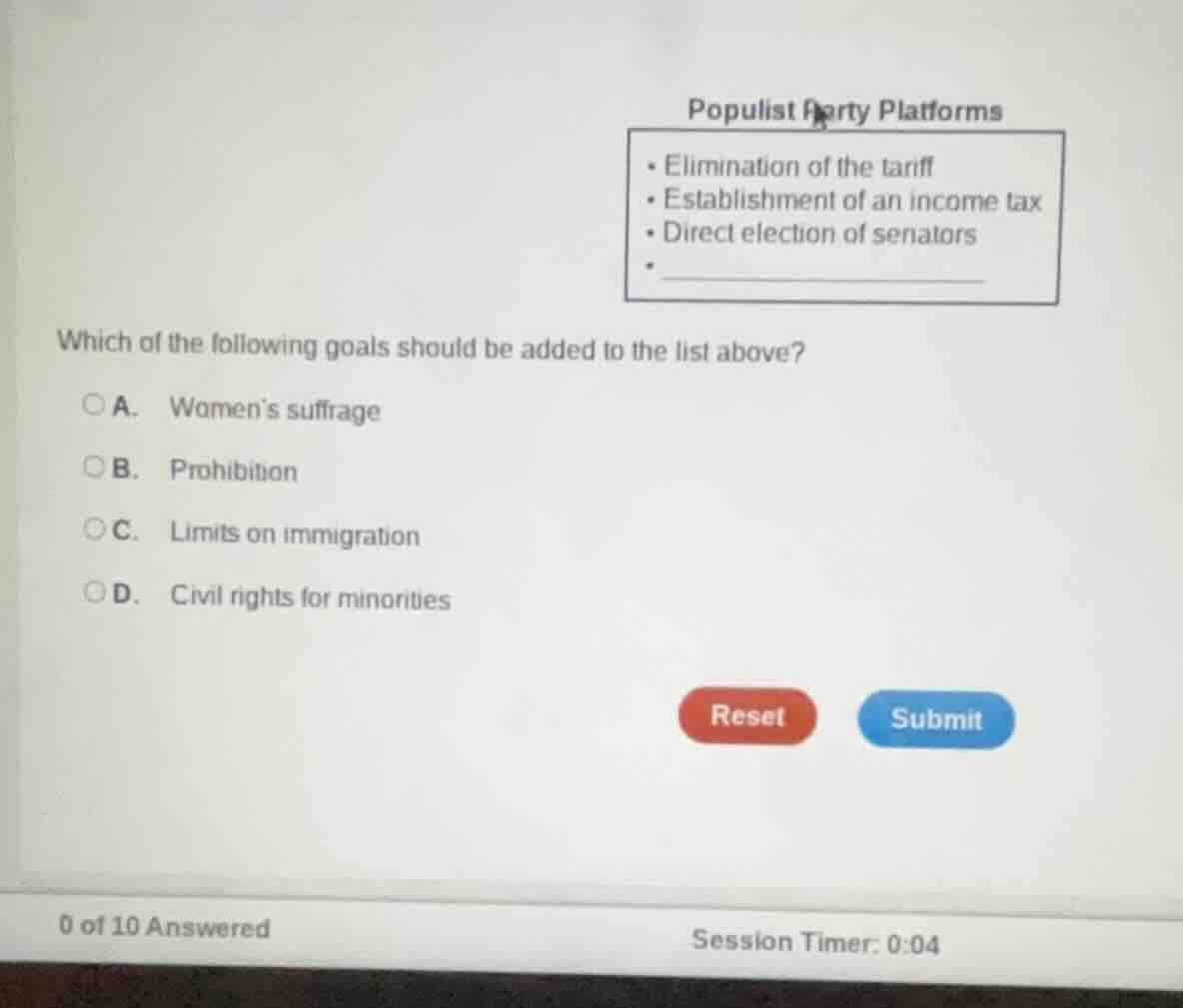
populist party platforms
- elimination of the tariff
- establishment of an income tax
- direct election of senators
*
which of the following goals should be added to the list above?
a. womens suffrage
b. prohibition
c. limits on immigration
d. civil rights for minorities
🆕 New Concept Discovered: Populist Movement Platforms
Economic and political goals of late 19th-century reformers
Step 1: Understand the Populist Party
The Populist Party (or People's Party) was formed in the late 19th century primarily by farmers and laborers. They aimed to curb the power of large corporations, banks, and railroads, while giving more political power directly to everyday citizens.
Their core platform (such as the Omaha Platform of 1892) included:
- A graduated income tax (to shift the tax burden to the wealthy)
- Direct election of U.S. Senators (to reduce corporate influence in state legislatures)
- Government ownership of railroads and telegraphs
- Free coinage of silver (to increase the money supply)
- An eight-hour workday for industrial laborers
- Restrictions on immigration
Step 2: Evaluate the Options
- A. Women's suffrage: While some individual Populists supported women's suffrage, it was not a core plank of the national Populist Party platform.
- B. Prohibition: Prohibition (banning alcohol) was championed by the Temperance Movement and the Prohibition Party, not the Populists.
- C. Limits on immigration: The Populist Party officially supported immigration restrictions. They believed that unregulated immigration increased the labor supply, which drove down wages for American industrial workers. By supporting immigration limits, they hoped to win the support of urban labor unions.
- D. Civil rights for minorities: The Populist Party did not champion civil rights for racial minorities; in fact, Southern Populists struggled with racial divisions and ultimately did not make civil rights a platform goal.

Snap & solve any problem in the app
Get step-by-step solutions on Sovi AI
Photo-based solutions with guided steps
Explore more problems and detailed explanations
C. Limits on immigration