QUESTION IMAGE
Question
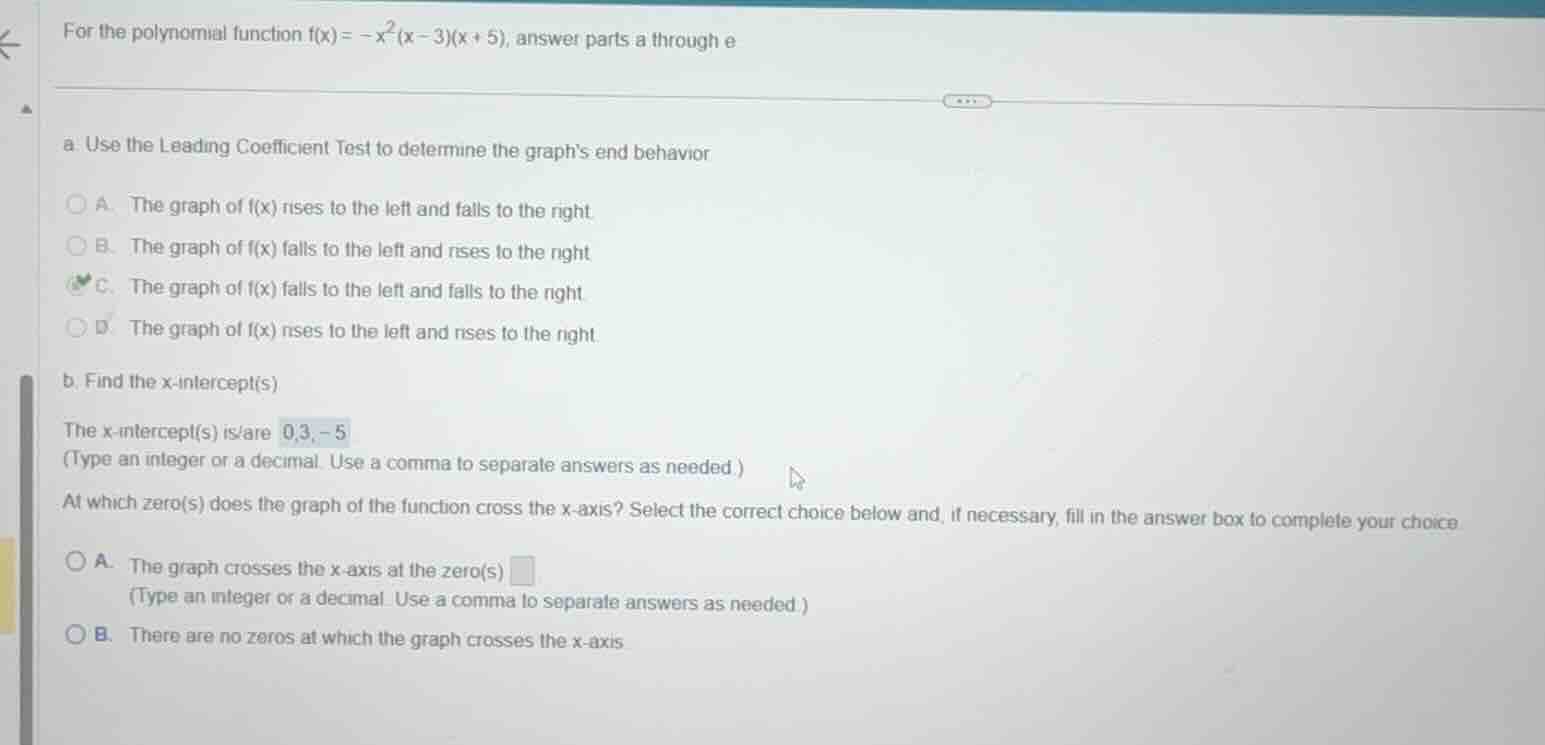
for the polynomial function \\(f(x) = -x^2(x-3)(x+5)\\), answer parts a through e
a. use the leading coefficient test to determine the graphs end behavior
a. the graph of \\(f(x)\\) rises to the left and falls to the right.
b. the graph of \\(f(x)\\) falls to the left and rises to the right.
c. the graph of \\(f(x)\\) falls to the left and falls to the right.
d. the graph of \\(f(x)\\) rises to the left and rises to the right.
b. find the x-intercept(s).
the x-intercept(s) is/are \\(0, 3, -5\\)
(type an integer or a decimal. use a comma to separate answers as needed.)
at which zero(s) does the graph of the function cross the x-axis? select the correct choice below and, if necessary, fill in the answer box to complete your choice.
a. the graph crosses the x-axis at the zero(s)
(type an integer or a decimal. use a comma to separate answers as needed.)
b. there are no zeros at which the graph crosses the x-axis.
Determine the degree and leading coefficient
Using the Leading Coefficient Test and End Behavior of Polynomials knowledge points
Determine the end behavior
Using the Leading Coefficient Test and End Behavior of Polynomials knowledge points
The graph falls to the left and falls to the right.
Find the x-intercepts
Using the Multiplicity of Zeros knowledge point
Determine where the graph crosses the x-axis
Using the Graph Behavior at Zeros and Multiplicity of Zeros knowledge points
The graph crosses the x-axis at the zeros \(3, -5\).

Snap & solve any problem in the app
Get step-by-step solutions on Sovi AI
Photo-based solutions with guided steps
Explore more problems and detailed explanations
Question a
- A. The graph of f(x) rises to the left and falls to the right.
- B. The graph of f(x) falls to the left and rises to the right.
- C. The graph of f(x) falls to the left and falls to the right. (Correct answer)
- D. The graph of f(x) rises to the left and rises to the right.
Question b
The x-intercept(s) is/are <blank>0, 3, -5</blank>
Question c
- A. The graph crosses the x-axis at the zero(s) <blank>3, -5</blank> (Correct answer)
- B. There are no zeros at which the graph crosses the x-axis