QUESTION IMAGE
Question
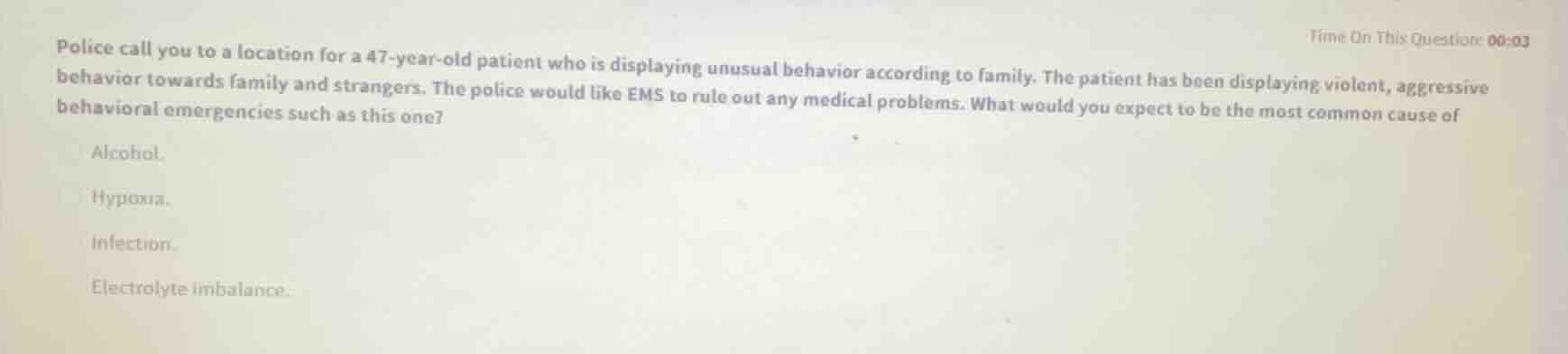
police call you to a location for a 47-year-old patient who is displaying unusual behavior according to family. the patient has been displaying violent, aggressive behavior towards family and strangers. the police would like ems to rule out any medical problems. what would you expect to be the most common cause of behavioral emergencies such as this one?
alcohol.
hypoxia.
infection.
electrolyte imbalance.
Analyze the clinical scenario
The scenario describes a 47-year-old patient displaying unusual, violent, and aggressive behavior. The police have requested EMS to rule out underlying medical causes for this acute behavioral change.
Evaluate medical causes of behavioral emergencies
When assessing acute behavioral changes or psychiatric emergencies, EMS must always consider and rule out organic (medical) causes. Common medical causes include:
- Hypoxia
- Hypoglycemia
- Substance use/abuse (especially alcohol or drugs)
- Infections (such as sepsis or urinary tract infections, particularly in elderly patients)
- Electrolyte imbalances
- Head trauma
Among the options provided (Alcohol, Hypoxia, Infection, Electrolyte imbalance), hypoxia (low oxygen levels in the blood/tissue) is clinically recognized as one of the most common, immediate, and life-threatening medical causes of acute agitation, confusion, and aggressive behavior. In emergency medicine and EMS protocols, hypoxia and hypoglycemia are the top two reversible medical emergencies that must be ruled out immediately when a patient presents with an acute behavioral emergency, with hypoxia being a primary respiratory-related driver of rapid cognitive and behavioral deterioration.
Match with the options
- Alcohol: While substance use is common, acute physiological hypoxia is a critical, primary medical cause that EMS must immediately assess and rule out as a life threat.
- Hypoxia: Correct. It is a highly common, rapidly reversible, and life-threatening medical cause of acute behavioral changes and aggression.
- Infection: More common in geriatric populations (e.g., UTIs causing delirium) but less common as the primary acute driver in a 47-year-old compared to hypoxia.
- Electrolyte imbalance: Can cause altered mental status, but is less common as an acute cause of sudden violent behavior compared to hypoxia.
Therefore, Hypoxia is the expected most common medical cause among the choices.

Snap & solve any problem in the app
Get step-by-step solutions on Sovi AI
Photo-based solutions with guided steps
Explore more problems and detailed explanations
- Alcohol.
- Hypoxia. (Correct answer)
- Infection.
- Electrolyte imbalance.