QUESTION IMAGE
Question
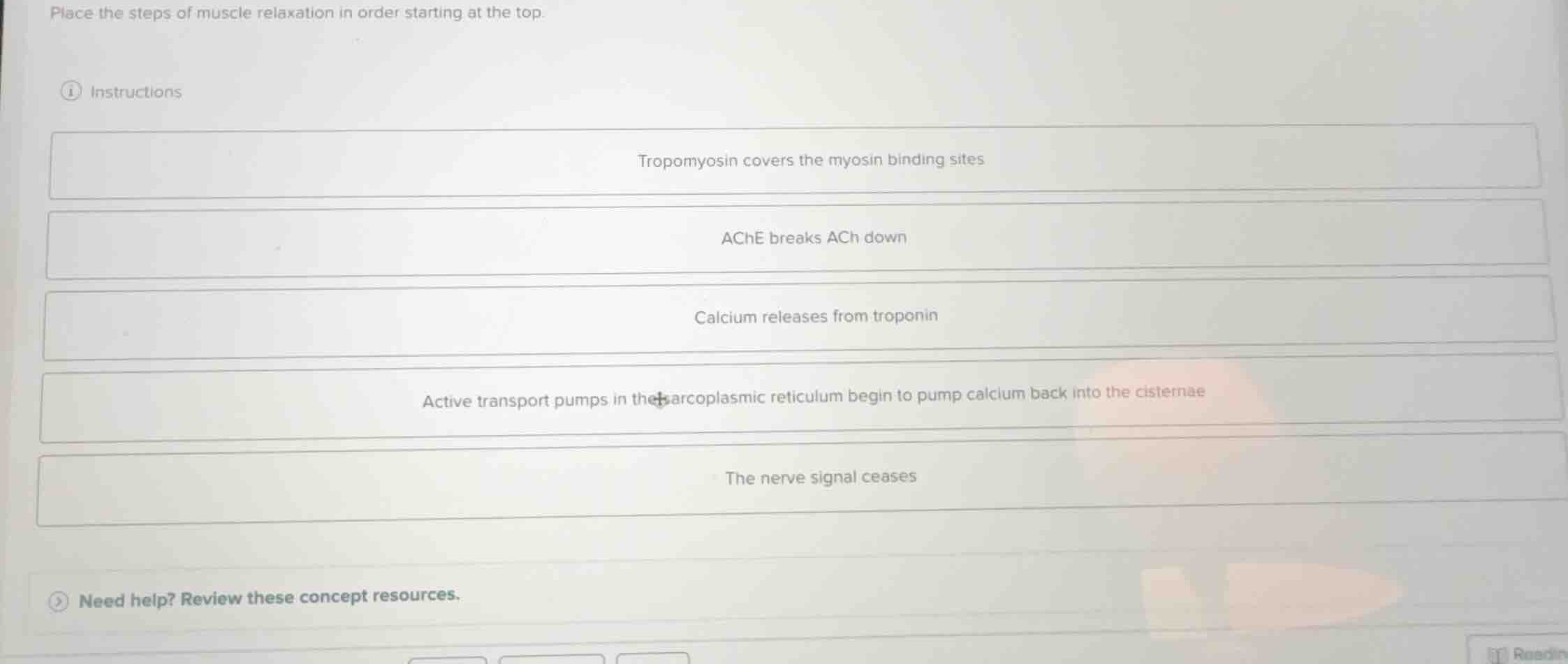
place the steps of muscle relaxation in order starting at the top.
tropomyosin covers the myosin binding sites
ache breaks ach down
calcium releases from troponin
active transport pumps in the sarcoplasmic reticulum begin to pump calcium back into the cisternae
the nerve signal ceases
Cessation of nerve signal
Using the Skeletal Muscle Relaxation knowledge point
The process of muscle relaxation begins when nerve impulses stop arriving at the neuromuscular junction. Without action potentials, the motor neuron stops releasing acetylcholine (ACh) into the synaptic cleft.
Breakdown of acetylcholine
Using the Acetylcholinesterase Function knowledge point
Acetylcholinesterase (AChE) quickly degrades the remaining ACh in the synaptic cleft. This stops the stimulation of the sarcolemma, allowing the muscle fiber to return to its resting membrane potential.
Active transport of calcium
Using the Calcium Reuptake knowledge point
Active transport pumps (SERCA) in the sarcoplasmic reticulum membrane pump calcium ions (\(\text{Ca}^{2+}\)) back into the terminal cisternae, removing them from the sarcoplasm.
Dissociation of calcium from troponin
Using the Muscle Relaxation Mechanism knowledge point
As sarcoplasmic calcium levels drop, calcium ions dissociate from troponin, which initiates the conformational shift of the thin filament regulatory proteins.
Covering of myosin binding sites
Using the Muscle Relaxation Mechanism knowledge point
Without calcium bound to troponin, tropomyosin shifts back into its resting position, covering the active myosin-binding sites on the actin filaments and preventing cross-bridge formation.

Snap & solve any problem in the app
Get step-by-step solutions on Sovi AI
Photo-based solutions with guided steps
Explore more problems and detailed explanations
- The nerve signal ceases
- AChE breaks ACh down
- Active transport pumps in the sarcoplasmic reticulum begin to pump calcium back into the cisternae
- Calcium releases from troponin
- Tropomyosin covers the myosin binding sites