QUESTION IMAGE
Question
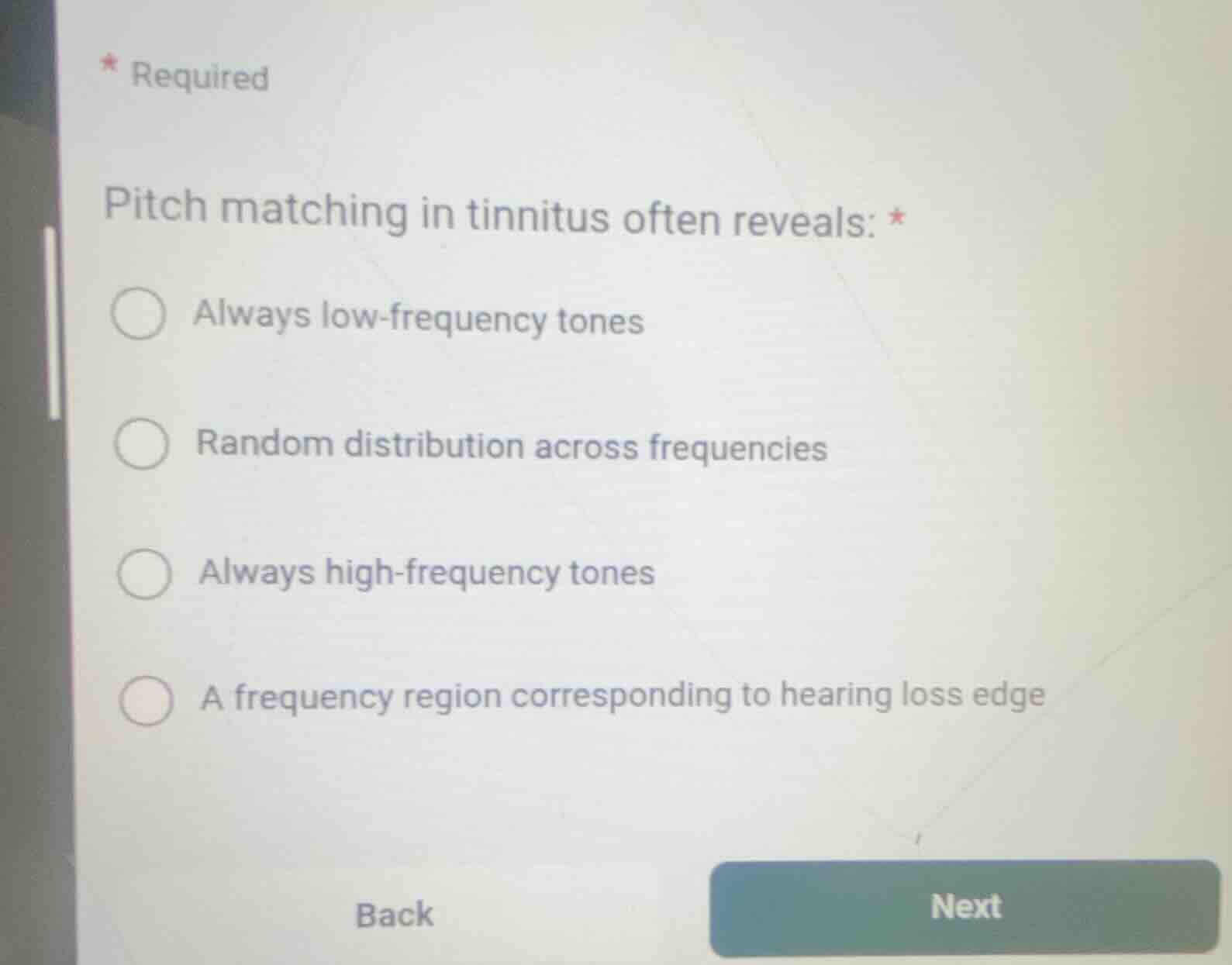
pitch matching in tinnitus often reveals:
always low-frequency tones
random distribution across frequencies
always high-frequency tones
a frequency region corresponding to hearing loss edge
<pre_analysis>
{
"quality": "clear",
"question_count": 1,
"skills_matched": [
"direct_cot",
"multiple_choice_formatter",
"explain_then_answer",
"tutor"
],
"needs_drawing": false,
"concepts_used": [],
"new_concepts": [
"Tinnitus Pitch Matching",
"Hearing Loss Edge"
],
"current_concepts": [
"Tinnitus Pitch Matching",
"Hearing Loss Edge",
"Clinical Audiometry"
]
}
</pre_analysis>
<reasoning>
Analyze the nature of tinnitus pitch
Tinnitus is highly correlated with peripheral hearing damage. When pitch-matching procedures are performed clinically, the matched pitch is rarely random, nor is it restricted to being "always" low-frequency or "always" high-frequency. Instead, the perceived pitch of subjective tinnitus most frequently corresponds to the frequency region where hearing sensitivity begins to decline or drops off sharply.
Evaluate the clinical relationship with hearing loss
The physiological mechanism of subjective tinnitus is closely linked to maladaptive plastic changes in the central auditory system following deafferentation (sensory deprivation). The cortical representation of the frequencies corresponding to the "edge" of the hearing loss (the transition zone between normal hearing and impaired hearing, or the region of maximum hearing loss) undergoes reorganization, which often manifests perceptually as the pitch of the tinnitus.
Assess the given multiple-choice options
- Always low-frequency tones: Incorrect, as tinnitus is frequently high-pitched, especially when associated with noise-induced hearing loss or presbycusis.
- Random distribution across frequencies: Incorrect, because there is a strong systematic correlation between the audiometric configuration and the matched pitch.
- Always high-frequency tones: Incorrect, as some patients (e.g., those with Ménière's disease) experience low-frequency roaring tinnitus.
- A frequency region corresponding to hearing loss edge: Correct, as it accurately describes the established clinical and neurophysiological finding that tinnitus pitch matches the transition or edge region of the patient's hearing loss.
</reasoning>
<answer>
<mcq-option>(A) Always low-frequency tones</mcq-option>
<mcq-option>(B) Random distribution across frequencies</mcq-option>
<mcq-option>(C) Always high-frequency tones</mcq-option>
<mcq-correct>(D) A frequency region corresponding to hearing loss edge</mcq-correct>
</answer>
<post_analysis>
{
"subject": "Natural Science",
"question_type": "Multiple Choice",
"knowledge_point": [
"Natural Science",
"Medicine",
"Audiology and Tinnitus"
]
}
</post_analysis>
Snap & solve any problem in the app
Get step-by-step solutions on Sovi AI
Photo-based solutions with guided steps
Explore more problems and detailed explanations
<pre_analysis>
{
"quality": "clear",
"question_count": 1,
"skills_matched": [
"direct_cot",
"multiple_choice_formatter",
"explain_then_answer",
"tutor"
],
"needs_drawing": false,
"concepts_used": [],
"new_concepts": [
"Tinnitus Pitch Matching",
"Hearing Loss Edge"
],
"current_concepts": [
"Tinnitus Pitch Matching",
"Hearing Loss Edge",
"Clinical Audiometry"
]
}
</pre_analysis>
<reasoning>
Analyze the nature of tinnitus pitch
Tinnitus is highly correlated with peripheral hearing damage. When pitch-matching procedures are performed clinically, the matched pitch is rarely random, nor is it restricted to being "always" low-frequency or "always" high-frequency. Instead, the perceived pitch of subjective tinnitus most frequently corresponds to the frequency region where hearing sensitivity begins to decline or drops off sharply.
Evaluate the clinical relationship with hearing loss
The physiological mechanism of subjective tinnitus is closely linked to maladaptive plastic changes in the central auditory system following deafferentation (sensory deprivation). The cortical representation of the frequencies corresponding to the "edge" of the hearing loss (the transition zone between normal hearing and impaired hearing, or the region of maximum hearing loss) undergoes reorganization, which often manifests perceptually as the pitch of the tinnitus.
Assess the given multiple-choice options
- Always low-frequency tones: Incorrect, as tinnitus is frequently high-pitched, especially when associated with noise-induced hearing loss or presbycusis.
- Random distribution across frequencies: Incorrect, because there is a strong systematic correlation between the audiometric configuration and the matched pitch.
- Always high-frequency tones: Incorrect, as some patients (e.g., those with Ménière's disease) experience low-frequency roaring tinnitus.
- A frequency region corresponding to hearing loss edge: Correct, as it accurately describes the established clinical and neurophysiological finding that tinnitus pitch matches the transition or edge region of the patient's hearing loss.
</reasoning>
<answer>
<mcq-option>(A) Always low-frequency tones</mcq-option>
<mcq-option>(B) Random distribution across frequencies</mcq-option>
<mcq-option>(C) Always high-frequency tones</mcq-option>
<mcq-correct>(D) A frequency region corresponding to hearing loss edge</mcq-correct>
</answer>
<post_analysis>
{
"subject": "Natural Science",
"question_type": "Multiple Choice",
"knowledge_point": [
"Natural Science",
"Medicine",
"Audiology and Tinnitus"
]
}
</post_analysis>