QUESTION IMAGE
Question
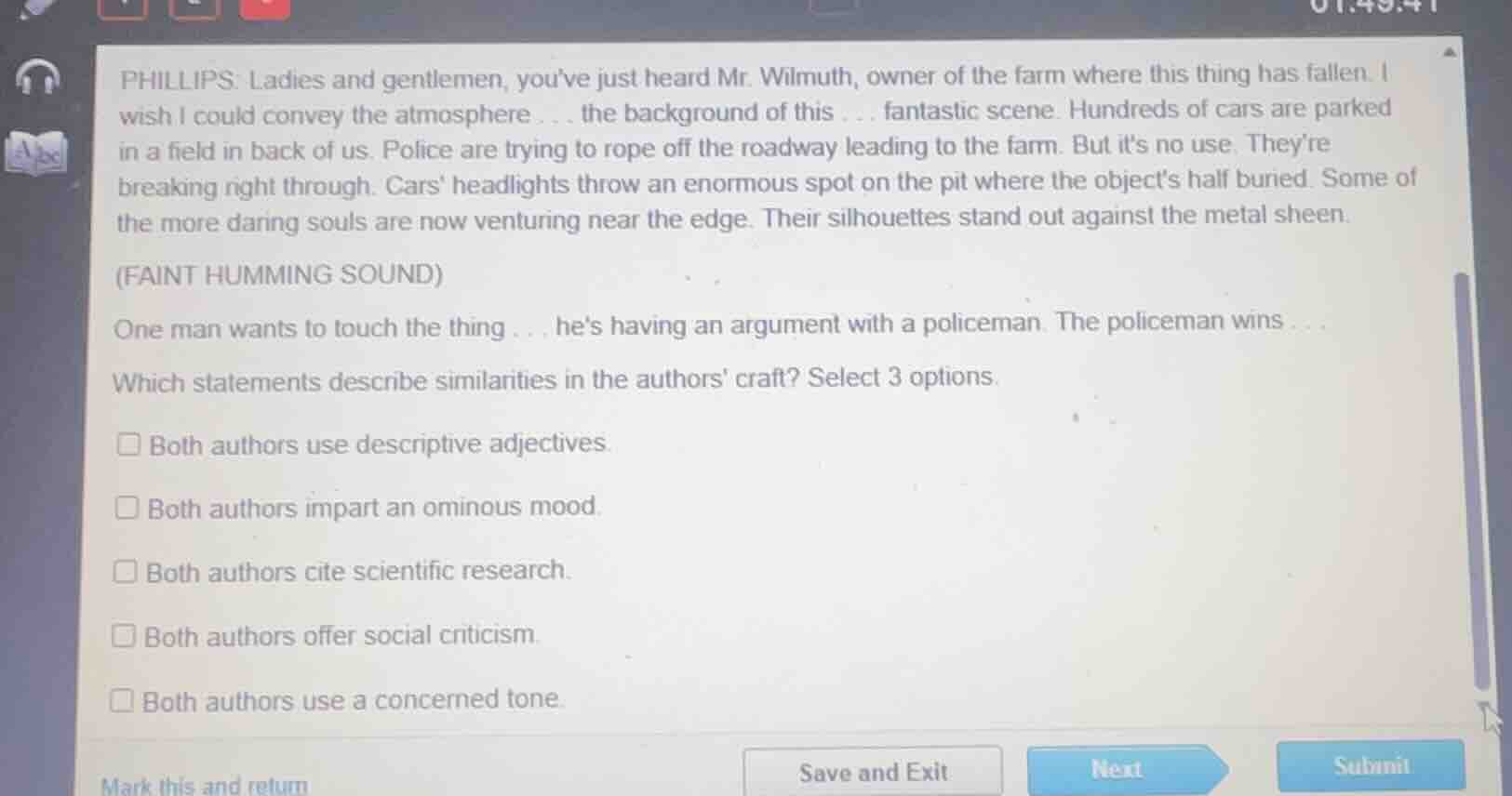
phillips: ladies and gentlemen, youve just heard mr. wilmuth, owner of the farm where this thing has fallen. i wish i could convey the atmosphere... the background of this... fantastic scene. hundreds of cars are parked in a field in back of us. police are trying to rope off the roadway leading to the farm. but its no use. theyre breaking right through. cars headlights throw an enormous spot on the pit where the objects half buried. some of the more daring souls are now venturing near the edge. their silhouettes stand out against the metal sheen.
(faint humming sound)
one man wants to touch the thing... hes having an argument with a policeman. the policeman wins...
which statements describe similarities in the authors craft? select 3 options.
both authors use descriptive adjectives.
both authors impart an ominous mood.
both authors cite scientific research.
both authors offer social criticism.
both authors use a concerned tone.
Analyze the prompt and passage
The question asks us to identify three statements that describe similarities in the authors' craft between two texts. Although only one passage is fully visible (the radio broadcast transcript from The War of the Worlds by Orson Welles/Howard Koch), this is a standard comparative literature question typically comparing the radio play adaptation to H.G. Wells' original science fiction novel The War of the Worlds.
Let's analyze the visible excerpt:
- Descriptive adjectives: The text uses descriptive adjectives such as "fantastic" (scene), "enormous" (spot), "daring" (souls), "metal" (sheen), and "faint" (humming sound). The original novel is also highly descriptive, using vivid imagery and adjectives to depict the alien cylinder and the surrounding crowd.
- Ominous mood: The mood is highly suspenseful and ominous ("this thing has fallen", "no use", "breaking right through", "faint humming sound", "daring souls... venturing near the edge"). Both the novel and the radio play aim to create a sense of dread and tension regarding the mysterious extraterrestrial object.
- Concerned tone: The narrator/speaker Phillips exhibits a highly concerned, urgent, and anxious tone as he reports live from the scene, unable to fully convey the atmosphere and describing the police losing control of the crowd. The narrator of the novel similarly reflects on these events with a serious, concerned, and retrospective tone of dread.
- Scientific research / Social criticism: Neither the radio play excerpt nor the corresponding opening scenes of the novel cite actual scientific research or offer explicit social criticism in this immediate context.
Using the Authors Craft and Tone and Mood Analysis knowledge points, we can confirm that both authors use descriptive adjectives, impart an ominous mood, and use a concerned tone.
Apply mastery-adaptive brevity
Using the Authors Craft knowledge point:
Both texts rely on vivid sensory details and precise descriptive adjectives to help the audience visualize the extraordinary scene of the fallen cylinder.
Using the Tone and Mood Analysis knowledge point:
Both authors establish an ominous, suspenseful mood to evoke fear of the unknown, accompanied by a deeply concerned tone from the narrator observing the chaotic scene.

Snap & solve any problem in the app
Get step-by-step solutions on Sovi AI
Photo-based solutions with guided steps
Explore more problems and detailed explanations
- Both authors use descriptive adjectives. (Correct answer)
- Both authors impart an ominous mood. (Correct answer)
- Both authors cite scientific research.
- Both authors offer social criticism.
- Both authors use a concerned tone. (Correct answer)