QUESTION IMAGE
Question
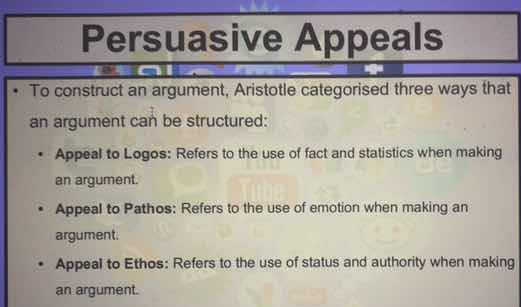
persuasive appeals
to construct an argument, aristotle categorised three ways that an argument can be structured:
- appeal to logos: refers to the use of fact and statistics when making an argument.
- appeal to pathos: refers to the use of emotion when making an argument.
- appeal to ethos: refers to the use of status and authority when making an argument.
<pre_analysis>
{
"quality": "clear",
"question_count": 1,
"skills_matched": [
"direct_cot",
"explain_then_answer",
"quick"
],
"needs_drawing": false,
"concepts_used": [],
"new_concepts": [
"Rhetorical Appeals",
"Aristotelian Rhetoric"
],
"current_concepts": [
"Rhetorical Appeals",
"Aristotelian Rhetoric"
]
}
</pre_analysis>
<reasoning>
Identify the core concepts of persuasive appeals
The image defines Aristotle's three modes of persuasion:
- Logos: Appeal to logic, facts, and statistics.
- Pathos: Appeal to emotion.
- Ethos: Appeal to credibility, status, and authority.
Summarize the definitions
- Logos: Logical reasoning and evidence.
- Pathos: Emotional connection and response.
- Ethos: Trustworthiness and character of the speaker.
</reasoning>
<answer>
Aristotle's three persuasive appeals are:
- Logos (Logic): Persuading through the use of reasoning, facts, and statistics.
- Pathos (Emotion): Persuading by appealing to the audience's emotions and feelings.
- Ethos (Credibility): Persuading by establishing the speaker's authority, character, and status.
</answer>
<post_analysis>
{
"subject": "Others",
"question_type": "Free Response",
"knowledge_point": [
"Others",
"English Language Arts",
"Rhetorical Analysis"
]
}
</post_analysis>
Snap & solve any problem in the app
Get step-by-step solutions on Sovi AI
Photo-based solutions with guided steps
Explore more problems and detailed explanations
<pre_analysis>
{
"quality": "clear",
"question_count": 1,
"skills_matched": [
"direct_cot",
"explain_then_answer",
"quick"
],
"needs_drawing": false,
"concepts_used": [],
"new_concepts": [
"Rhetorical Appeals",
"Aristotelian Rhetoric"
],
"current_concepts": [
"Rhetorical Appeals",
"Aristotelian Rhetoric"
]
}
</pre_analysis>
<reasoning>
Identify the core concepts of persuasive appeals
The image defines Aristotle's three modes of persuasion:
- Logos: Appeal to logic, facts, and statistics.
- Pathos: Appeal to emotion.
- Ethos: Appeal to credibility, status, and authority.
Summarize the definitions
- Logos: Logical reasoning and evidence.
- Pathos: Emotional connection and response.
- Ethos: Trustworthiness and character of the speaker.
</reasoning>
<answer>
Aristotle's three persuasive appeals are:
- Logos (Logic): Persuading through the use of reasoning, facts, and statistics.
- Pathos (Emotion): Persuading by appealing to the audience's emotions and feelings.
- Ethos (Credibility): Persuading by establishing the speaker's authority, character, and status.
</answer>
<post_analysis>
{
"subject": "Others",
"question_type": "Free Response",
"knowledge_point": [
"Others",
"English Language Arts",
"Rhetorical Analysis"
]
}
</post_analysis>