QUESTION IMAGE
Question
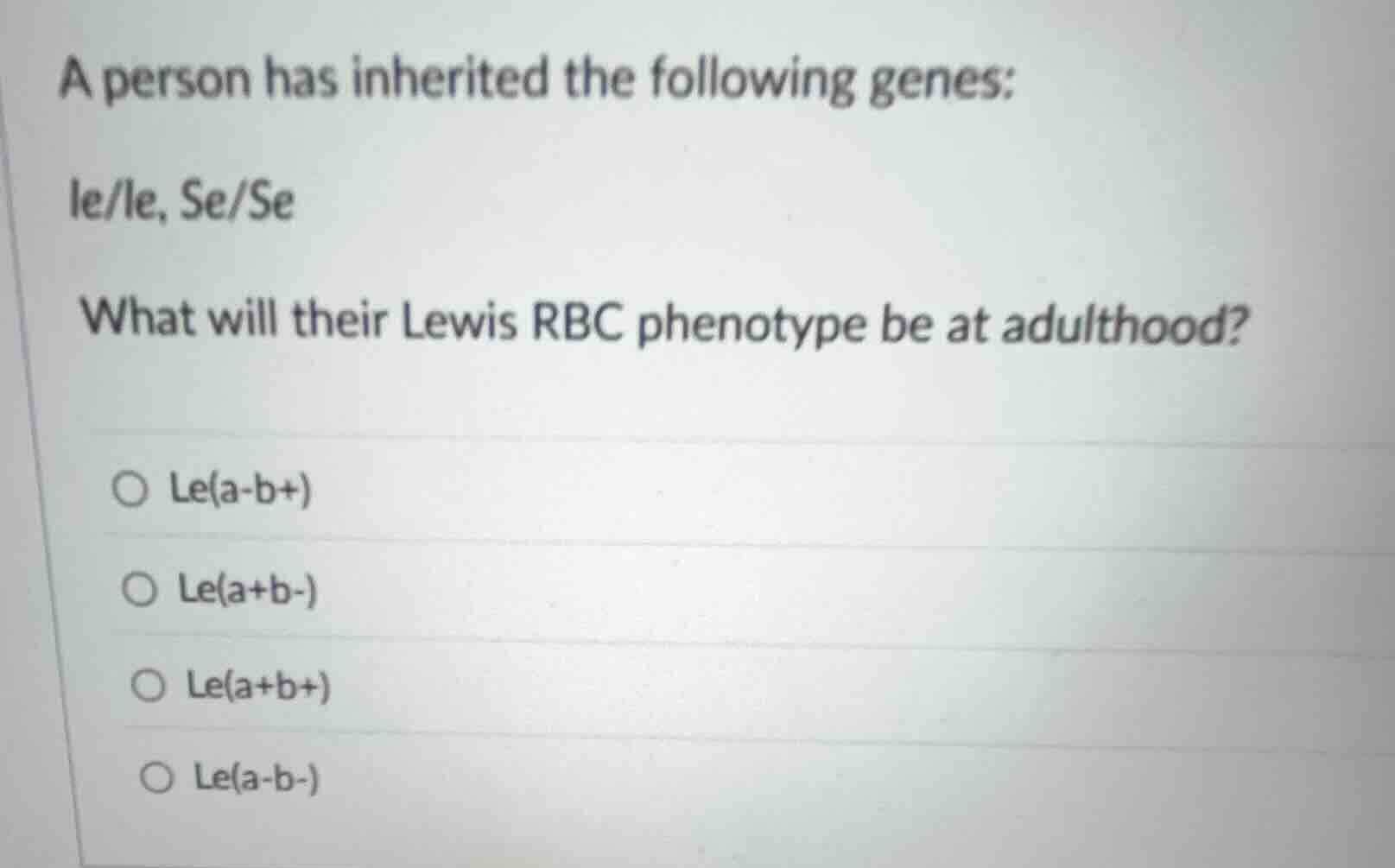
a person has inherited the following genes:
le/le, se/se
what will their lewis rbc phenotype be at adulthood?
o le(a-b+)
o le(a+b-)
o le(a+b+)
o le(a-b-)
Analyze the inherited Lewis genotype
Using the Lewis Blood Group and Lewis Antigen Biosynthesis knowledge points
- The individual has inherited the homozygous recessive genotype \(le/le\).
- The \(le\) gene is an inactive amorph that does not produce a functional fucosyltransferase enzyme (FUT3).
- Without a functional \(Le\) gene, no Lewis antigens (\(\text{Le}^\text{a}\) or \(\text{Le}^\text{b}\)) can be synthesized in secretions or adsorbed onto red blood cell membranes.
Determine the effect of the Secretor genotype
Using the Lewis Phenotypes knowledge point
- The individual has inherited the homozygous dominant secretor genotype \(Se/Se\).
- Although a functional secretor enzyme (FUT2) is present, it acts on type 1 precursor chains to form type 1 H substance, but cannot synthesize Lewis antigens without the active \(Le\) gene.
- Consequently, no Lewis antigens are present in secretions to be adsorbed onto the red blood cells.
Identify the final adult red blood cell phenotype
Using the Lewis Phenotypes knowledge point
- Since neither \(\text{Le}^\text{a}\) nor \(\text{Le}^\text{b}\) antigens are synthesized or present on the red blood cells, the phenotype is negative for both.
- Therefore, the adult red blood cell phenotype is \(\text{Le(a-b-)}\).

Snap & solve any problem in the app
Get step-by-step solutions on Sovi AI
Photo-based solutions with guided steps
Explore more problems and detailed explanations
- (A) Le(a-b+)
- (B) Le(a+b-)
- (C) Le(a+b+)
- (D) Le(a-b-) (Correct answer)