QUESTION IMAGE
Question
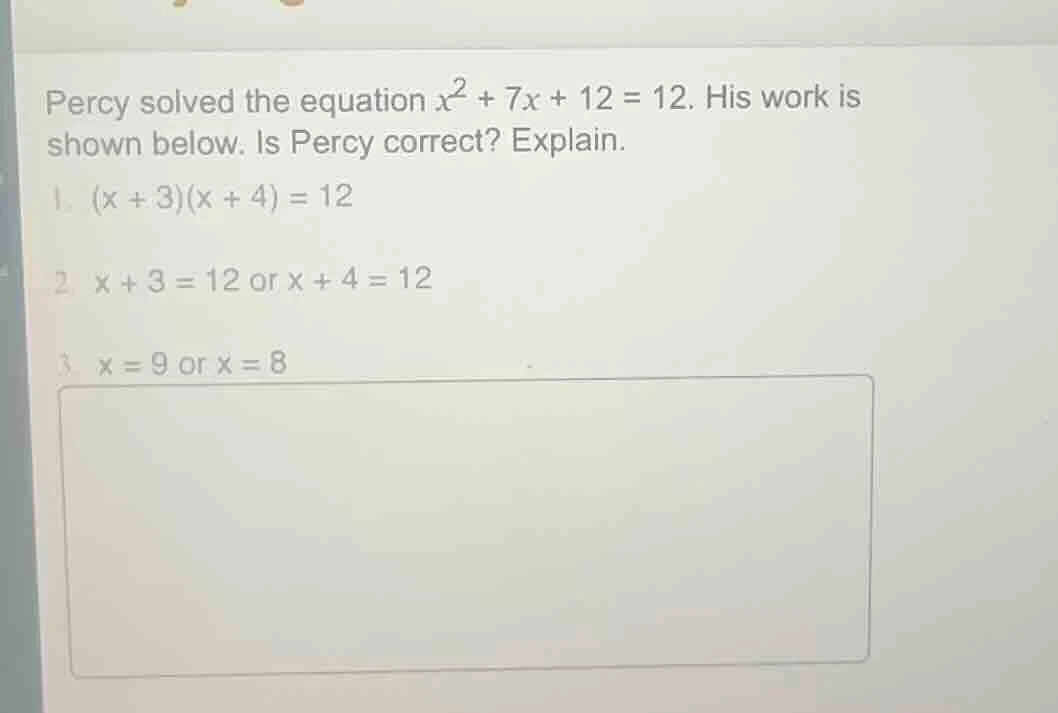
percy solved the equation $x^2 + 7x + 12 = 12$. his work is shown below. is percy correct? explain.
- $(x + 3)(x + 4) = 12$
- $x + 3 = 12$ or $x + 4 = 12$
- $x = 9$ or $x = 8$
Step 1: Analyze the original equation
The original equation is \(x^{2}+7x + 12=12\). First, we should simplify this equation. Subtract 12 from both sides:
\(x^{2}+7x+12 - 12=12 - 12\)
\(x^{2}+7x=0\)
Step 2: Analyze Percy's first step
Percy factored the left - hand side as \((x + 3)(x + 4)=12\). But when we use the zero - product property (if \(ab = 0\), then \(a = 0\) or \(b = 0\)), the right - hand side of the equation must be zero. In Percy's equation \((x + 3)(x + 4)=12\), the right - hand side is 12 (not zero), so we cannot directly set \(x + 3=12\) or \(x + 4=12\) using the zero - product property.
Step 3: Solve the equation correctly
Starting from \(x^{2}+7x+12 = 12\), subtract 12 from both sides to get \(x^{2}+7x=0\). Then factor out an \(x\): \(x(x + 7)=0\).
Using the zero - product property, we have \(x=0\) or \(x+7 = 0\).
If \(x+7 = 0\), then \(x=-7\).

Snap & solve any problem in the app
Get step-by-step solutions on Sovi AI
Photo-based solutions with guided steps
Explore more problems and detailed explanations
Percy is not correct. The error occurs in Step 2. The zero - product property (if \(ab = c\), we can only set \(a = 0\) or \(b = 0\) when \(c = 0\)). In the equation \((x + 3)(x + 4)=12\), the right - hand side is 12 (not zero), so we cannot set \(x + 3 = 12\) or \(x + 4 = 12\) directly. The correct solution is obtained by first subtracting 12 from both sides of the original equation to get \(x^{2}+7x=0\), then factoring as \(x(x + 7)=0\), and using the zero - product property to find \(x = 0\) or \(x=-7\).