Sovi.AI - AI Math Tutor

Scan to solve math questions

QUESTION IMAGE

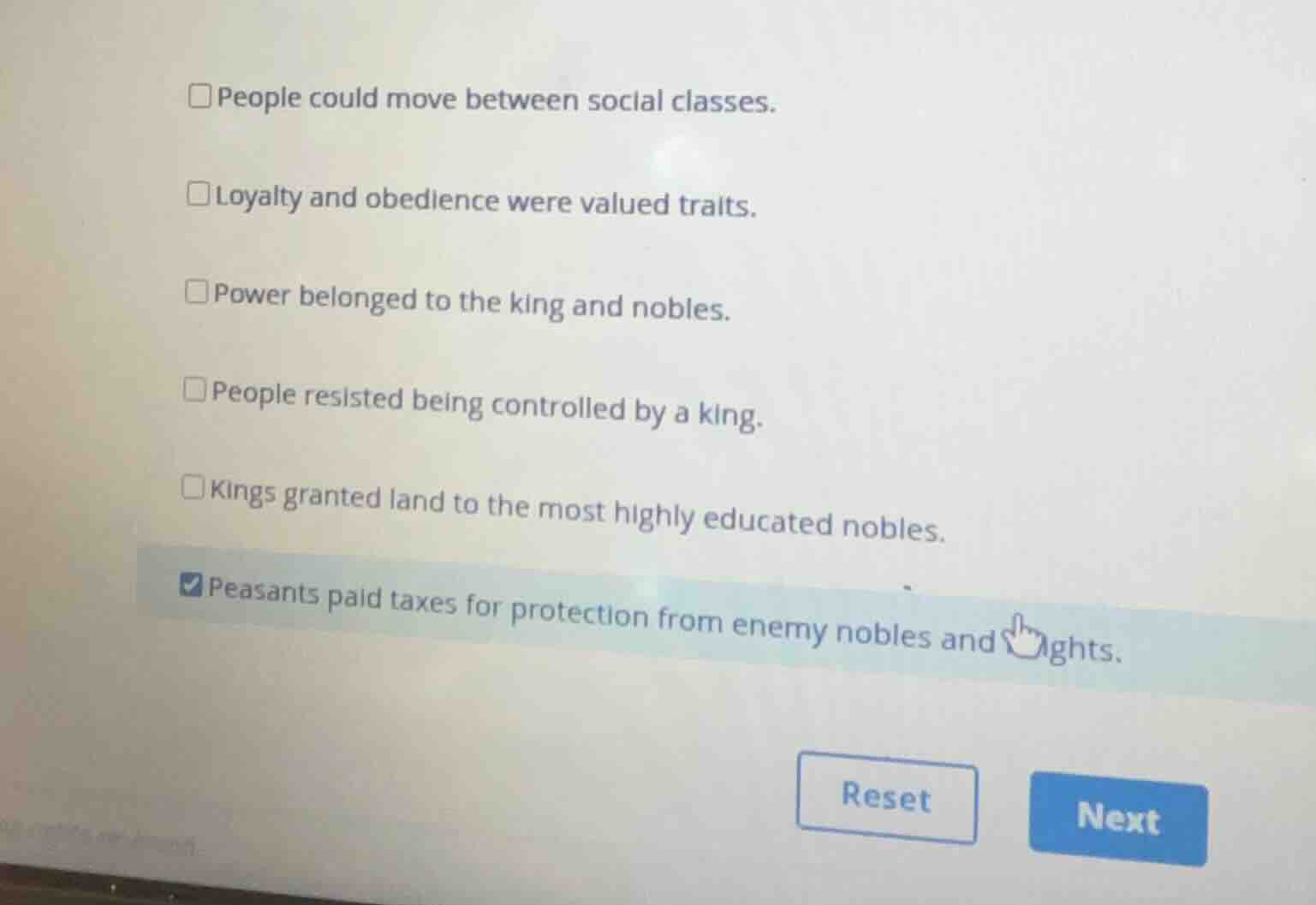
people could move between social classes. loyalty and obedience were va…

Question

people could move between social classes.
loyalty and obedience were valued traits.
power belonged to the king and nobles.
people resisted being controlled by a king.
kings granted land to the most highly educated nobles.
peasants paid taxes for protection from enemy nobles and knights.

Explanation:

Response

<pre_analysis>
{
"quality": "clear",
"question_count": 1,
"skills_matched": [
"direct_cot",
"multiple_choice_formatter",
"explain_then_answer",
"tutor"
],
"needs_drawing": false,
"concepts_used": [],
"new_concepts": [
"Feudalism",
"Medieval Social Structure"
],
"current_concepts": [
"Feudalism",
"Medieval Social Structure"
]
}
</pre_analysis>

<reasoning>

Identify the core historical system

The options describe social dynamics, power structures, and economic exchanges. These elements are characteristic of Feudalism in medieval Europe.

Analyze the selected statement

The checked option states: "Peasants paid taxes for protection from enemy nobles and knights." Under the feudal system, peasants (or serfs) provided labor and taxes (often in the form of crops) to the lord. In exchange, the lord provided physical protection and security.

Evaluate the historical accuracy

This statement accurately reflects the mutual, though highly unequal, obligations that defined the feudal contract between peasants and the ruling military class.
</reasoning>

<answer>
<mcq-option>People could move between social classes.</mcq-option>
<mcq-option>Loyalty and obedience were valued traits.</mcq-option>
<mcq-option>Power belonged to the king and nobles.</mcq-option>
<mcq-option>People resisted being controlled by a king.</mcq-option>
<mcq-option>Kings granted land to the most highly educated nobles.</mcq-option>
<mcq-correct>Peasants paid taxes for protection from enemy nobles and knights.</mcq-correct>
</answer>

<post_analysis>
{
"subject": "Social Science",
"question_type": "Multiple Choice",
"knowledge_point": [
"Social Science",
"History",
"Feudalism"
]
}
</post_analysis>

Answer:

<pre_analysis>
{
"quality": "clear",
"question_count": 1,
"skills_matched": [
"direct_cot",
"multiple_choice_formatter",
"explain_then_answer",
"tutor"
],
"needs_drawing": false,
"concepts_used": [],
"new_concepts": [
"Feudalism",
"Medieval Social Structure"
],
"current_concepts": [
"Feudalism",
"Medieval Social Structure"
]
}
</pre_analysis>

<reasoning>

Identify the core historical system

The options describe social dynamics, power structures, and economic exchanges. These elements are characteristic of Feudalism in medieval Europe.

Analyze the selected statement

The checked option states: "Peasants paid taxes for protection from enemy nobles and knights." Under the feudal system, peasants (or serfs) provided labor and taxes (often in the form of crops) to the lord. In exchange, the lord provided physical protection and security.

Evaluate the historical accuracy

This statement accurately reflects the mutual, though highly unequal, obligations that defined the feudal contract between peasants and the ruling military class.
</reasoning>

<answer>
<mcq-option>People could move between social classes.</mcq-option>
<mcq-option>Loyalty and obedience were valued traits.</mcq-option>
<mcq-option>Power belonged to the king and nobles.</mcq-option>
<mcq-option>People resisted being controlled by a king.</mcq-option>
<mcq-option>Kings granted land to the most highly educated nobles.</mcq-option>
<mcq-correct>Peasants paid taxes for protection from enemy nobles and knights.</mcq-correct>
</answer>

<post_analysis>
{
"subject": "Social Science",
"question_type": "Multiple Choice",
"knowledge_point": [
"Social Science",
"History",
"Feudalism"
]
}
</post_analysis>