QUESTION IMAGE
Question
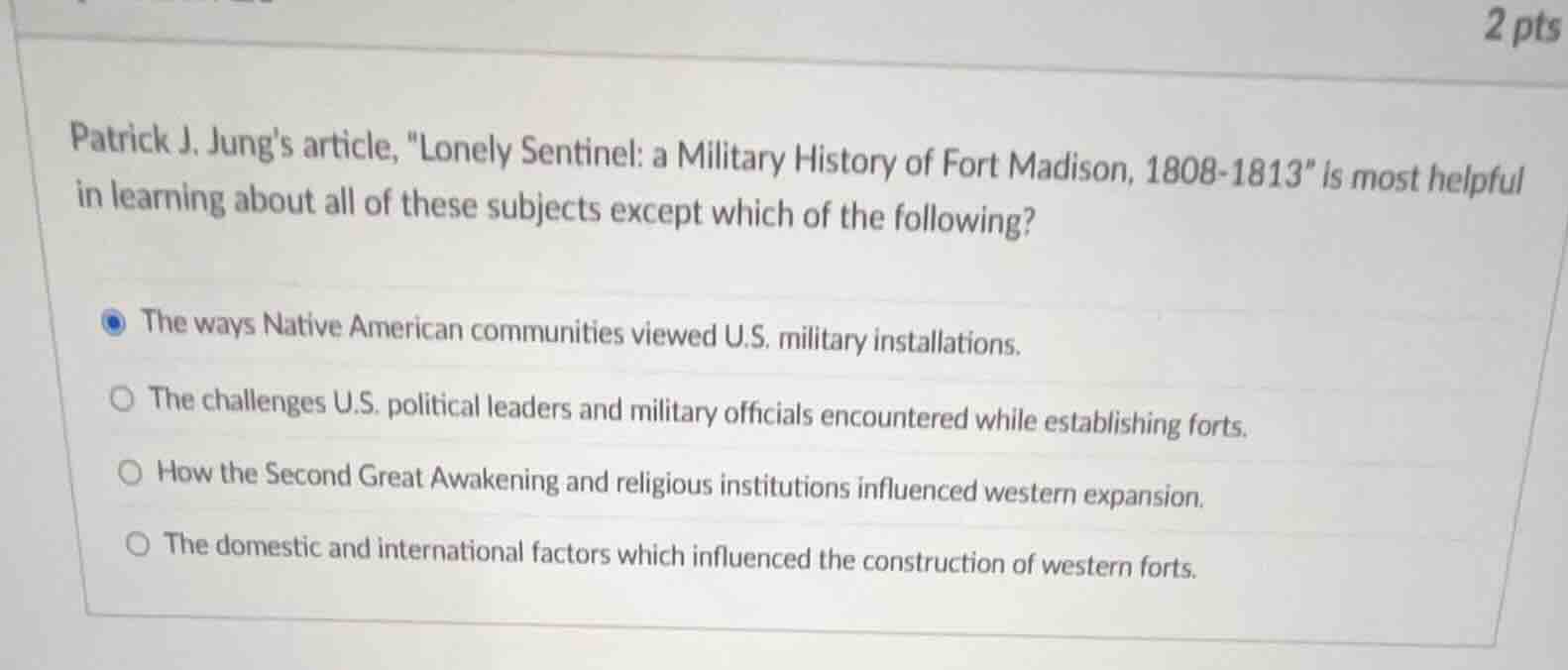
patrick j. jungs article, \lonely sentinel: a military history of fort madison, 1808-1813\ is most helpful in learning about all of these subjects except which of the following?
- the ways native american communities viewed u.s. military installations.
- the challenges u.s. political leaders and military officials encountered while establishing forts.
- how the second great awakening and religious institutions influenced western expansion.
- the domestic and international factors which influenced the construction of western forts.
⚡ Using what you learned: westward expansion policy and outcomes
Step 1: Analyze the scope of the source material
The article is titled "Lonely Sentinel: a Military History of Fort Madison, 1808-1813".
- Subject: A specific military fort (Fort Madison).
- Timeframe: 1808–1813 (the period leading up to and during the War of 1812).
- Focus: Military history, construction of western outposts, geopolitical tensions, and interactions with local Native American populations during this era of early westward expansion.
Step 2: Evaluate the options against the source scope
- Option 1: The ways Native American communities viewed U.S. military installations.
- Evaluation: Highly relevant. Fort Madison was built on disputed lands and faced direct resistance and sieges from Native American groups (such as the Sauk), making their perspective a core part of its military history.
- Option 2: The challenges U.S. political leaders and military officials encountered while establishing forts.
- Evaluation: Highly relevant. A military history of a frontier fort directly covers the logistical, political, and strategic difficulties of establishing and maintaining such outposts.
- Option 3: How the Second Great Awakening and religious institutions influenced western expansion.
- Evaluation: Not relevant. The Second Great Awakening was a Protestant religious revival movement. While it occurred during this general era, a strictly military history of a specific frontier fort (1808–1813) would not focus on religious revivalism or the influence of religious institutions on expansion.
- Option 4: The domestic and international factors which influenced the construction of western forts.
- Evaluation: Highly relevant. The construction of Fort Madison was heavily influenced by domestic policies regarding the fur trade and international tensions between the United States and Great Britain leading into the War of 1812.
Step 3: Identify the exception
Since the question asks which subject the article is least helpful in learning about ("except which of the following"), the correct choice is the option concerning religious history and the Second Great Awakening.

Snap & solve any problem in the app
Get step-by-step solutions on Sovi AI
Photo-based solutions with guided steps
Explore more problems and detailed explanations
How the Second Great Awakening and religious institutions influenced western expansion.