QUESTION IMAGE
Question
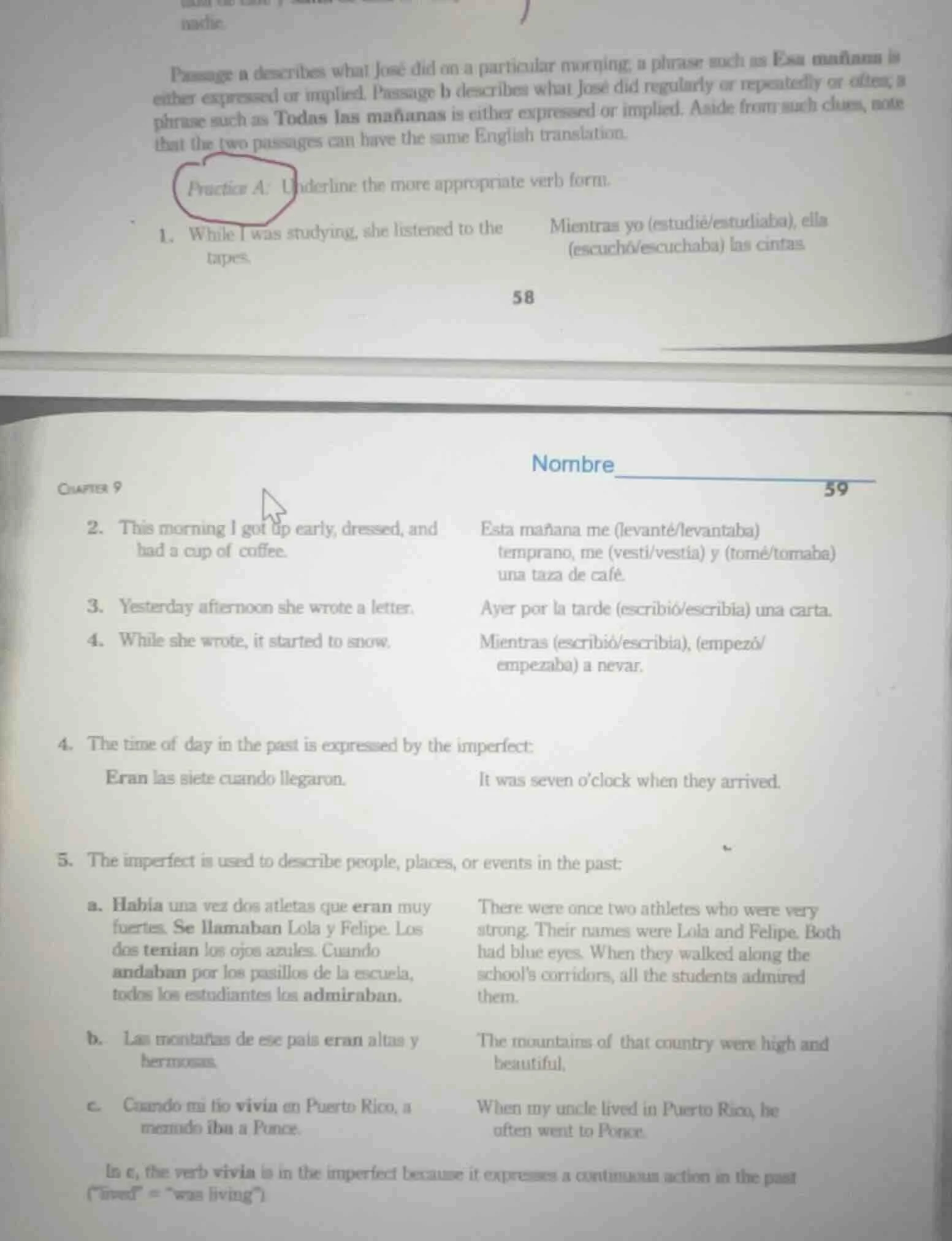
passage a describes what josé did on a particular morning; a phrase such as esta mañana is either expressed or implied. passage b describes what josé did regularly or repeatedly or often; a phrase such as todas las mañanas is either expressed or implied. aside from such clues, note that the two passages can have the same english translation.
practice a: underline the more appropriate verb form.
- while i was studying, she listened to the tapes. mientras yo (estudié/estudiaba), ella (escuchó/escuchaba) las cintas
chapter 9
- this morning i got up early, dressed, and had a cup of coffee. esta mañana me (levanté/levantaba) temprano, me (vestí/vestía) y (tomé/tomaba) una taza de café.
- yesterday afternoon she wrote a letter. ayer por la tarde (escribió/escribía) una carta.
- while she wrote, it started to snow. mientras (escribió/escribía), (empezó/ empezaba) a nevar.
- the time of day in the past is expressed by the imperfect:
eran las siete cuando llegaron. it was seven o’clock when they arrived.
- the imperfect is used to describe people, places, or events in the past:
a. había una vez dos atletas que eran muy fuertes. se llamaban lola y felipe. los dos tenían los ojos azules. cuando andaban por los pasillos de la escuela, todos los estudiantes las admiraban. there were once two athletes who were very strong. their names were lola and felipe. both had blue eyes. when they walked along the school’s corridors, all the students admired them.
b. las montañas de ese país eran altas y hermosas. the mountains of that country were high and beautiful.
c. cuando mi tío vivía en puerto rico, a menudo iba a ponce. when my uncle lived in puerto rico, he often went to ponce.
in c, the verb vivía is in the imperfect because it expresses a continuous action in the past (\lived\ = \was living\).
Question 1
In Spanish, the imperfect tense is used for ongoing actions in the past, and the preterite for completed actions. "While I was studying" (ongoing) uses imperfect estudiaba, and "she listened" (completed) uses preterite escuchó.
"Esta mañana" (this morning) refers to a specific, completed morning, so preterite verbs (levanté, vestí, tomé) are used for the completed actions of getting up, dressing, and having coffee.
"Yesterday afternoon" describes a specific, completed time, so the preterite escribió is used for the completed action of writing a letter.

Snap & solve any problem in the app
Get step-by-step solutions on Sovi AI
Photo-based solutions with guided steps
Explore more problems and detailed explanations
Mientras yo estudiaba, ella escuchó las cintas