QUESTION IMAGE
Question
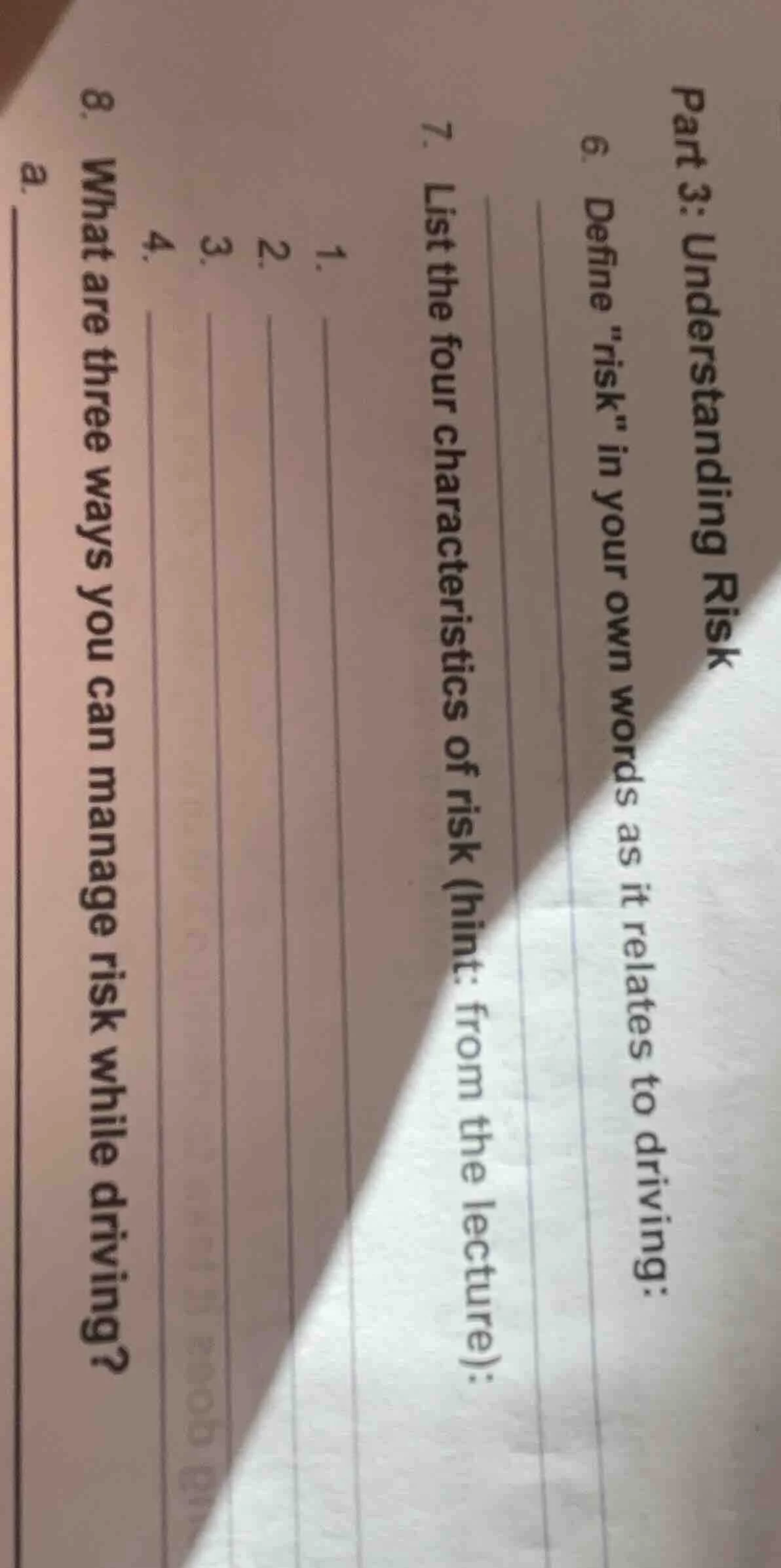
part 3: understanding risk
- define
isk\ in your own words as it relates to driving:
- list the four characteristics of risk (hint: from the lecture):
1.
2.
3.
4.
- what are three ways you can manage risk while driving?
a.
Brief Explanations
For Question 6:
Risk in driving refers to the chance of an unwanted, harmful event (like a crash, injury, or property damage) occurring due to factors like driver behavior, road conditions, or vehicle issues, along with the potential severity of that event.
For Question 7:
The core characteristics of driving risk are:
- Uncertainty: You cannot definitively predict if a harmful event will happen.
- Potential for Harm: It involves the possibility of injury, damage, or loss.
- Exposure: Risk increases with how often you are in driving situations (e.g., frequent driving).
- Probability: It is measured by how likely a dangerous event is to occur.
For Question 8a:
Common methods to manage driving risk include:
- Avoidance: Steer clear of high-risk situations (e.g., not driving in severe rain).
- Reduction: Take actions to lower risk (e.g., slowing down in a school zone).
- Control: Use safe driving habits to manage risk (e.g., wearing a seatbelt, using cruise control appropriately).

Snap & solve any problem in the app
Get step-by-step solutions on Sovi AI
Photo-based solutions with guided steps
Explore more problems and detailed explanations
- Risk in driving is the chance of an unwanted, harmful event (such as a collision, injury, or property damage) occurring while operating a vehicle, stemming from factors like driver error, road hazards, or vehicle malfunctions, paired with the potential severity of that event.
- 1. Uncertainty
- Potential for harm/loss
- Dependence on exposure
- Measurable probability
- a. 1. Avoid high-risk driving situations
- Reduce risk through safe actions
- Control risk with defensive habits