Sovi.AI - AI Math Tutor

Scan to solve math questions

QUESTION IMAGE

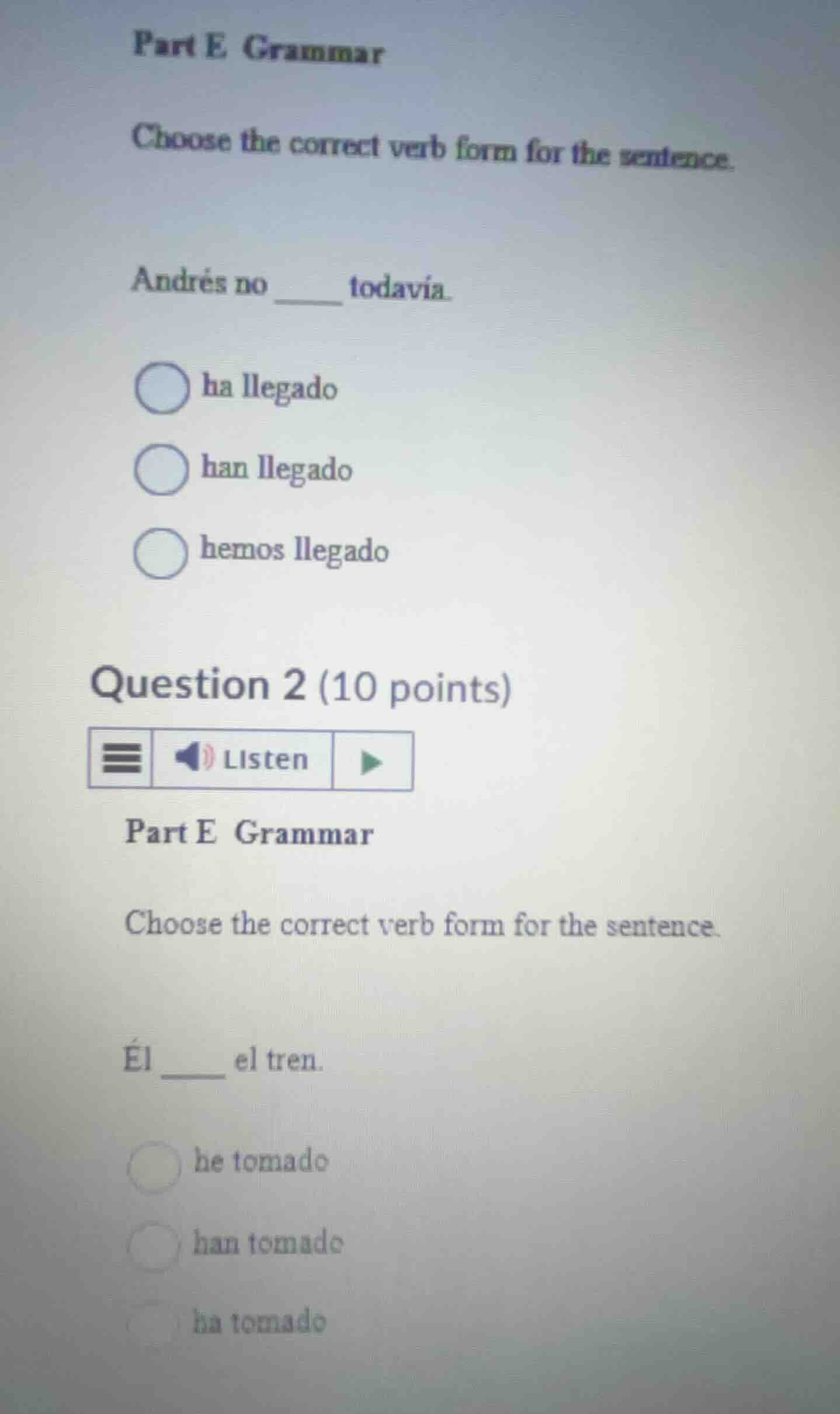
part e grammar choose the correct verb form for the sentence. andrés no…

Question

part e grammar

choose the correct verb form for the sentence.

andrés no ____ todavía.

ha llegado
han llegado
hemos llegado

question 2 (10 points)

part e grammar

choose the correct verb form for the sentence.

él ____ el tren.

he tomado
han tomado
ha tomado

Explanation:

Response

<pre_analysis>
{
"quality": "clear",
"question_count": 2,
"skills_matched": [
"direct_cot",
"multiple_choice_formatter",
"explain_then_answer",
"quick"
],
"needs_drawing": false,
"concepts_used": [
"Spanish Verb Conjugation",
"Spanish Subject Verb Agreement"
],
"new_concepts": [
"Spanish Present Perfect"
],
"current_concepts": [
"Spanish Verb Conjugation",
"Spanish Subject Verb Agreement",
"Spanish Present Perfect"
]
}
</pre_analysis>

<reasoning>

Analyze the subject and verb agreement for the first sentence

The subject is "Andrés" (third-person singular, "él"). The present perfect conjugation of "haber" for "él" is "ha". Therefore, the correct verb form is "ha llegado".

Analyze the subject and verb agreement for the second sentence

The subject is "Él" (third-person singular). The present perfect conjugation of "haber" for "él" is "ha". Therefore, the correct verb form is "ha tomado".
</reasoning>

<answer>

Question 1

<mcq-correct>ha llegado</mcq-correct>
<mcq-option>han llegado</mcq-option>
<mcq-option>hemos llegado</mcq-option>

Question 2

<mcq-option>he tomado</mcq-option>
<mcq-option>han tomado</mcq-option>
<mcq-correct>ha tomado</mcq-correct>
</answer>

<post_analysis>
{
"subject": "Others",
"question_type": "Multiple Choice",
"knowledge_point": [
"Others",
"Spanish",
"Spanish Present Perfect"
]
}
</post_analysis>

Answer:

<pre_analysis>
{
"quality": "clear",
"question_count": 2,
"skills_matched": [
"direct_cot",
"multiple_choice_formatter",
"explain_then_answer",
"quick"
],
"needs_drawing": false,
"concepts_used": [
"Spanish Verb Conjugation",
"Spanish Subject Verb Agreement"
],
"new_concepts": [
"Spanish Present Perfect"
],
"current_concepts": [
"Spanish Verb Conjugation",
"Spanish Subject Verb Agreement",
"Spanish Present Perfect"
]
}
</pre_analysis>

<reasoning>

Analyze the subject and verb agreement for the first sentence

The subject is "Andrés" (third-person singular, "él"). The present perfect conjugation of "haber" for "él" is "ha". Therefore, the correct verb form is "ha llegado".

Analyze the subject and verb agreement for the second sentence

The subject is "Él" (third-person singular). The present perfect conjugation of "haber" for "él" is "ha". Therefore, the correct verb form is "ha tomado".
</reasoning>

<answer>

Question 1

<mcq-correct>ha llegado</mcq-correct>
<mcq-option>han llegado</mcq-option>
<mcq-option>hemos llegado</mcq-option>

Question 2

<mcq-option>he tomado</mcq-option>
<mcq-option>han tomado</mcq-option>
<mcq-correct>ha tomado</mcq-correct>
</answer>

<post_analysis>
{
"subject": "Others",
"question_type": "Multiple Choice",
"knowledge_point": [
"Others",
"Spanish",
"Spanish Present Perfect"
]
}
</post_analysis>