QUESTION IMAGE
Question
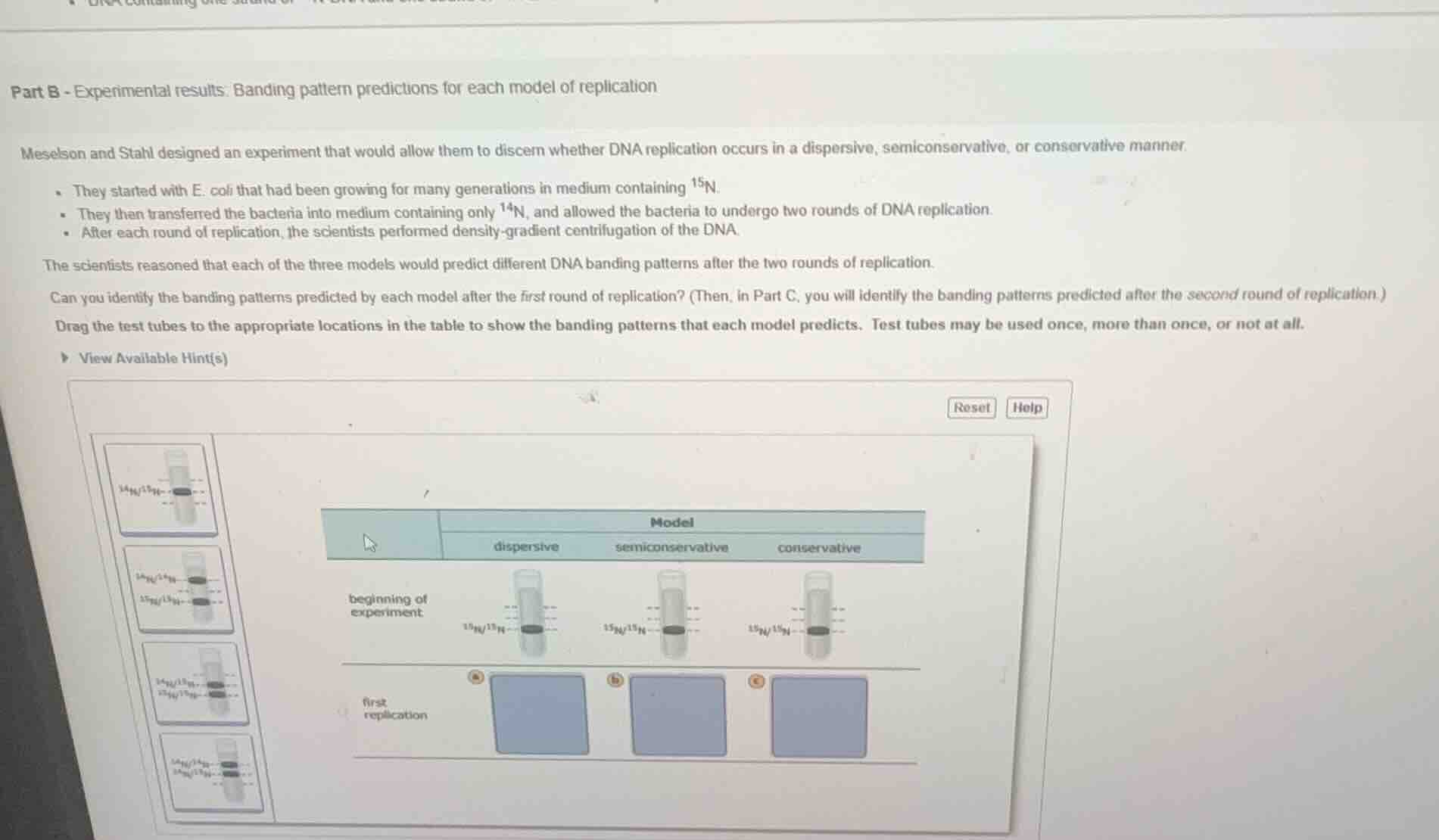
part b - experimental results: banding pattern predictions for each model of replication
meselson and stahl designed an experiment that would allow them to discern whether dna replication occurs in a dispersive, semiconservative, or conservative manner.
- they started with e. coli that had been growing for many generations in medium containing \\(^{15}\text{n}\\).
- they then transferred the bacteria into medium containing only \\(^{14}\text{n}\\), and allowed the bacteria to undergo two rounds of dna replication.
- after each round of replication, the scientists performed density-gradient centrifugation of the dna.
the scientists reasoned that each of the three models would predict different dna banding patterns after the two rounds of replication.
can you identify the banding patterns predicted by each model after the first round of replication? (then, in part c, you will identify the banding patterns predicted after the second round of replication.)
drag the test tubes to the appropriate locations in the table to show the banding patterns that each model predicts. test tubes may be used once, more than once, or not at all.
Analyze the experimental setup
Using the Meselson-Stahl Experiment and DNA Density Labeling knowledge points
- E. coli starts in a heavy \(^{15}\text{N}\) medium, so all parental DNA is heavy (\(^{15}\text{N}/^{15}\text{N}\)), forming a single band at the bottom of the tube.
- The bacteria are transferred to a light \(^{14}\text{N}\) medium for replication.
Predict the dispersive model pattern
Using the Meselson-Stahl Experiment knowledge point
- In the dispersive model, every individual strand of the replicated DNA contains alternating segments of parental (\(^{15}\text{N}\)) and newly synthesized (\(^{14}\text{N}\)) DNA.
- After one round of replication, all DNA molecules are hybrid, containing exactly \(50\%\) \(^{15}\text{N}\) and \(50\%\) \(^{14}\text{N}\).
- This results in a single intermediate density band (\(^{14}\text{N}/^{15}\text{N}\)) in the middle of the tube.
Predict the semiconservative model pattern
Using the Meselson-Stahl Experiment knowledge point
- In the semiconservative model, each replicated DNA molecule consists of one original parental strand (\(^{15}\text{N}\)) and one newly synthesized strand (\(^{14}\text{N}\)).
- After one round of replication, all DNA molecules are hybrid (\(^{14}\text{N}/^{15}\text{N}\)).
- This results in a single intermediate density band (\(^{14}\text{N}/^{15}\text{N}\)) in the middle of the tube.
Predict the conservative model pattern
Using the Meselson-Stahl Experiment knowledge point
- In the conservative model, the original parental double helix (\(^{15}\text{N}/^{15}\text{N}\)) is completely conserved, and an entirely new double helix (\(^{14}\text{N}/^{14}\text{N}\)) is synthesized.
- After one round of replication, \(50\%\) of the DNA is fully heavy (\(^{15}\text{N}/^{15}\text{N}\)) and \(50\%\) is fully light (\(^{14}\text{N}/^{14}\text{N}\)).
- This results in two distinct bands: one light band at the top and one heavy band at the bottom.
Match the test tube images to the targets
Using the Density-Gradient Centrifugation knowledge point
- Target (a) - Dispersive: Single intermediate band in the middle (\(^{14}\text{N}/^{15}\text{N}\)).
- Target (b) - Semiconservative: Single intermediate band in the middle (\(^{14}\text{N}/^{15}\text{N}\)).
- Target (c) - Conservative: Two bands, one light (\(^{14}\text{N}/^{14}\text{N}\)) at the top and one heavy (\(^{15}\text{N}/^{15}\text{N}\)) at the bottom.

Snap & solve any problem in the app
Get step-by-step solutions on Sovi AI
Photo-based solutions with guided steps
Explore more problems and detailed explanations
- (a) dispersive: Test tube with a single hybrid band in the middle (\(^{14}\text{N}/^{15}\text{N}\))
- (b) semiconservative: Test tube with a single hybrid band in the middle (\(^{14}\text{N}/^{15}\text{N}\))
- (c) conservative: Test tube with two bands, one light (\(^{14}\text{N}/^{14}\text{N}\)) near the top and one heavy (\(^{15}\text{N}/^{15}\text{N}\)) near the bottom