QUESTION IMAGE
Question
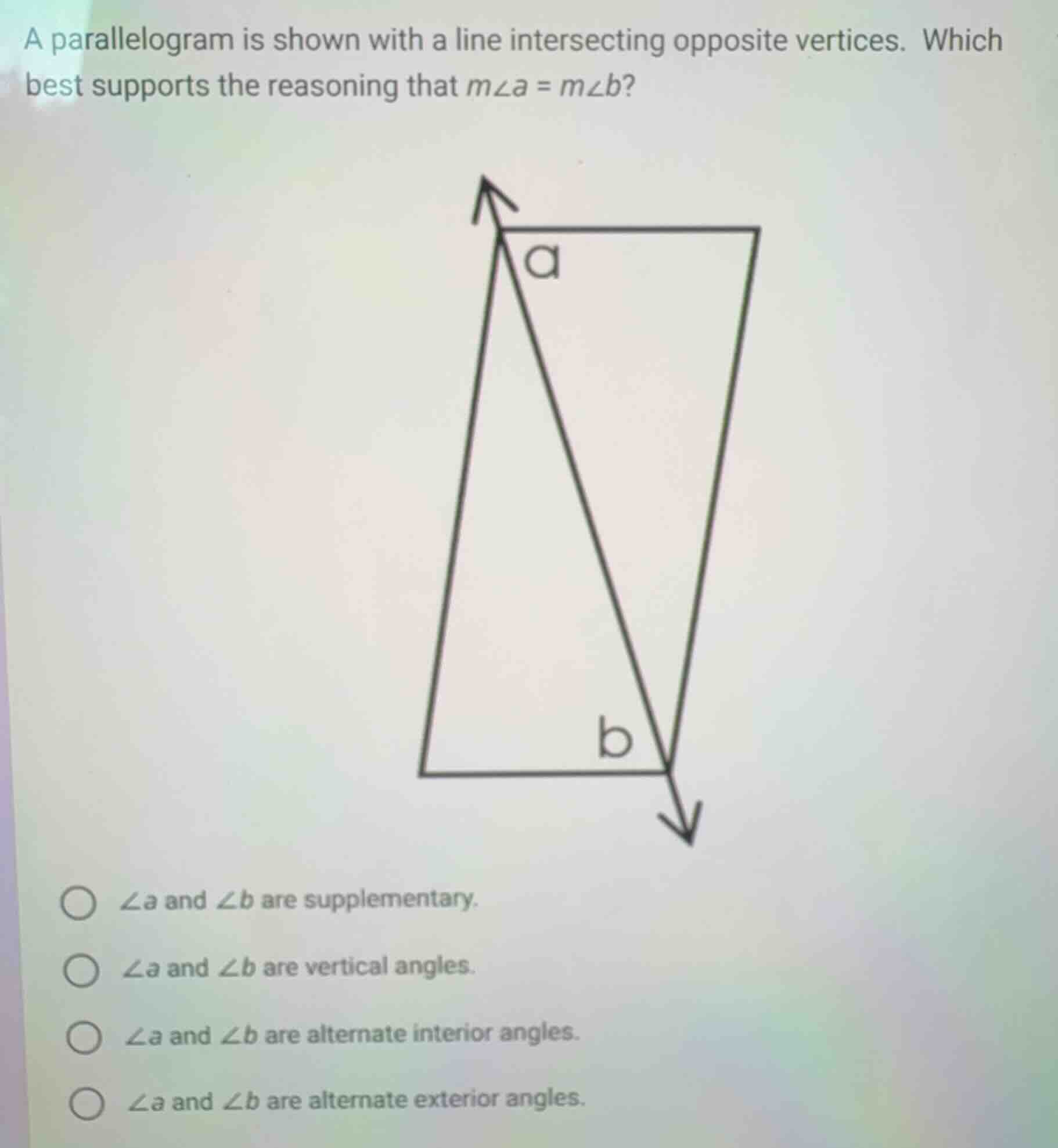
a parallelogram is shown with a line intersecting opposite vertices. which best supports the reasoning that \\(m\angle a = m\angle b\\)?
\\(\bigcirc\\) \\(\angle a\\) and \\(\angle b\\) are supplementary.
\\(\bigcirc\\) \\(\angle a\\) and \\(\angle b\\) are vertical angles.
\\(\bigcirc\\) \\(\angle a\\) and \\(\angle b\\) are alternate interior angles.
\\(\bigcirc\\) \\(\angle a\\) and \\(\angle b\\) are alternate exterior angles.
Identify parallel lines and the transversal
Using the Parallel Lines Cut by a Transversal knowledge point
$$
LATEXBLOCK0
$$
Classify the angle relationship
Using the Alternate Interior Angles knowledge point
$$
LATEXBLOCK1
$$
Evaluate the given options
- Supplementary angles sum to \(180^\circ\), which is not the primary reason they are equal here.
- Vertical angles are opposite each other at a single intersection, which does not apply to these two different vertices.
- Alternate interior angles are equal when lines are parallel, which perfectly supports \(m\angle a = m\angle b\).
- Alternate exterior angles lie on the outside of the parallel lines, which is incorrect.

Snap & solve any problem in the app
Get step-by-step solutions on Sovi AI
Photo-based solutions with guided steps
Explore more problems and detailed explanations
- \(\angle a\) and \(\angle b\) are supplementary.
- \(\angle a\) and \(\angle b\) are vertical angles.
- \(\angle a\) and \(\angle b\) are alternate interior angles. (Correct answer)
- \(\angle a\) and \(\angle b\) are alternate exterior angles.