QUESTION IMAGE
Question
page 46
2.3. describe the principles of governance and the powers of the national government defined by the constitution.
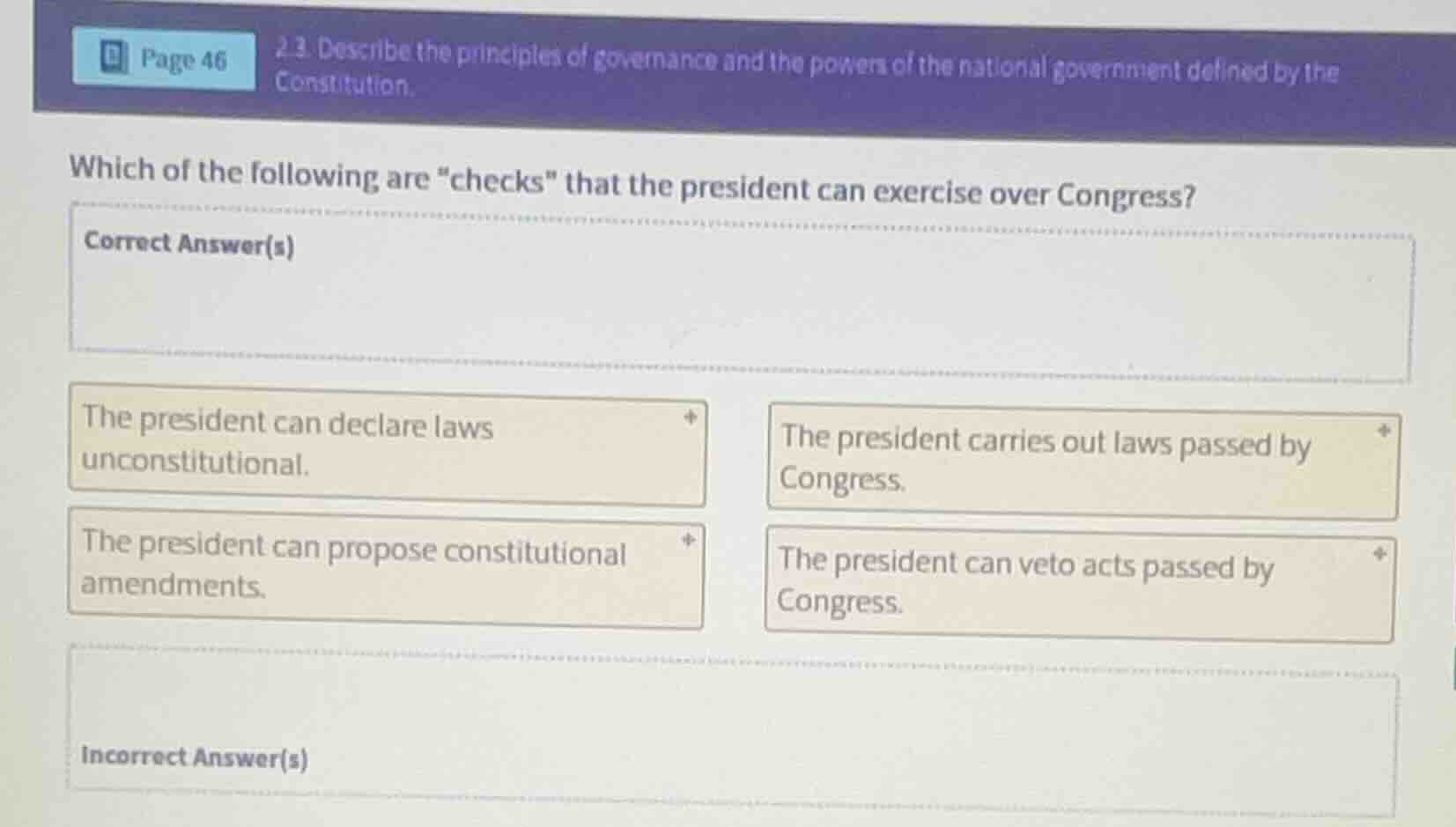
which of the following are \checks\ that the president can exercise over congress?
correct answer(s)
the president can declare laws unconstitutional.
the president carries out laws passed by congress.
the president can propose constitutional amendments.
the president can veto acts passed by congress.
incorrect answer(s)
Analyze the definition of a constitutional check
A "check" is a specific constitutional power that allows one branch of government to limit, block, or influence the actions of another branch.
Evaluate each option against presidential checks on Congress
- The president can declare laws unconstitutional: This is a power of judicial review, which belongs to the judicial branch (the Supreme Court), not the president.
- The president can propose constitutional amendments: Amendments are proposed by a two-thirds vote in both houses of Congress or by a constitutional convention, not by the president.
- The president carries out laws passed by Congress: This is an inherent executive duty (enforcement of law), not a "check" designed to limit or block legislative power.
- The president can veto acts passed by Congress: This is a direct constitutional mechanism enabling the executive branch to block legislation passed by Congress.

Snap & solve any problem in the app
Get step-by-step solutions on Sovi AI
Photo-based solutions with guided steps
Explore more problems and detailed explanations
- The president can declare laws unconstitutional.
- The president can propose constitutional amendments.
- The president carries out laws passed by Congress.
- The president can veto acts passed by Congress. (Correct answer)