QUESTION IMAGE
Question
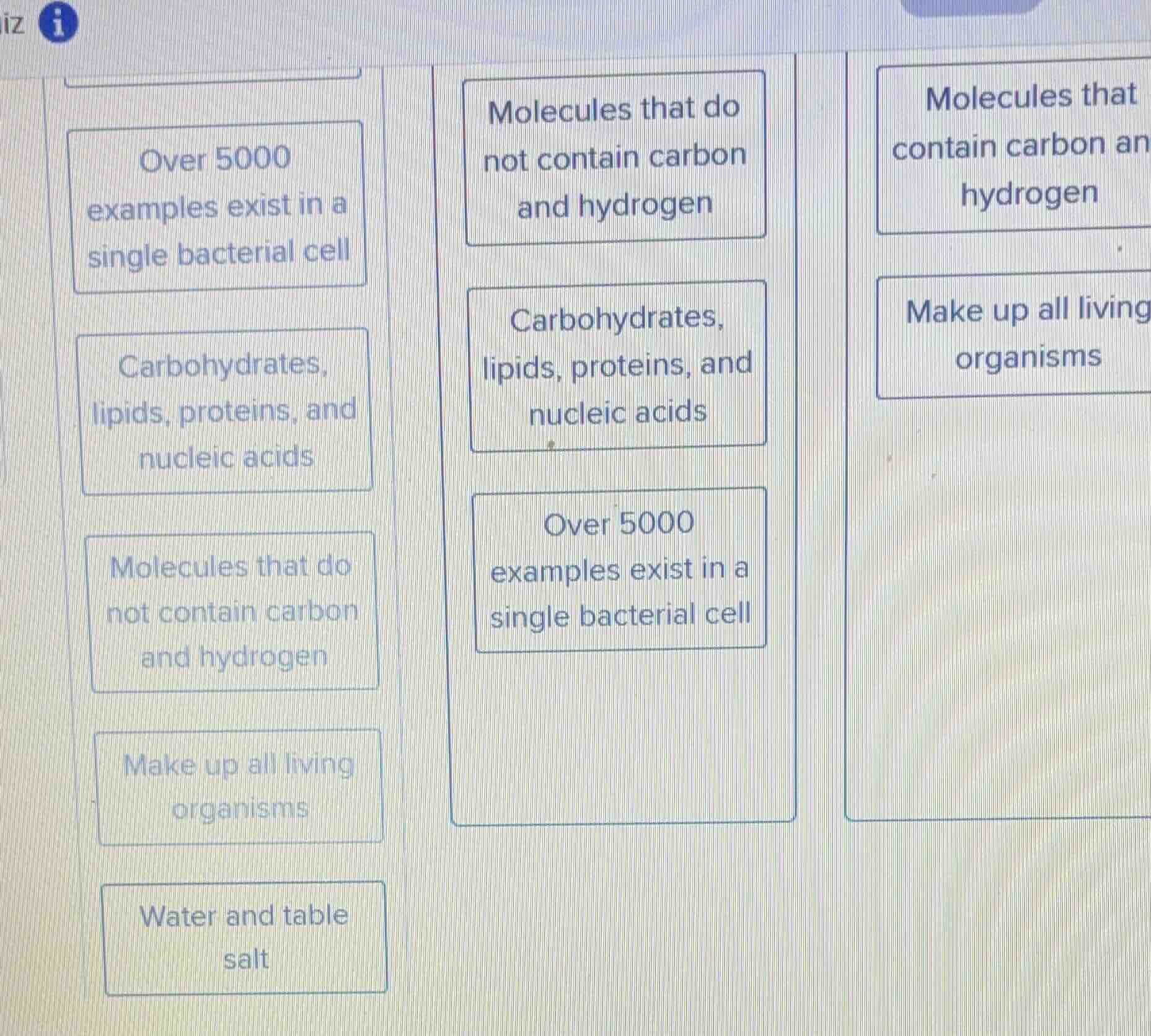
over 5000 examples exist in a single bacterial cell
carbohydrates, lipids, proteins, and nucleic acids
molecules that do not contain carbon and hydrogen
make up all living organisms
water and table salt
molecules that do not contain carbon and hydrogen
carbohydrates, lipids, proteins, and nucleic acids
over 5000 examples exist in a single bacterial cell
molecules that contain carbon and hydrogen
make up all living organisms
Identify the categories
The image shows a drag-and-drop classification activity. Based on the visible text fragments, the two main target categories (columns) are:
- Inorganic Molecules (middle column, based on the description "Molecules that do not contain carbon and hydrogen")
- Organic Molecules (right column, based on the description "Molecules that contain carbon and hydrogen")
Classify inorganic characteristics
Using the Inorganic Molecules knowledge point:
- Definition: "Molecules that do not contain carbon and hydrogen"
- Examples: "Water and table salt"
Classify organic characteristics
Using the Organic Molecules knowledge point:
- Definition: "Molecules that contain carbon and hydrogen"
- Examples: "Carbohydrates, lipids, proteins, and nucleic acids"
- Abundance: "Over 5000 examples exist in a single bacterial cell"
- Role: "Make up all living organisms"

Snap & solve any problem in the app
Get step-by-step solutions on Sovi AI
Photo-based solutions with guided steps
Explore more problems and detailed explanations
Based on the characteristics of organic and inorganic molecules, the items should be classified into the two columns as follows:
Inorganic Molecules
- Molecules that do not contain carbon and hydrogen
- Water and table salt
Organic Molecules
- Molecules that contain carbon and hydrogen
- Carbohydrates, lipids, proteins, and nucleic acids
- Over 5000 examples exist in a single bacterial cell
- Make up all living organisms