QUESTION IMAGE
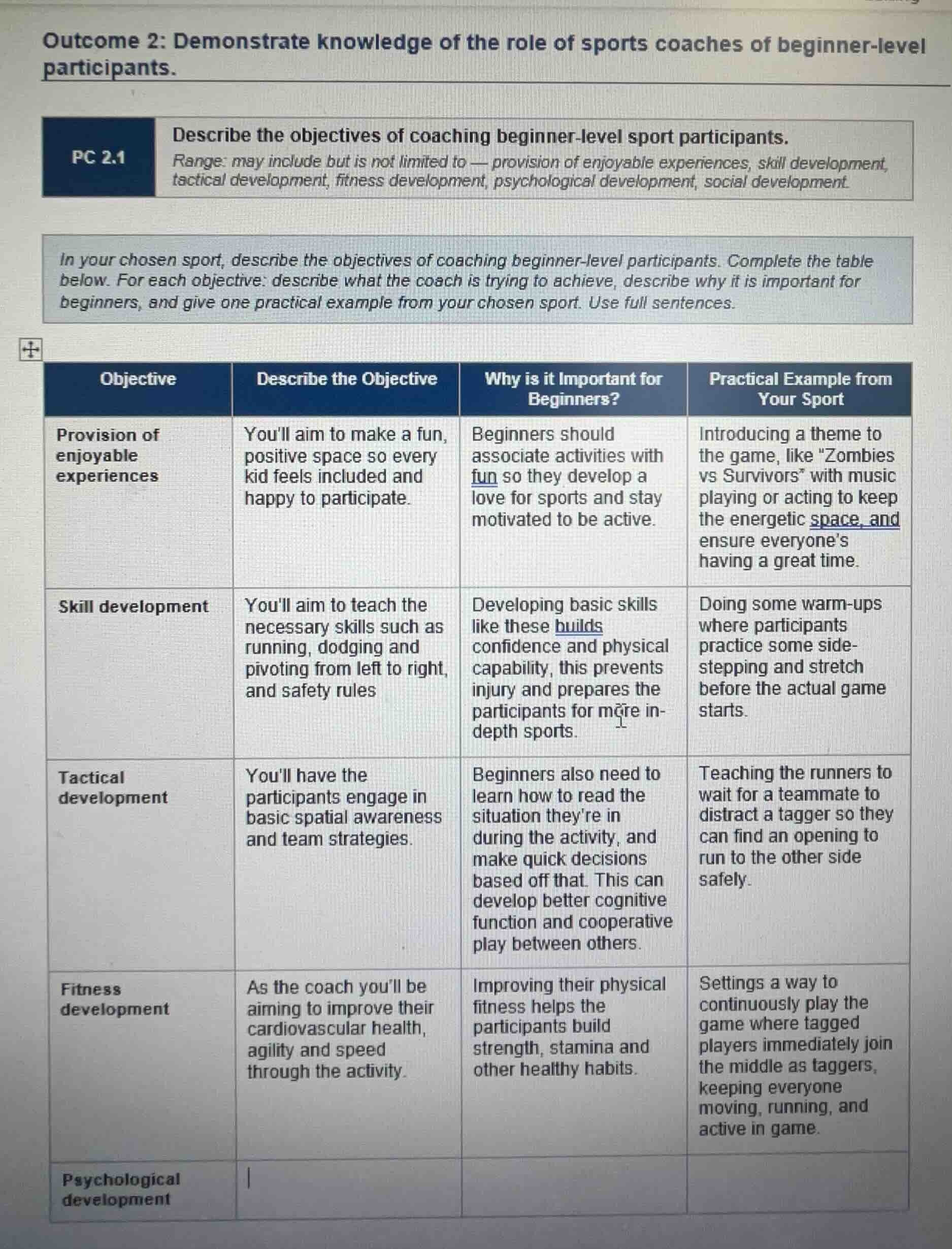
Question
outcome 2: demonstrate knowledge of the role of sports coaches of beginner-level participants.
pc 2.1 describe the objectives of coaching beginner-level sport participants.
range: may include but is not limited to - provision of enjoyable experiences, skill development, tactical development, fitness development, psychological development, social development.
in your chosen sport, describe the objectives of coaching beginner-level participants. complete the table below. for each objective: describe what the coach is trying to achieve, describe why it is important for beginners, and give one practical example from your chosen sport. use full sentences.
| objective | describe the objective | why is it important for beginners? | practical example from your sport |
|---|---|---|---|
| skill development | youll aim to teach the necessary skills such as running, dodging and pivoting from left to right, and safety rules | developing basic skills like these builds confidence and physical capability, this prevents injury and prepares the participants for more in-depth sports. | doing some warm-ups where participants practice some side-stepping and stretch before the actual game starts. |
| tactical development | youll have the participants engage in basic spatial awareness and team strategies. | beginners also need to learn how to read the situation theyre in during the activity, and make quick decisions based off that. this can develop better cognitive function and cooperative play between others. | teaching the runners to wait for a teammate to distract a tagger so they can find an opening to run to the other side safely. |
| fitness development | as the coach youll be aiming to improve their cardiovascular health, agility and speed through the activity. | improving their physical fitness helps the participants build strength, stamina and other healthy habits. | settings a way to continuously play the game where tagged players immediately join the middle as taggers, keeping everyone moving, running, and active in game. |
| psychological development |
Identify the target objective
The task requires completing the final row of the table for the objective Psychological development in the context of coaching beginner-level sport participants (using the sport of tag/active games established in the previous rows).
Describe the objective
For psychological development, a coach aims to build mental resilience, self-esteem, and emotional regulation. In beginner sports, this means helping participants build confidence, manage mistakes positively, and develop a growth mindset.
Explain why it is important
Beginners often face fear of failure, performance anxiety, or frustration when learning new skills. Developing psychological strength helps them overcome these barriers, build self-confidence, and maintain a positive attitude toward physical activity.
Provide a practical example
In a tag game, a practical example is encouraging players who get tagged to view it as a normal part of the game rather than a failure, or praising effort and sportsmanship (like high-fiving the tagger) to build emotional control and positive reinforcement.

Snap & solve any problem in the app
Get step-by-step solutions on Sovi AI
Photo-based solutions with guided steps
Explore more problems and detailed explanations
| Objective | Describe the Objective | Why is it Important for Beginners? | Practical Example from Your Sport |
|---|