QUESTION IMAGE
Question
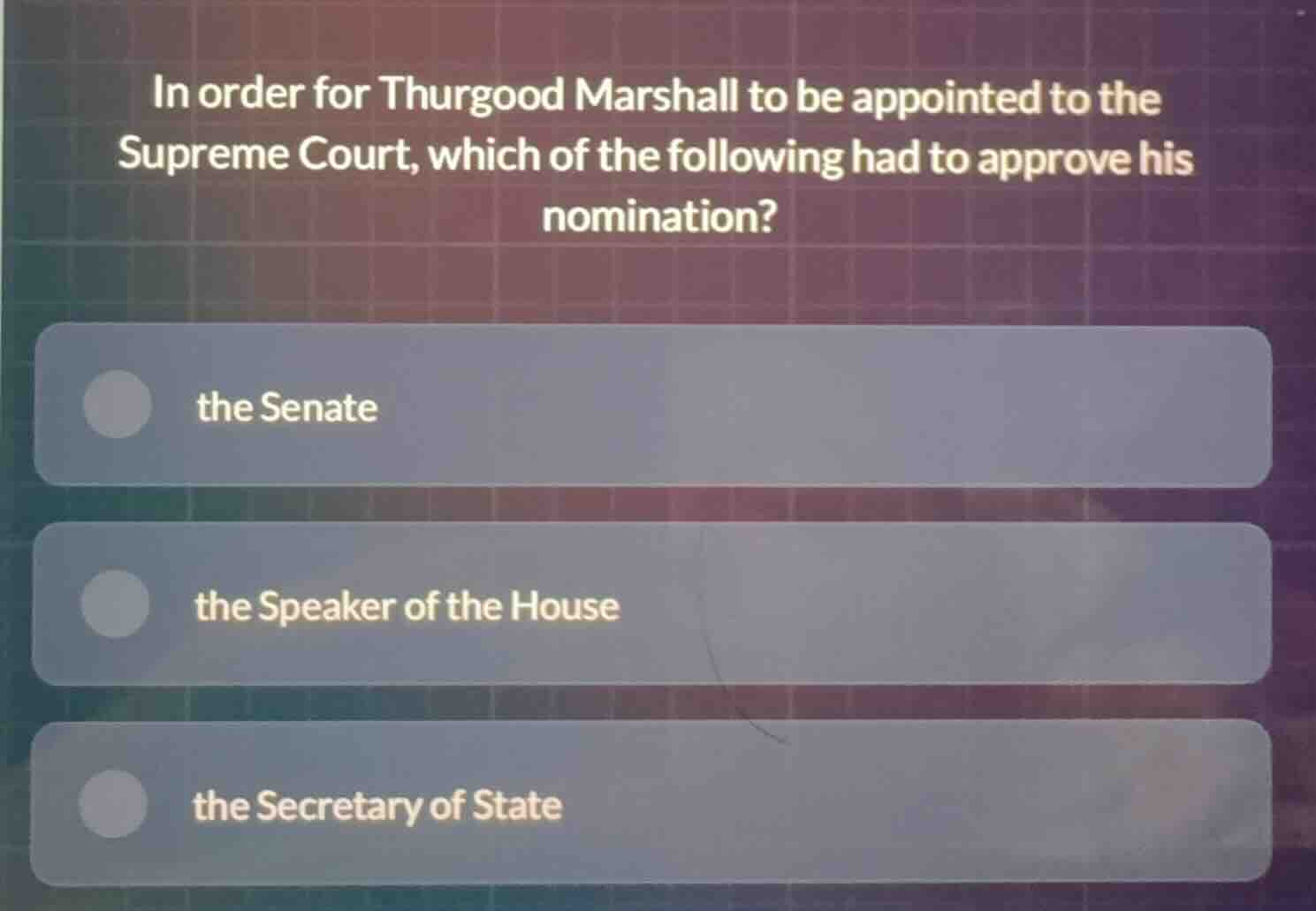
in order for thurgood marshall to be appointed to the supreme court, which of the following had to approve his nomination?
the senate
the speaker of the house
the secretary of state
🆕 New Concept Discovered: Constitutional Confirmation Process
How federal appointments are approved
Step 1: Identify the constitutional rule for Supreme Court appointments
Under Article II, Section 2, Clause 2 of the United States Constitution (known as the Appointments Clause), the President has the power to nominate Supreme Court Justices. However, these nominations only take effect with the "Advice and Consent" of a specific legislative body.
Step 2: Determine which body holds the power of advice and consent
The Constitution grants the power to confirm or reject presidential nominees exclusively to the Senate. Neither the House of Representatives (led by the Speaker of the House) nor executive cabinet members (like the Secretary of State) have a role in voting to confirm Supreme Court nominees.
Step 3: Apply the rule to Thurgood Marshall's nomination
When President Lyndon B. Johnson nominated Thurgood Marshall to the Supreme Court in 1967, the nomination had to be sent to the Senate. Following hearings by the Senate Judiciary Committee, the full Senate voted to confirm his appointment.

Snap & solve any problem in the app
Get step-by-step solutions on Sovi AI
Photo-based solutions with guided steps
Explore more problems and detailed explanations
the Senate