QUESTION IMAGE
Question
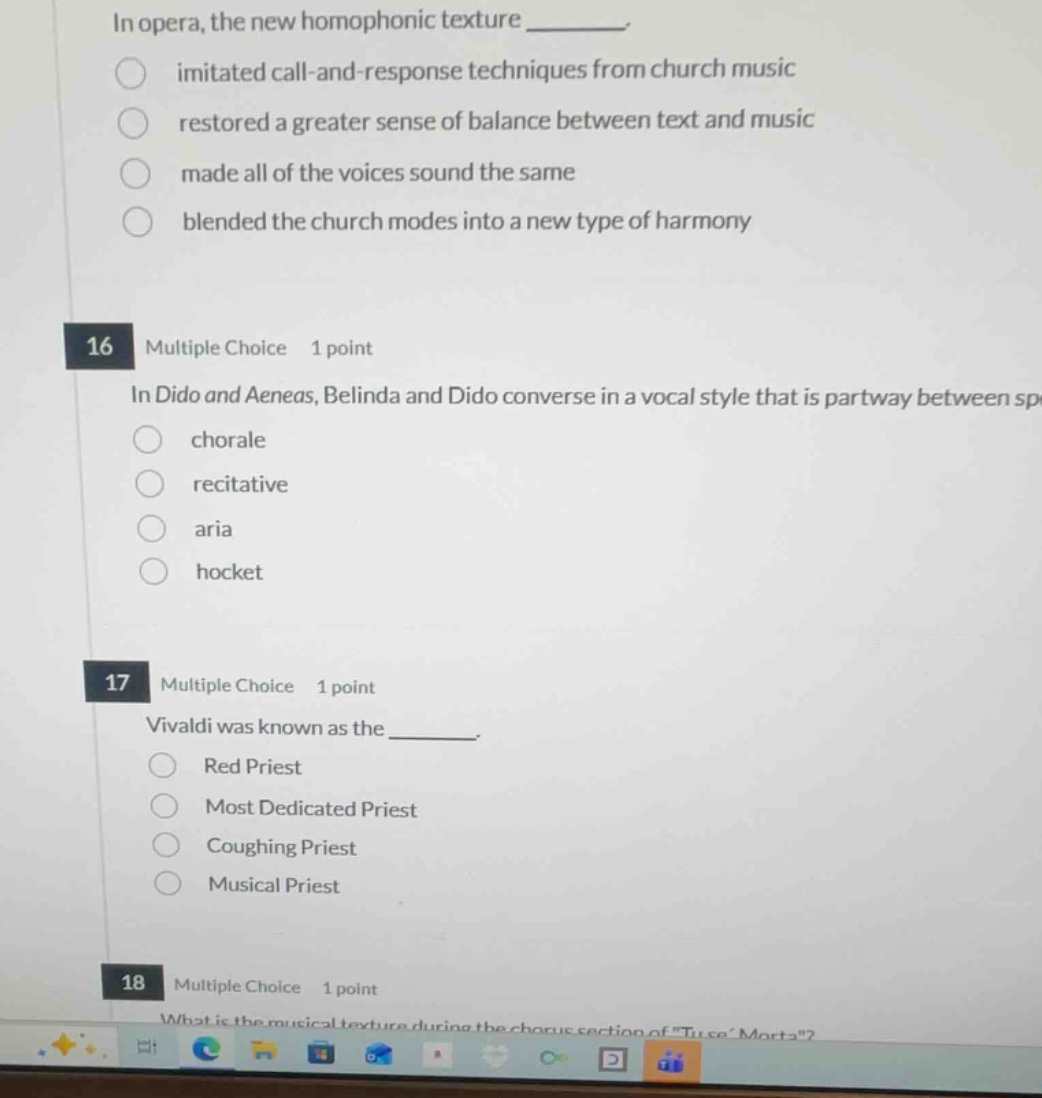
in opera, the new homophonic texture ______.
- imitated call-and-response techniques from church music
- restored a greater sense of balance between text and music
- made all of the voices sound the same
- blended the church modes into a new type of harmony
16 multiple choice 1 point
in dido and aeneas, belinda and dido converse in a vocal style that is partway between speech and song:
- chorale
- recitative
- aria
- hocket
17 multiple choice 1 point
vivaldi was known as the ______.
- red priest
- most dedicated priest
- coughing priest
- musical priest
18 multiple choice 1 point
what is the musical texture during the chorus section of \tu se morta\?
Analyze the first question on homophonic texture in early opera
The first question asks about the purpose or effect of the new homophonic texture in early opera. Early opera composers (such as the Florentine Camerata) rejected complex Renaissance polyphony because it obscured the lyrics. They introduced monody/homophony to ensure that the text could be clearly understood, thereby restoring a greater sense of balance and emotional expression between the text and the music.
Analyze Question 16 on vocal style in Dido and Aeneas
Question 16 asks about the vocal style that is partway between speech and song used by Belinda and Dido to converse. This style is known as Recitative Style, which mimics the natural inflections of speech.
Analyze Question 17 on Vivaldi's nickname
Question 17 asks for Antonio Vivaldi's famous nickname. Vivaldi was ordained as a priest and had red hair, leading to his well-known moniker, the "Red Priest" (il Prete Rosso), which is a key detail in Vivaldi Biography.
Analyze Question 18 on the musical texture of "Tu se' morta"
Question 18 is partially cut off at the bottom, but the visible text asks: "What is the musical texture during the chorus section of 'Tu se' morta'?" (from Monteverdi's L'Orfeo). The chorus sections in early Baroque operas like L'Orfeo typically comment on the action using homophonic or polyphonic choral textures. Specifically, the chorus "Ahi caso acerbo" that follows "Tu se' morta" is primarily written in a expressive, homophonic texture to make the collective grief of the shepherds and nymphs clearly understood.

Snap & solve any problem in the app
Get step-by-step solutions on Sovi AI
Photo-based solutions with guided steps
Explore more problems and detailed explanations
Question 15
In opera, the new homophonic texture __________.
- imitated call-and-response techniques from church music
- restored a greater sense of balance between text and music (Correct answer)
- made all of the voices sound the same
- blended the church modes into a new type of harmony
Question 16
In Dido and Aeneas, Belinda and Dido converse in a vocal style that is partway between speech and song:
- chorale
- recitative (Correct answer)
- aria
- hocket
Question 17
Vivaldi was known as the __________.
- Red Priest (Correct answer)
- Most Dedicated Priest
- Coughing Priest
- Musical Priest
Question 18
What is the musical texture during the chorus section of "Tu se' morta"?
- homophonic (Correct answer)
- polyphonic
- monophonic
- heterophonic