QUESTION IMAGE
Question
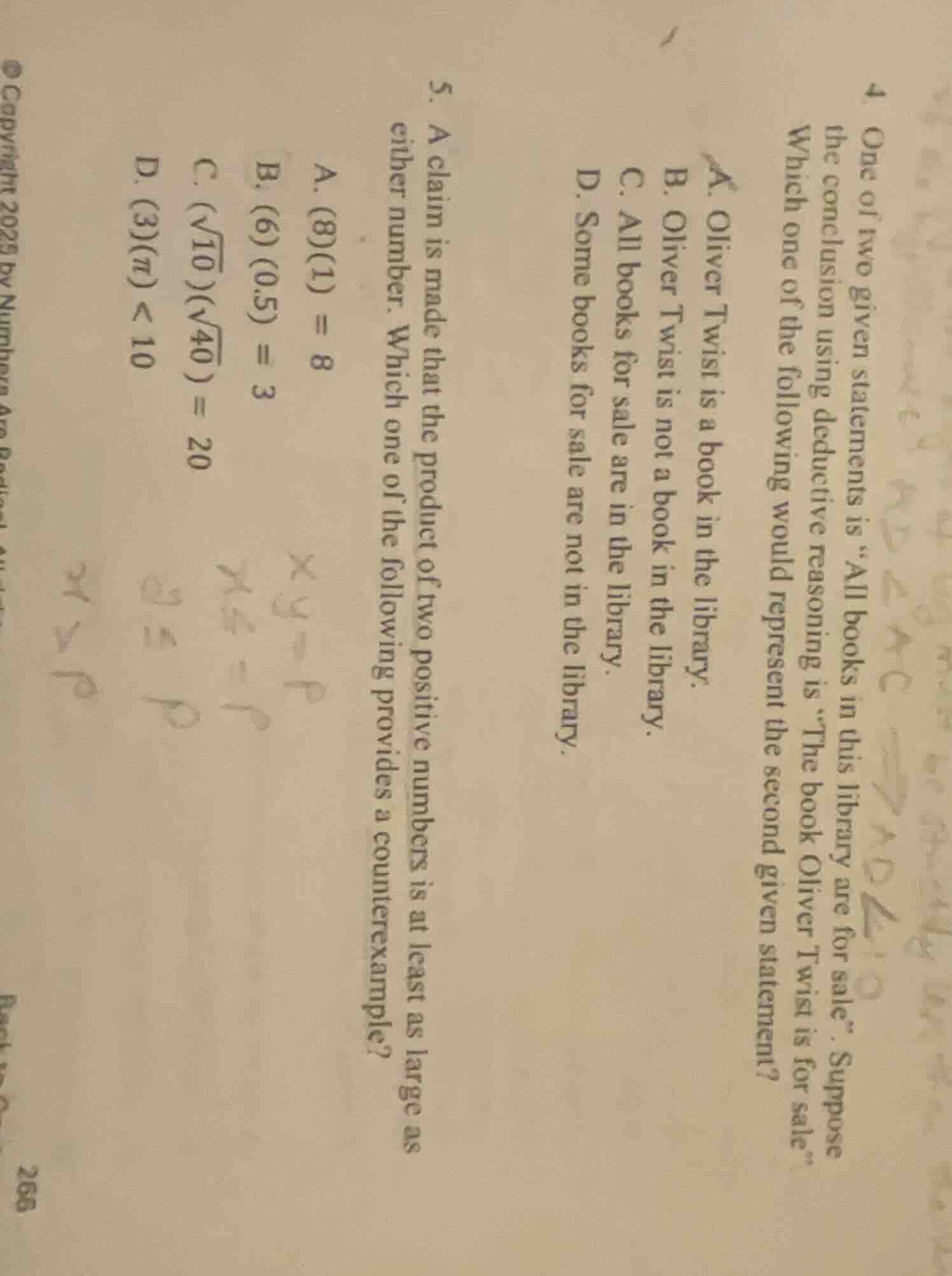
- one of two given statements is \all books in this library are for sale\. suppose the conclusion using deductive reasoning is \the book oliver twist is for sale\. which one of the following would represent the second given statement?
a. oliver twist is a book in the library.
b. oliver twist is not a book in the library.
c. all books for sale are in the library.
d. some books for sale are not in the library.
- a claim is made that the product of two positive numbers is at least as large as either number. which one of the following provides a counterexample?
a. (8)(1) = 8
b. (6)(0.5) = 3
c. (\sqrt{10})(\sqrt{40}) = 20
d. (3)(\pi) < 10
⚡ Using what you learned: Inductive and Deductive Reasoning · Conjectures and Counterexamples
Step 1: Analyze Question 4
We are given:
- Statement 1 (Premise): "All books in this library are for sale."
- Conclusion: "The book Oliver Twist is for sale."
For this conclusion to be logically valid using deductive reasoning (specifically a syllogism), the second premise must connect the subject of the conclusion (Oliver Twist) to the condition of the first premise (being in this library).
The logical structure is:
- If a book is in this library, then it is for sale. (\(P
ightarrow Q\))
- Oliver Twist is a book in this library. (\(P\))
- Therefore, Oliver Twist is for sale. (\(Q\))
Thus, the second statement must be: "Oliver Twist is a book in the library." (Option A)
Step 2: Analyze Question 5
The claim is: "The product of two positive numbers is at least as large as either number."
Mathematically, for two positive numbers \(x\) and \(y\), the claim states:
A counterexample must show two positive numbers whose product is strictly less than at least one of the original numbers:
Let's evaluate the options:
- A. \((8)(1) = 8\). Here, \(8 \ge 8\) and \(8 \ge 1\). This supports the claim.
- B. \((6)(0.5) = 3\). Here, the product \(3\) is less than one of the original numbers (\(3 < 6\)). This disproves the claim.
- C. \((\sqrt{10})(\sqrt{40}) = \sqrt{400} = 20\). Here, \(20 \ge \sqrt{10}\) and \(20 \ge \sqrt{40}\). This supports the claim.
- D. \((3)(\pi) < 10\). This is an inequality statement, not a direct counterexample showing a product violating the rule.
Thus, option B provides the counterexample.

Snap & solve any problem in the app
Get step-by-step solutions on Sovi AI
Photo-based solutions with guided steps
Explore more problems and detailed explanations
Question 4: A (Oliver Twist is a book in the library.)
Question 5: B (\((6)(0.5) = 3\))