QUESTION IMAGE
Question
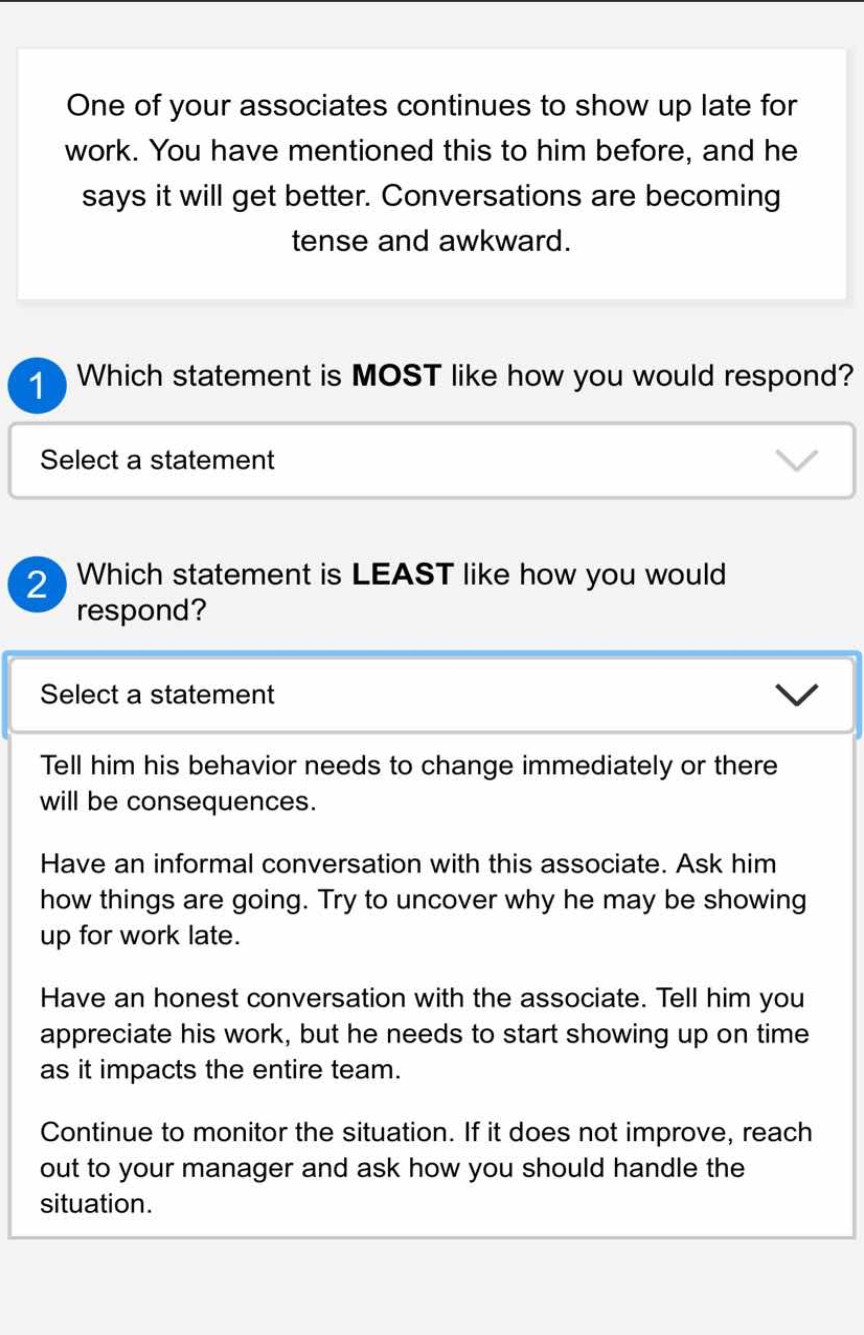
one of your associates continues to show up late for work. you have mentioned this to him before, and he says it will get better. conversations are becoming tense and awkward.
1 which statement is most like how you would respond?
select a statement
2 which statement is least like how you would respond?
select a statement
tell him his behavior needs to change immediately or there will be consequences.
have an informal conversation with this associate. ask him how things are going. try to uncover why he may be showing up for work late.
have an honest conversation with the associate. tell him you appreciate his work, but he needs to start showing up on time as it impacts the entire team.
continue to monitor the situation. if it does not improve, reach out to your manager and ask how you should handle the situation.
Analyze the scenario and options
Using the SJT Best Practices knowledge point, we evaluate the scenario: an associate is repeatedly late, previous reminders haven't worked, and conversations are becoming tense. We need to find the MOST effective (supportive yet accountable) and LEAST effective (passive or overly aggressive) responses.
The options are:
- "Tell him his behavior needs to change immediately or there will be consequences." (Aggressive, escalates tension)
- "Have an informal conversation with this associate. Ask him how things are going. Try to uncover why he may be showing up for work late." (Collaborative, seeks root cause)
- "Have an honest conversation with the associate. Tell him you appreciate his work, but he needs to start showing up on time as it impacts the entire team." (Balanced, constructive, sets clear expectations)
- "Continue to monitor the situation. If it does not improve, reach out to your manager and ask how you should handle the situation." (Passive, avoids taking leadership responsibility)
Determine the MOST effective response
Using the Constructive Feedback and Supportive Leadership knowledge points:
- Option 3 balances positive reinforcement ("appreciate his work") with clear, objective feedback regarding the impact of his lateness on the team. This directly addresses the performance issue while maintaining a supportive relationship, making it the MOST effective response.
- Option 2 is also positive but does not address the impact or set firm expectations as clearly as Option 3 given that previous informal reminders have already failed.
Determine the LEAST effective response
Using the Performance Management knowledge point:
- Option 4 represents passive avoidance. Monitoring a known, ongoing issue without taking direct action and immediately passing the responsibility to a manager demonstrates a lack of leadership initiative. Therefore, this is the LEAST effective response.
- Option 1 is harsh but at least addresses the issue directly, making it less passive than Option 4.

Snap & solve any problem in the app
Get step-by-step solutions on Sovi AI
Photo-based solutions with guided steps
Explore more problems and detailed explanations
Question 1
- (A) Tell him his behavior needs to change immediately or there will be consequences.
- (B) Have an informal conversation with this associate. Ask him how things are going. Try to uncover why he may be showing up for work late.
- (C) Have an honest conversation with the associate. Tell him you appreciate his work, but he needs to start showing up on time as it impacts the entire team. (Correct answer)
- (D) Continue to monitor the situation. If it does not improve, reach out to your manager and ask how you should handle the situation.
Question 2
- (A) Tell him his behavior needs to change immediately or there will be consequences.
- (B) Have an informal conversation with this associate. Ask him how things are going. Try to uncover why he may be showing up for work late.
- (C) Have an honest conversation with the associate. Tell him you appreciate his work, but he needs to start showing up on time as it impacts the entire team.
- (D) Continue to monitor the situation. If it does not improve, reach out to your manager and ask how you should handle the situation. (Correct answer)