QUESTION IMAGE
Question
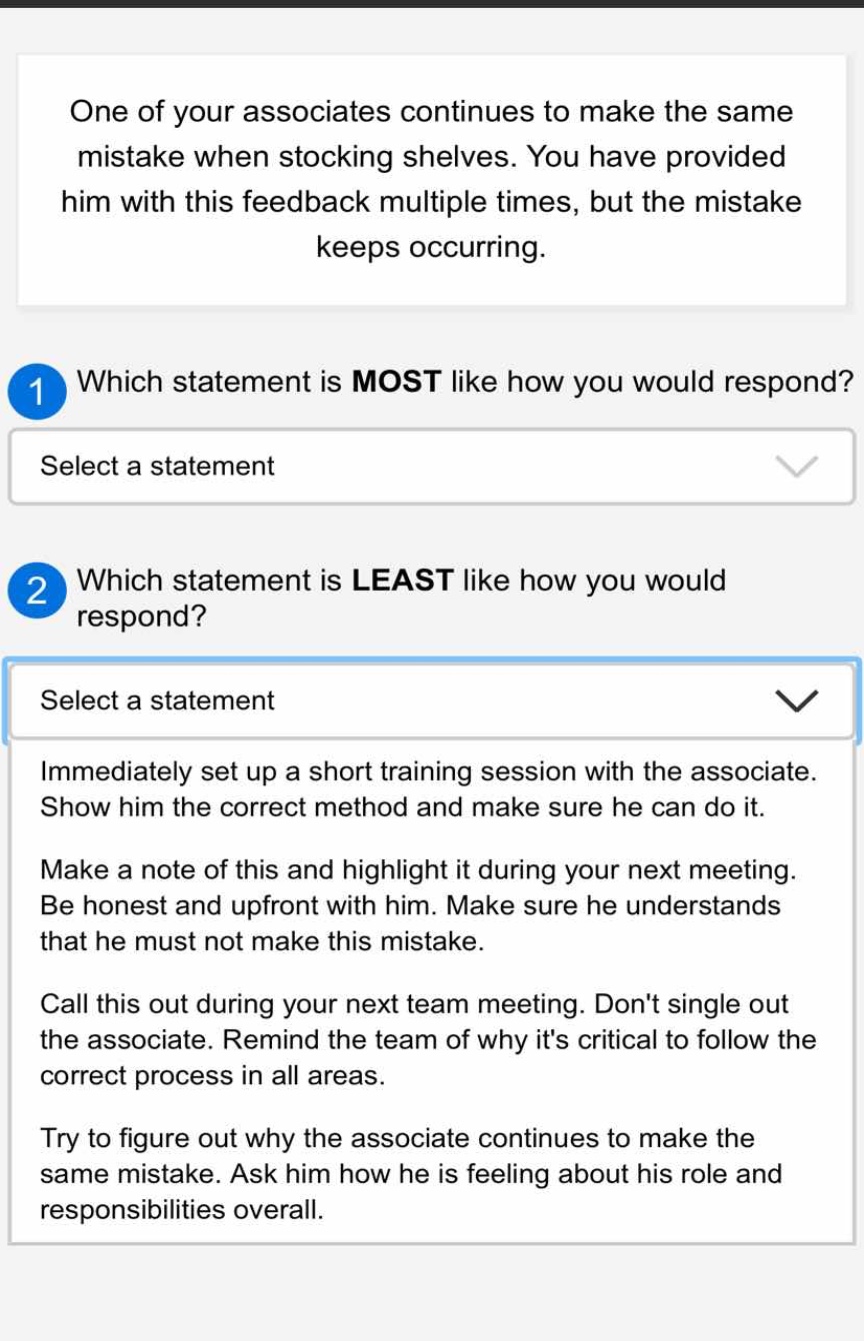
one of your associates continues to make the same mistake when stocking shelves. you have provided him with this feedback multiple times, but the mistake keeps occurring.
1 which statement is most like how you would respond?
select a statement
2 which statement is least like how you would respond?
select a statement
immediately set up a short training session with the associate. show him the correct method and make sure he can do it.
make a note of this and highlight it during your next meeting. be honest and upfront with him. make sure he understands that he must not make this mistake.
call this out during your next team meeting. dont single out the associate. remind the team of why its critical to follow the correct process in all areas.
try to figure out why the associate continues to make the same mistake. ask him how he is feeling about his role and responsibilities overall.
Analyze the leadership scenario
Using the Situational Judgment and Performance Management knowledge points:
- Scenario: An associate repeatedly makes the same shelf-stocking mistake despite receiving feedback multiple times.
- Goal: Identify the most effective (MOST) and least effective (LEAST) leadership responses.
- Key Challenge: Standard feedback has failed, indicating a deeper issue (e.g., lack of skill, motivation, or understanding) that requires a supportive, diagnostic approach rather than simple repetition or public deflection.
Evaluate the response options
Using the Supportive Leadership and Constructive Feedback knowledge points:
- Option A ("Immediately set up a short training session..."): Proactive and hands-on. It directly addresses a potential skill gap by demonstrating the correct method and verifying capability. Highly effective.
- Option B ("Make a note of this and highlight it during your next meeting..."): Postpones action and relies on repeating the same "must not make this mistake" message without diagnosing why it keeps happening. Suboptimal but direct.
- Option C ("Call this out during your next team meeting..."): Passive-aggressive and inefficient. Addressing an individual's repeated performance issue in a team meeting wastes team time and fails to resolve the specific associate's root problem.
- Option D ("Try to figure out why... Ask him how he is feeling..."): Diagnostic and supportive. It seeks the root cause of the repeated failure and checks on the employee's overall engagement, which is crucial when standard feedback fails.
Determine the MOST effective response
Using the Supportive Leadership knowledge point:
- Option D is the MOST effective response. When repeated feedback fails, a supportive leader must investigate the root cause (e.g., personal issues, role misalignment, or motivational blocks) through open dialogue.
Determine the LEAST effective response
Using the Performance Management knowledge point:
- Option C is the LEAST effective response. Addressing an individual's specific, repeated mistake in a general team meeting is highly ineffective, avoids direct accountability, and does not help the associate correct their behavior.

Snap & solve any problem in the app
Get step-by-step solutions on Sovi AI
Photo-based solutions with guided steps
Explore more problems and detailed explanations
Question 1
- (A) Immediately set up a short training session with the associate. Show him the correct method and make sure he can do it.
- (B) Make a note of this and highlight it during your next meeting. Be honest and upfront with him. Make sure he understands that he must not make this mistake.
- (C) Call this out during your next team meeting. Don't single out the associate. Remind the team of why it's critical to follow the correct process in all areas.
- (D) Try to figure out why the associate continues to make the same mistake. Ask him how he is feeling about his role and responsibilities overall. (Correct answer)
Question 2
- (A) Immediately set up a short training session with the associate. Show him the correct method and make sure he can do it.
- (B) Make a note of this and highlight it during your next meeting. Be honest and upfront with him. Make sure he understands that he must not make this mistake.
- (C) Call this out during your next team meeting. Don't single out the associate. Remind the team of why it's critical to follow the correct process in all areas. (Correct answer)
- (D) Try to figure out why the associate continues to make the same mistake. Ask him how he is feeling about his role and responsibilities overall.