QUESTION IMAGE
Question
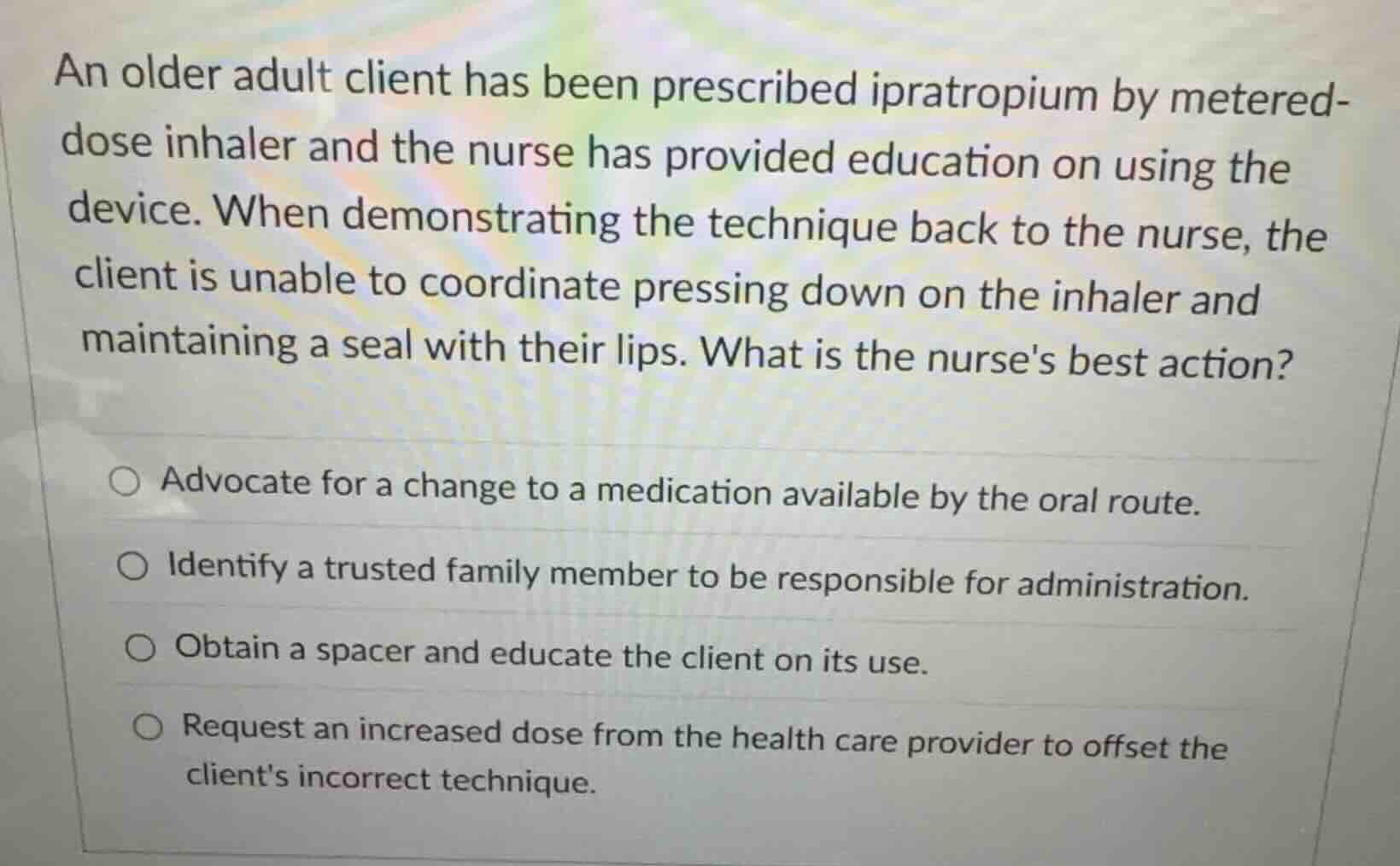
an older adult client has been prescribed ipratropium by metered-dose inhaler and the nurse has provided education on using the device. when demonstrating the technique back to the nurse, the client is unable to coordinate pressing down on the inhaler and maintaining a seal with their lips. what is the nurses best action?
advocate for a change to a medication available by the oral route.
identify a trusted family member to be responsible for administration.
obtain a spacer and educate the client on its use.
request an increased dose from the health care provider to offset the clients incorrect technique.
Identify the clinical problem
The patient is an older adult struggling with the coordination required to use a metered-dose inhaler (MDI) correctly. Specifically, they cannot coordinate pressing the canister while maintaining a proper lip seal and inhaling.
Evaluate the clinical intervention
Using the Inhaler Technique knowledge point, we know that coordination difficulties with MDIs are common, especially in older adults or pediatric patients.
Using the Inhaler Technique knowledge point
- A spacer (valved holding chamber) is designed specifically to address coordination issues by holding the aerosolized medication in suspension, allowing the patient to inhale at their own pace without needing to coordinate actuation and inhalation simultaneously.
Analyze the incorrect options
- Changing to an oral route is inappropriate because inhaled ipratropium acts locally on the airways with minimal systemic side effects, whereas oral alternatives may have increased systemic adverse effects.
- Delegating administration to a family member reduces the client's independence unnecessarily when a simple assistive device can solve the issue.
- Requesting an increased dose does not correct the underlying administration failure and increases the risk of adverse drug reactions.

Snap & solve any problem in the app
Get step-by-step solutions on Sovi AI
Photo-based solutions with guided steps
Explore more problems and detailed explanations
- Advocate for a change to a medication available by the oral route.
- Identify a trusted family member to be responsible for administration.
- Obtain a spacer and educate the client on its use. (Correct answer)
- Request an increased dose from the health care provider to offset the client's incorrect technique.