QUESTION IMAGE
Question
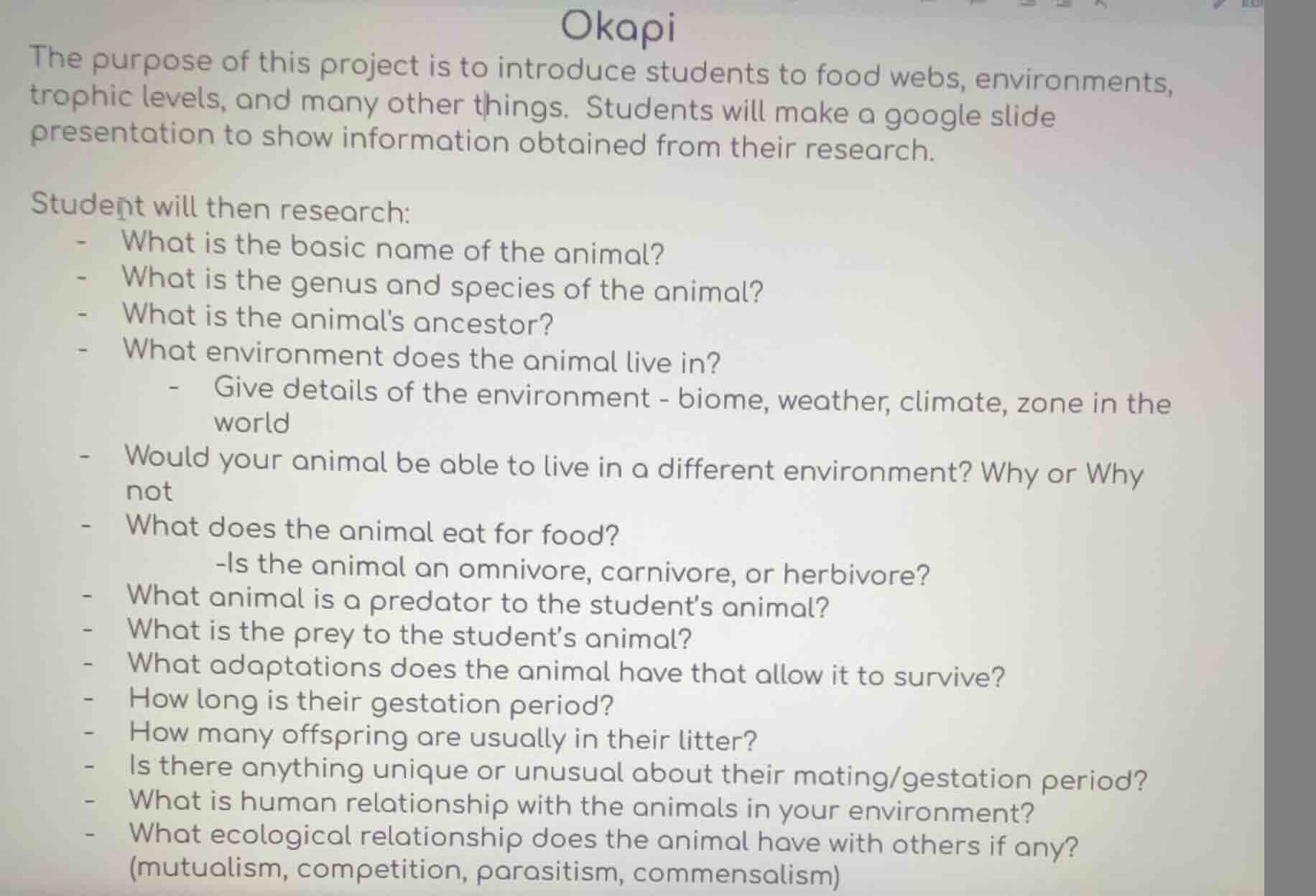
okapi
the purpose of this project is to introduce students to food webs, environments, trophic levels, and many other things. students will make a google slide presentation to show information obtained from their research.
student will then research:
- what is the basic name of the animal?
- what is the genus and species of the animal?
- what is the animals ancestor?
- what environment does the animal live in?
- give details of the environment - biome, weather, climate, zone in the world
- would your animal be able to live in a different environment? why or why not
- what does the animal eat for food?
- is the animal an omnivore, carnivore, or herbivore?
- what animal is a predator to the students animal?
- what is the prey to the students animal?
- what adaptations does the animal have that allow it to survive?
- how long is their gestation period?
- how many offspring are usually in their litter?
- is there anything unique or unusual about their mating/gestation period?
- what is human relationship with the animals in your environment?
- what ecological relationship does the animal have with others if any?
(mutualism, competition, parasitism, commensalism)
Identify classification and ancestry
Using the Biological Classification knowledge point, we identify the okapi's taxonomic details and evolutionary history.
- Common Name: Okapi
- Scientific Name: Okapia johnstoni (Genus: Okapia, Species: johnstoni)
- Evolutionary Ancestor: The closest living relative and evolutionary sister taxon is the giraffe (Giraffa camelopardalis). They share a common Miocene ancestor, such as Canthumeryx or Samotherium.
Describe habitat and adaptability
Using the Environmental Adaptation knowledge point, we analyze the okapi's native environment and its capacity to survive elsewhere.
- Environment: Tropical rainforests (specifically the Ituri Rainforest in the Democratic Republic of the Congo).
- Climate/Biome: Dense, high-canopy tropical wet forest with high humidity, heavy rainfall, and warm temperatures year-round.
- Adaptability: No, they are highly specialized. They rely on dense canopy cover for camouflage, constant high humidity, and specific understory clay/vegetation, making them poorly suited to arid, temperate, or open grassland biomes.
Determine diet and trophic level
We analyze the okapi's feeding habits and its position in the local food web.
- Diet: Herbivore. They feed on tree leaves, buds, shoots, fungi, fruits, and charcoal/clay (for minerals).
- Predators: Leopards (Panthera pardus) are their primary natural predators; humans also hunt them.
- Prey: None, as they are strict herbivores.
Analyze physical and behavioral adaptations
Using the Environmental Adaptation knowledge point, we examine the specific traits that aid the okapi's survival.
- Camouflage: Zebra-like striped hindquarters break up their outline in the filtered forest light.
- Prehensile Tongue: A long, blue-black prehensile tongue (similar to a giraffe's) allows them to strip leaves from branches.
- Scent Glands: Interdigital glands on their feet secrete a tar-like substance to mark territory.
- Infrasonic Communication: They produce low-frequency sounds below human hearing range to communicate without alerting predators.
Detail reproduction and ecological relationships
We outline the reproductive biology and community interactions of the okapi.
- Gestation Period: Approximately 14 to 16 months (around 420–450 days).
- Litter Size: Typically a single calf.
- Unique Mating/Gestation: Calves do not defecate for the first few weeks of life to prevent predators from tracking their scent.
- Human Relationship: Threatened by habitat destruction (deforestation, mining), poaching, and civil unrest.
- Ecological Relationships:
- Mutualism: Seed dispersal of forest plants via defecation.
- Competition: Compete with other forest herbivores (like duikers) for understory foliage.

Snap & solve any problem in the app
Get step-by-step solutions on Sovi AI
Photo-based solutions with guided steps
Explore more problems and detailed explanations
Here is the research profile for the Okapi project:
- Basic Name: Okapi (also known as the forest giraffe)
- Genus and Species: Okapia johnstoni
- Ancestor: Shares a common prehistoric ancestor with the giraffe (family Giraffidae); its closest fossil relatives include Miocene giraffids like Samotherium.
- Environment:
- Biome: Tropical Rainforest
- Climate/Weather: Hot, highly humid, and wet with high annual rainfall.
- Zone: Central Africa (endemic to the Ituri Rainforest in the Democratic Republic of the Congo).
- Adaptability to Other Environments: No. Okapis are highly specialized for dense canopy rainforests. They would not survive in open, dry, or cold environments due to their reliance on specific understory plants, high humidity, and camouflage.
- Diet: Herbivore. They eat leaves, buds, shoots, fruits, fungi, and even charcoal or clay for essential minerals.
- Predators: Leopards (Panthera pardus) and humans.
- Prey: None (herbivorous).
- Adaptations:
- Striped Hindquarters: Provides camouflage in filtered forest light.
- Prehensile Tongue: Long, dark tongue used to strip leaves from branches.
- Infrasonic Hearing/Vocalization: Communicates using low-frequency sounds that leopards cannot hear.
- Scent Glands: Located on their hooves to mark territory in dense brush.
- Gestation Period: 14 to 16 months (approximately 420–450 days).
- Litter Size: 1 calf.
- Unique Mating/Gestation Feature: Calves do not defecate for the first 4 to 8 weeks of life, an adaptation that prevents predators from finding them by scent while they hide in the vegetation.
- Human Relationship: Severely threatened by human activities, including poaching for bushmeat/skins, habitat loss due to logging and mining, and regional armed conflict.
- Ecological Relationships:
- Mutualism: Disperses seeds of the forest fruits they consume.
- Competition: Competes with other forest herbivores, such as duikers (small antelopes), for understory browse.