Sovi.AI - AI Math Tutor

Scan to solve math questions

QUESTION IMAGE

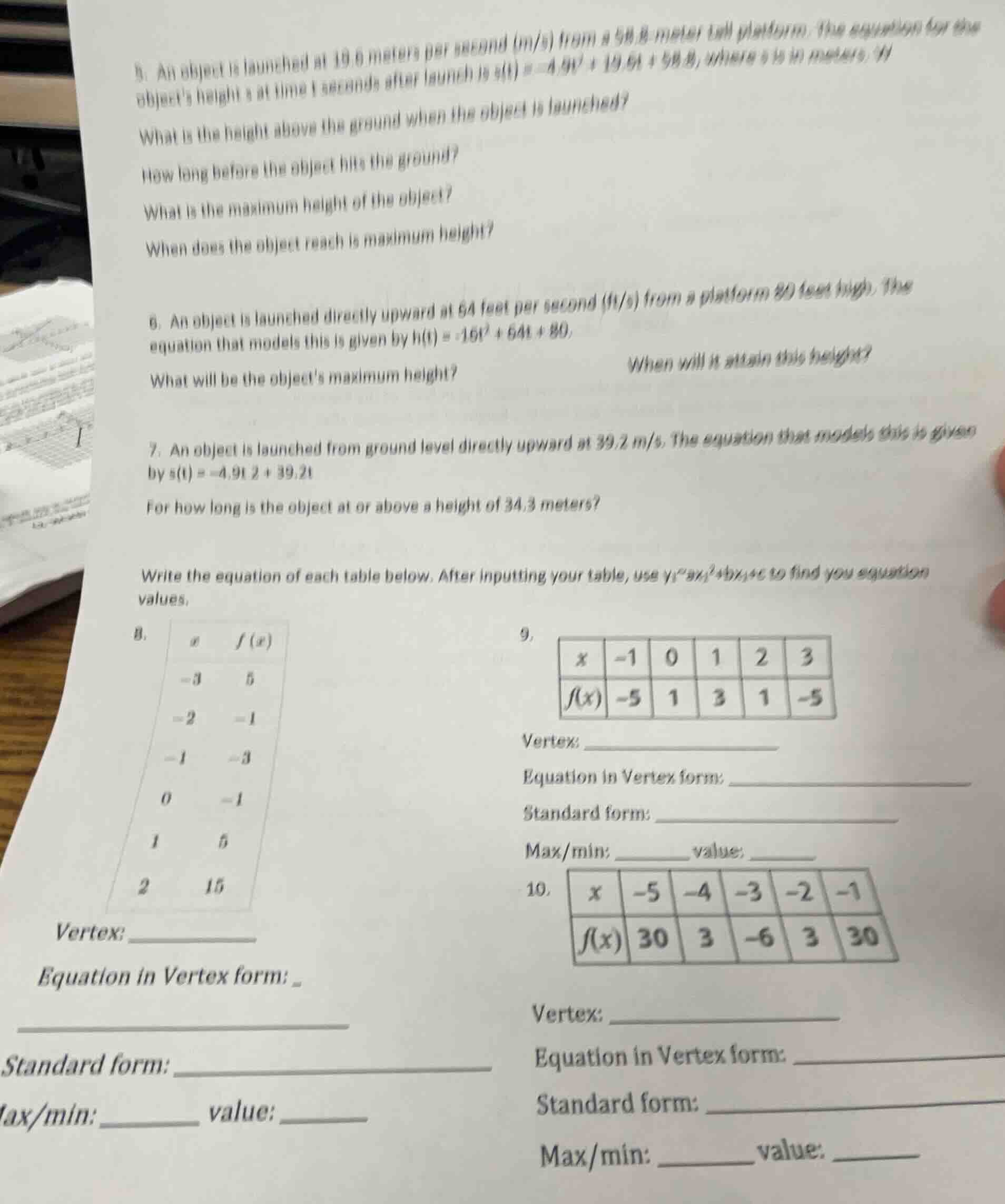
5. an object is launched at 19.6 meters per second (m/s) from a 58.8 me…

Question

  1. an object is launched at 19.6 meters per second (m/s) from a 58.8 meter tall platform. the equation for the objects height s at time t seconds after launch is \\(s(t) = -4.9t^2 + 19.6t + 58.8\\), where s is in meters.

what is the height above the ground when the object is launched?
how long before the object hits the ground?
what is the maximum height of the object?
when does the object reach is maximum height?

  1. an object is launched directly upward at 64 feet per second (ft/s) from a platform 80 feet high. the equation that models this is given by \\(h(t) = -16t^2 + 64t + 80\\).

what will be the objects maximum height?
when will it attain this height?

  1. an object is launched from ground level directly upward at 39.2 m/s. the equation that models this is given by \\(s(t) = -4.9t^2 + 39.2t\\).

for how long is the object at or above a height of 34.3 meters?

write the equation of each table below. after inputting your table, use \\(y_1 \sim ax_1^2 + bx_1 + c\\) to find you equation values.

8.
\\(\

$$\begin{array}{|c|c|} \\hline x & f(x) \\\\ \\hline -3 & 5 \\\\ -2 & -1 \\\\ -1 & -3 \\\\ 0 & -1 \\\\ 1 & 5 \\\\ 2 & 15 \\\\ \\hline \\end{array}$$

\\)
vertex:
equation in vertex form:
standard form:
max/min:
value:

9.
\\(\

$$\begin{array}{|c|c|c|c|c|c|} \\hline x & -1 & 0 & 1 & 2 & 3 \\\\ \\hline f(x) & -5 & 1 & 3 & 1 & -5 \\\\ \\hline \\end{array}$$

\\)
vertex:
equation in vertex form:
standard form:
max/min:
value:

10.
\\(\

$$\begin{array}{|c|c|c|c|c|c|} \\hline x & -5 & -4 & -3 & -2 & -1 \\\\ \\hline f(x) & 30 & 3 & -6 & 3 & 30 \\\\ \\hline \\end{array}$$

\\)
vertex:
equation in vertex form:
standard form:
max/min:
value:

Explanation:

Response

<pre_analysis>
{
"quality": "clear",
"question_count": 3,
"skills_matched": [
"step_cot",
"explain_then_answer",
"tutor"
],
"needs_drawing": false,
"concepts_used": [
"Vertex of Quadratic"
],
"new_concepts": [
"Quadratic Vertex Form",
"Quadratic Standard Form"
],
"current_concepts": [
"Vertex of Quadratic",
"Quadratic Vertex Form",
"Quadratic Standard Form"
]
}
</pre_analysis>

<reasoning>

Identify the vertex from each table

Using the Vertex of Quadratic knowledge point, we find the symmetric center of the \(y\)-values.

  • For Question 8: The \(f(x)\) values are symmetric around \(x = -1\), where \(f(-1) = -3\). Thus, the vertex is \((-1, -3)\).
  • For Question 9: The \(f(x)\) values are symmetric around \(x = 1\), where \(f(1) = 3\). Thus, the vertex is \((1, 3)\).
  • For Question 10: The \(f(x)\) values are symmetric around \(x = -3\), where \(f(-3) = -6\). Thus, the vertex is \((-3, -6)\).

Determine the vertex form equations

Using the vertex form \(f(x) = a(x - h)^2 + k\) with vertex \((h, k)\):

  • For Question 8: \(f(x) = a(x + 1)^2 - 3\). Using point \((0, -1)\): \(-1 = a(0 + 1)^2 - 3 \implies a = 2\). Equation: \(f(x) = 2(x + 1)^2 - 3\).
  • For Question 9: \(f(x) = a(x - 1)^2 + 3\). Using point \((0, 1)\): \(1 = a(0 - 1)^2 + 3 \implies a = -2\). Equation: \(f(x) = -2(x - 1)^2 + 3\).
  • For Question 10: \(f(x) = a(x + 3)^2 - 6\). Using point \((-2, 3)\): \(3 = a(-2 + 3)^2 - 6 \implies a = 9\). Equation: \(f(x) = 9(x + 3)^2 - 6\).

Convert to standard form

Expand the vertex form equations into \(f(x) = ax^2 + bx + c\):

  • For Question 8: \(f(x) = 2(x^2 + 2x + 1) - 3 = 2x^2 + 4x - 1\).
  • For Question 9: \(f(x) = -2(x^2 - 2x + 1) + 3 = -2x^2 + 4x + 1\).
  • For Question 10: \(f(x) = 9(x^2 + 6x + 9) - 6 = 9x^2 + 54x + 75\).

Determine the maximum or minimum value

Identify if the vertex represents a maximum or minimum based on the sign of \(a\):

  • For Question 8: Since \(a = 2 > 0\), it has a minimum value of \(-3\).
  • For Question 9: Since \(a = -2 < 0\), it has a maximum value of \(3\).
  • For Question 10: Since \(a = 9 > 0\), it has a minimum value of \(-6\).

</reasoning>

<answer>

Question 8

  • Vertex: \((-1, -3)\)
  • Equation in Vertex form: \(f(x) = 2(x + 1)^2 - 3\)
  • Standard form: \(f(x) = 2x^2 + 4x - 1\)
  • Max/min: min, value: \(-3\)

Question 9

  • Vertex: \((1, 3)\)
  • Equation in Vertex form: \(f(x) = -2(x - 1)^2 + 3\)
  • Standard form: \(f(x) = -2x^2 + 4x + 1\)
  • Max/min: max, value: \(3\)

Question 10

  • Vertex: \((-3, -6)\)
  • Equation in Vertex form: \(f(x) = 9(x + 3)^2 - 6\)
  • Standard form: \(f(x) = 9x^2 + 54x + 75\)
  • Max/min: min, value: \(-6\)

</answer>

<post_analysis>
{
"subject": "Mathematics",
"question_type": "Multi-part",
"knowledge_point": [
"Mathematics",
"Algebra",
"Quadratic Functions"
]
}
</post_analysis>

Answer:

<pre_analysis>
{
"quality": "clear",
"question_count": 3,
"skills_matched": [
"step_cot",
"explain_then_answer",
"tutor"
],
"needs_drawing": false,
"concepts_used": [
"Vertex of Quadratic"
],
"new_concepts": [
"Quadratic Vertex Form",
"Quadratic Standard Form"
],
"current_concepts": [
"Vertex of Quadratic",
"Quadratic Vertex Form",
"Quadratic Standard Form"
]
}
</pre_analysis>

<reasoning>

Identify the vertex from each table

Using the Vertex of Quadratic knowledge point, we find the symmetric center of the \(y\)-values.

  • For Question 8: The \(f(x)\) values are symmetric around \(x = -1\), where \(f(-1) = -3\). Thus, the vertex is \((-1, -3)\).
  • For Question 9: The \(f(x)\) values are symmetric around \(x = 1\), where \(f(1) = 3\). Thus, the vertex is \((1, 3)\).
  • For Question 10: The \(f(x)\) values are symmetric around \(x = -3\), where \(f(-3) = -6\). Thus, the vertex is \((-3, -6)\).

Determine the vertex form equations

Using the vertex form \(f(x) = a(x - h)^2 + k\) with vertex \((h, k)\):

  • For Question 8: \(f(x) = a(x + 1)^2 - 3\). Using point \((0, -1)\): \(-1 = a(0 + 1)^2 - 3 \implies a = 2\). Equation: \(f(x) = 2(x + 1)^2 - 3\).
  • For Question 9: \(f(x) = a(x - 1)^2 + 3\). Using point \((0, 1)\): \(1 = a(0 - 1)^2 + 3 \implies a = -2\). Equation: \(f(x) = -2(x - 1)^2 + 3\).
  • For Question 10: \(f(x) = a(x + 3)^2 - 6\). Using point \((-2, 3)\): \(3 = a(-2 + 3)^2 - 6 \implies a = 9\). Equation: \(f(x) = 9(x + 3)^2 - 6\).

Convert to standard form

Expand the vertex form equations into \(f(x) = ax^2 + bx + c\):

  • For Question 8: \(f(x) = 2(x^2 + 2x + 1) - 3 = 2x^2 + 4x - 1\).
  • For Question 9: \(f(x) = -2(x^2 - 2x + 1) + 3 = -2x^2 + 4x + 1\).
  • For Question 10: \(f(x) = 9(x^2 + 6x + 9) - 6 = 9x^2 + 54x + 75\).

Determine the maximum or minimum value

Identify if the vertex represents a maximum or minimum based on the sign of \(a\):

  • For Question 8: Since \(a = 2 > 0\), it has a minimum value of \(-3\).
  • For Question 9: Since \(a = -2 < 0\), it has a maximum value of \(3\).
  • For Question 10: Since \(a = 9 > 0\), it has a minimum value of \(-6\).

</reasoning>

<answer>

Question 8

  • Vertex: \((-1, -3)\)
  • Equation in Vertex form: \(f(x) = 2(x + 1)^2 - 3\)
  • Standard form: \(f(x) = 2x^2 + 4x - 1\)
  • Max/min: min, value: \(-3\)

Question 9

  • Vertex: \((1, 3)\)
  • Equation in Vertex form: \(f(x) = -2(x - 1)^2 + 3\)
  • Standard form: \(f(x) = -2x^2 + 4x + 1\)
  • Max/min: max, value: \(3\)

Question 10

  • Vertex: \((-3, -6)\)
  • Equation in Vertex form: \(f(x) = 9(x + 3)^2 - 6\)
  • Standard form: \(f(x) = 9x^2 + 54x + 75\)
  • Max/min: min, value: \(-6\)

</answer>

<post_analysis>
{
"subject": "Mathematics",
"question_type": "Multi-part",
"knowledge_point": [
"Mathematics",
"Algebra",
"Quadratic Functions"
]
}
</post_analysis>