QUESTION IMAGE
Question
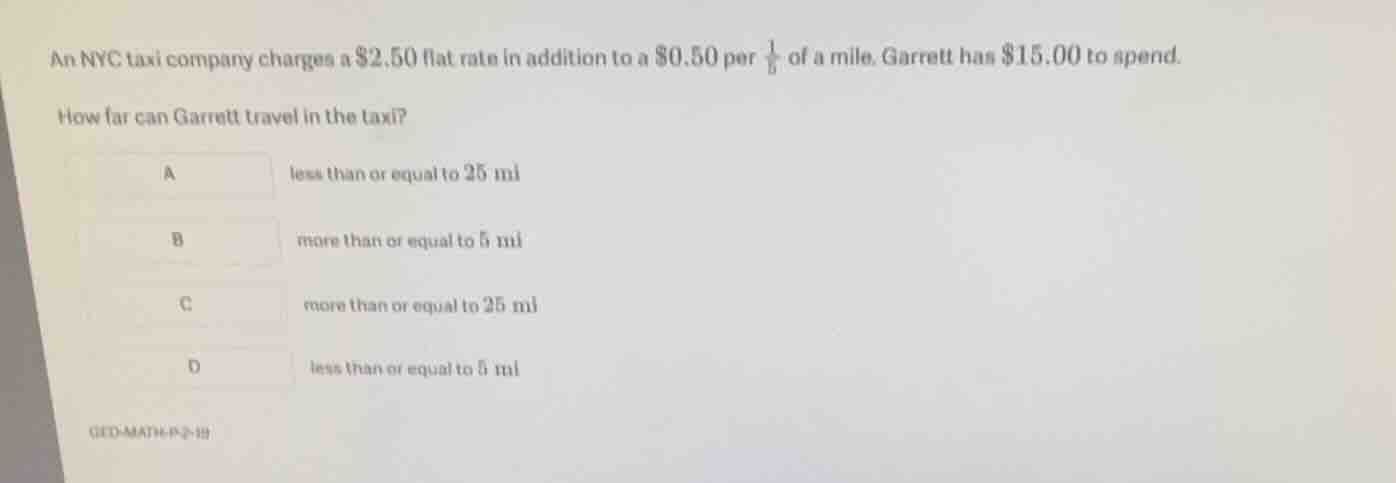
an nyc taxi company charges a \\$2.50 flat rate in addition to a \\$0.50 per \\(\frac{1}{5}\\) of a mile. garrett has \\$15.00 to spend.
how far can garrett travel in the taxi?
a. less than or equal to 25 mi
b. more than or equal to 5 mi
c. more than or equal to 25 mi
d. less than or equal to 5 mi
🆕 New Concept Discovered: Solving Linear Inequalities in Word Problems
Translating real-world limits into inequality equations
Step 1: Find the cost per mile
The taxi charges \( \$0.50 \) per \( \frac{1}{5} \) of a mile. To find the cost for one full mile, we multiply the rate by \( 5 \):
Step 2: Set up the inequality
Let \( x \) represent the number of miles Garrett can travel.
The total cost consists of a flat rate of \( \$2.50 \) plus \( \$2.50 \) per mile. Since Garrett has a maximum of \( \$15.00 \) to spend, the total cost must be less than or equal to \( \$15.00 \):
Step 3: Solve for \( x \)
Subtract the flat rate of \( 2.50 \) from both sides:
Divide both sides by \( 2.50 \):
This means Garrett can travel a distance less than or equal to \( 5 \text{ mi} \).

Snap & solve any problem in the app
Get step-by-step solutions on Sovi AI
Photo-based solutions with guided steps
Explore more problems and detailed explanations
D less than or equal to 5 mi