QUESTION IMAGE
Question
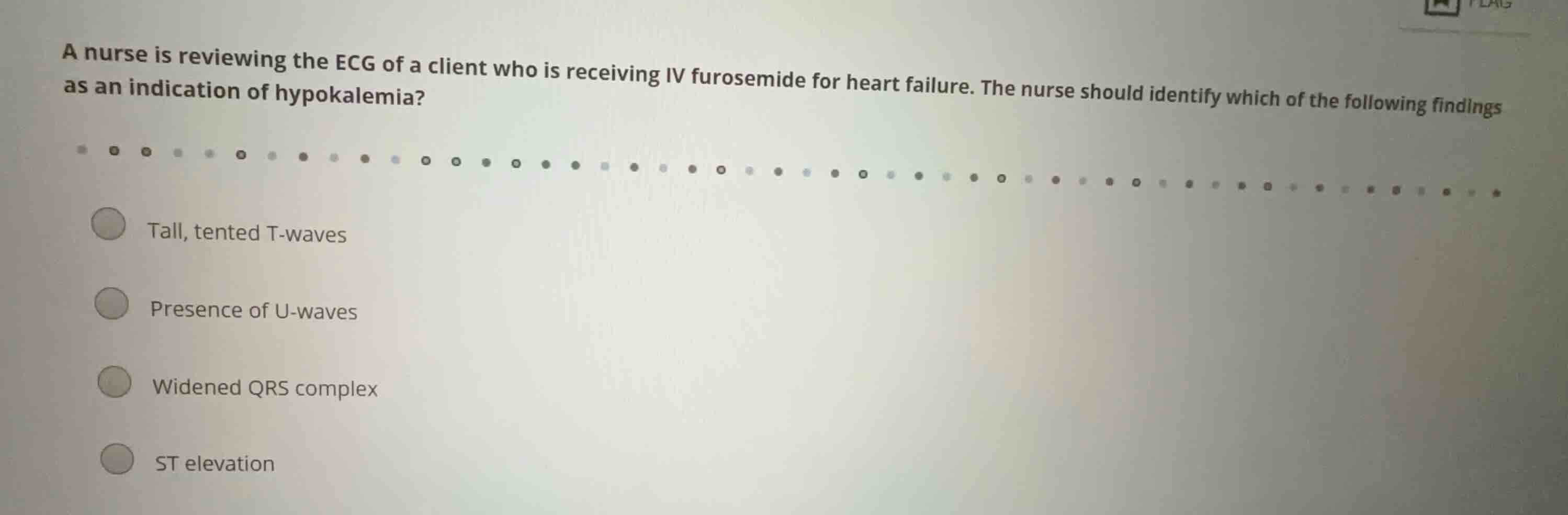
a nurse is reviewing the ecg of a client who is receiving iv furosemide for heart failure. the nurse should identify which of the following findings as an indication of hypokalemia?
tall, tented t-waves
presence of u-waves
widened qrs complex
st elevation
Analyze the clinical scenario
The client is receiving IV furosemide, which is a loop diuretic commonly used to treat fluid overload in heart failure. Loop diuretics promote the excretion of water, sodium, and potassium. A major adverse effect of loop diuretics is hypokalemia (low serum potassium levels). The nurse is reviewing the electrocardiogram (ECG) to monitor for cardiac manifestations of hypokalemia.
Evaluate the ECG manifestations of hypokalemia
Hypokalemia alters myocardial repolarization, leading to characteristic changes on an ECG:
- Flattened or inverted T-waves
- ST-segment depression
- Prominent U-waves (an extra wave following the T-wave)
- Prolonged PR interval
Compare with the provided options
- Tall, tented T-waves: This is a classic sign of hyperkalemia (high potassium), not hypokalemia.
- Presence of U-waves: This is a classic, specific ECG finding associated with hypokalemia.
- Widened QRS complex: This is typically seen in severe hyperkalemia, bundle branch blocks, or drug toxicities (like tricyclic antidepressants), rather than uncomplicated hypokalemia.
- ST elevation: This indicates acute myocardial injury or infarction, not hypokalemia (which causes ST depression).
Determine the correct choice
The presence of U-waves is the correct indicator of hypokalemia among the choices provided.

Snap & solve any problem in the app
Get step-by-step solutions on Sovi AI
Photo-based solutions with guided steps
Explore more problems and detailed explanations
- Tall, tented T-waves
- Presence of U-waves (Correct answer)
- Widened QRS complex
- ST elevation