QUESTION IMAGE
Question
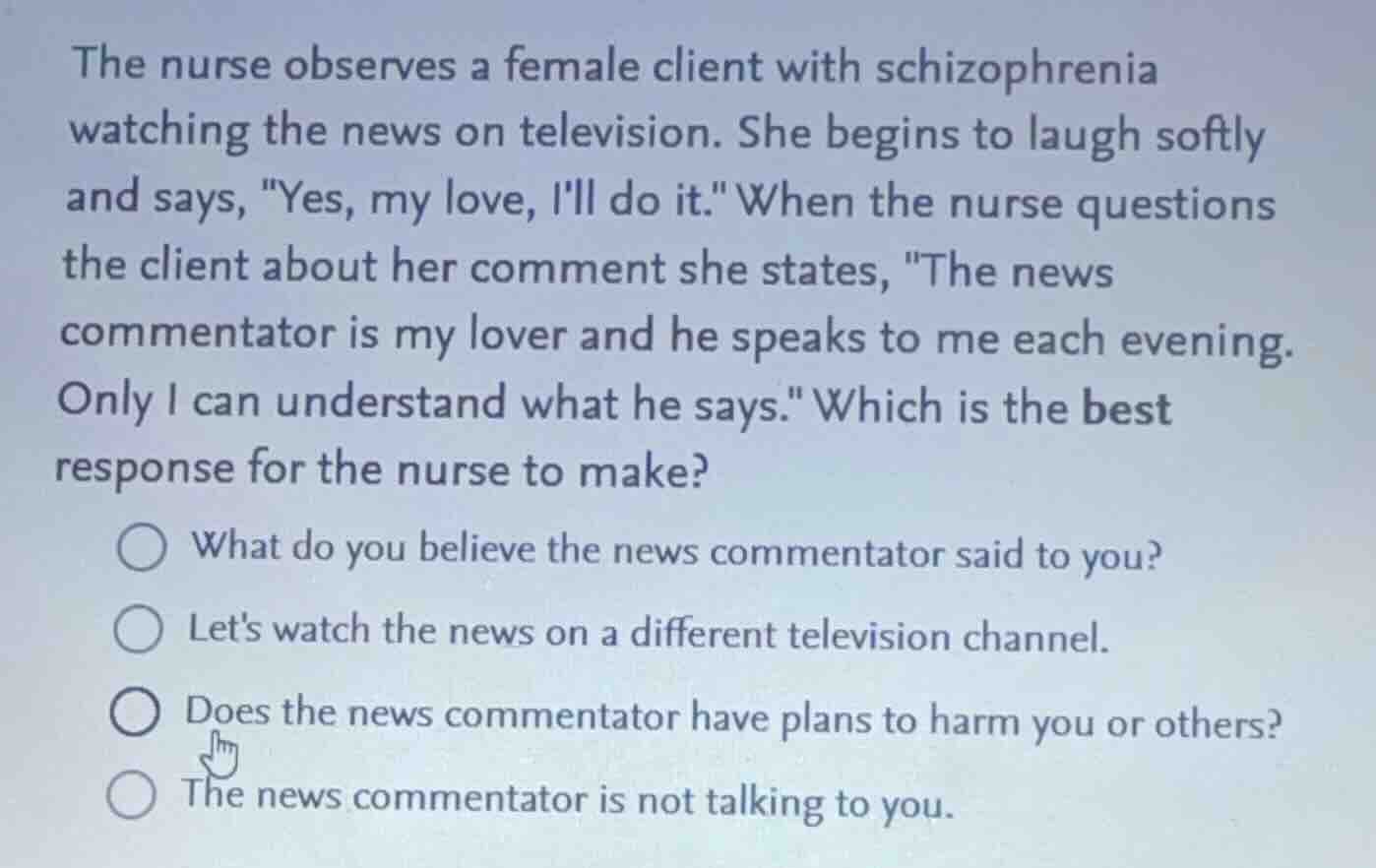
the nurse observes a female client with schizophrenia watching the news on television. she begins to laugh softly and says, \yes, my love, ill do it.\ when the nurse questions the client about her comment she states, \the news commentator is my lover and he speaks to me each evening. only i can understand what he says.\ which is the best response for the nurse to make?
what do you believe the news commentator said to you?
lets watch the news on a different television channel.
does the news commentator have plans to harm you or others?
the news commentator is not talking to you.
Identify the clinical presentation and type of delusion
The client is exhibiting a delusion of reference (believing a television commentator is speaking directly to her) and an erotomanic delusion (believing the commentator is her lover).
Evaluate the therapeutic communication options
- Option 1 ("What do you believe the news commentator said to you?") seeks to clarify the content of the delusion without validating or reinforcing it, which is the initial step in assessing the nature of the delusion (especially regarding potential commands or safety risks).
- Option 2 ("Let's watch the news on a different television channel.") is an avoidant redirection that does not address the client's immediate statement.
- Option 3 ("Does the news commentator have plans to harm you or others?") jumps directly to a safety risk assessment without first understanding what the client perceived was said, and the client's delusion is romantic/positive ("my love"), not persecutory.
- Option 4 ("The news commentator is not talking to you.") directly challenges the delusion, which can cause defensiveness and damage the therapeutic alliance.
Determine the best initial nursing response
The nurse should first assess the content of the delusion to ensure safety and understand the client's experience by asking an open-ended clarifying question.

Snap & solve any problem in the app
Get step-by-step solutions on Sovi AI
Photo-based solutions with guided steps
Explore more problems and detailed explanations
- (A) What do you believe the news commentator said to you? (Correct answer)
- (B) Let's watch the news on a different television channel.
- (C) Does the news commentator have plans to harm you or others?
- (D) The news commentator is not talking to you.