QUESTION IMAGE
Question
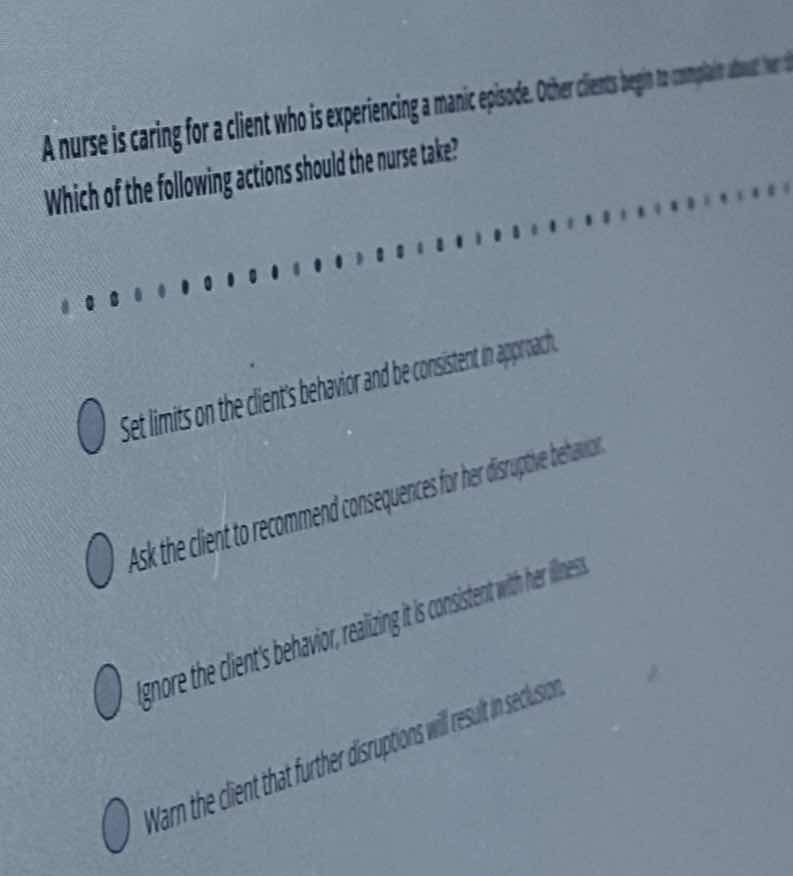
a nurse is caring for a client who is experiencing a manic episode. other clients begin to complain about her behavior. which of the following actions should the nurse take?
set limits on the clients behavior and be consistent in approach
ask the client to recommend consequences for her disruptive behavior
ignore the clients behavior, realizing it is consistent with her illness
warn the client that further disruptions will result in seclusion
Analyze the clinical scenario
The scenario describes a client experiencing an acute manic episode who is disrupting other clients on the unit. In psychiatric nursing, managing a client in a manic state requires maintaining unit safety, establishing clear boundaries, and providing structured, consistent care.
Evaluate the options
- Option 1: "Set limits on the client's behavior and be consistent in approach"
Setting clear, firm, and non-punitive limits is the standard therapeutic intervention for manic behavior. Consistency among all staff members prevents the client from exploiting inconsistencies and helps provide a safe, structured environment.
- Option 2: "Ask the client to recommend consequences for her disruptive behavior"
A client in an acute manic episode has impaired judgment, poor impulse control, and flight of ideas. They are cognitively unable to analyze their behavior or establish appropriate consequences.
- Option 3: "Ignore the client's behavior, realizing it is consistent with her illness"
Ignoring disruptive behavior is unsafe and unfair to other clients on the unit. The nurse must intervene to maintain a therapeutic and safe environment for everyone.
- Option 4: "Warn the client that further disruptions will result in seclusion"
Threatening seclusion is punitive and violates ethical and legal standards of care. Seclusion should only be used as a last resort when the client poses an immediate danger to themselves or others, not as a threat or consequence for disruptive behavior.
Determine the correct intervention
The most therapeutic, safe, and effective action is to set clear limits on the disruptive behavior and ensure all staff members are consistent in their approach.

Snap & solve any problem in the app
Get step-by-step solutions on Sovi AI
Photo-based solutions with guided steps
Explore more problems and detailed explanations
- Set limits on the client's behavior and be consistent in approach (Correct answer)
- Ask the client to recommend consequences for her disruptive behavior
- Ignore the client's behavior, realizing it is consistent with her illness
- Warn the client that further disruptions will result in seclusion