QUESTION IMAGE
Question
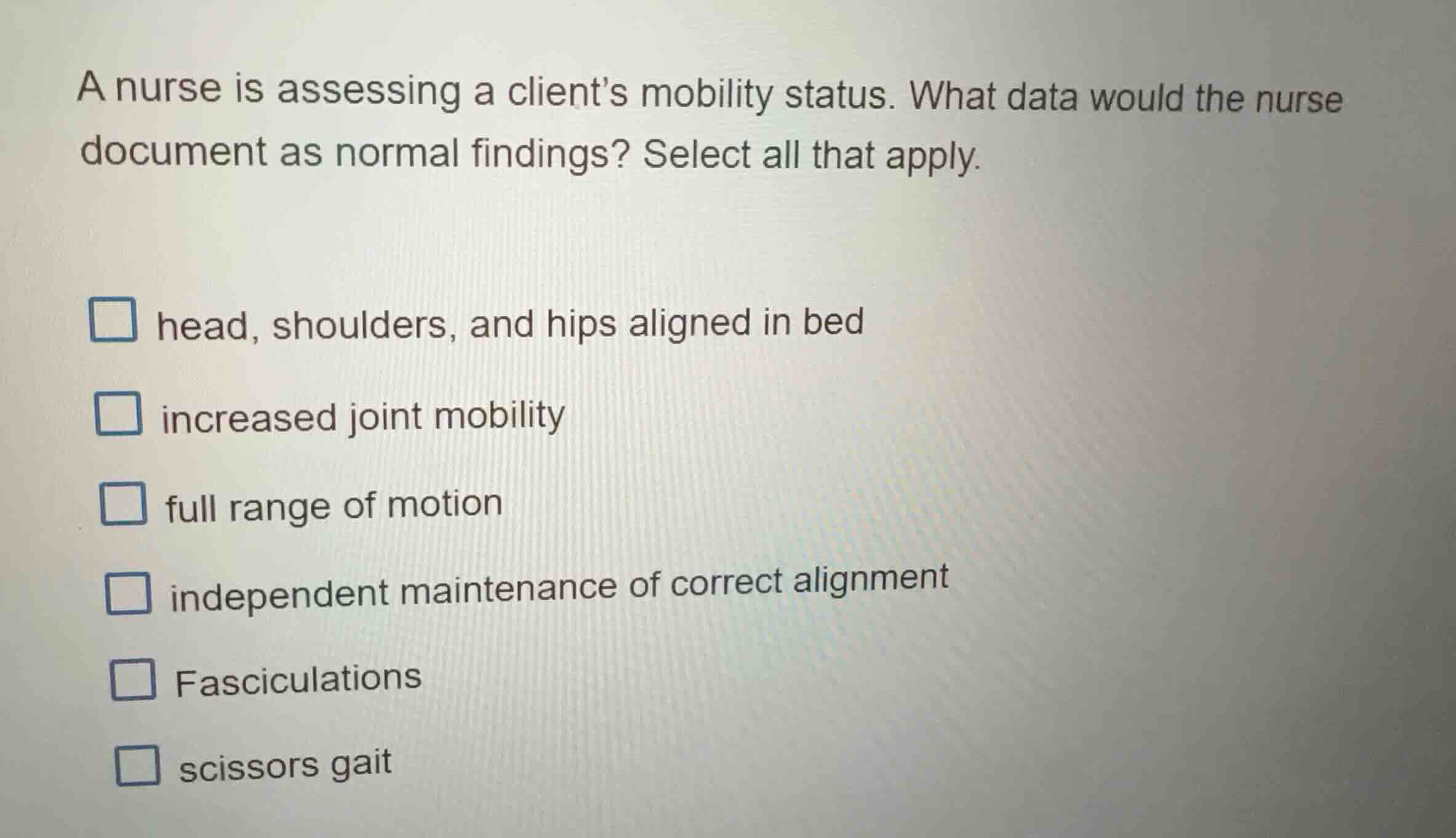
a nurse is assessing a clients mobility status. what data would the nurse document as normal findings? select all that apply.
head, shoulders, and hips aligned in bed
increased joint mobility
full range of motion
independent maintenance of correct alignment
fasciculations
scissors gait
Analyze the clinical question
The question asks to identify normal findings during a mobility status assessment. We need to evaluate each option to determine if it represents a healthy, physiological baseline or an abnormal pathological state.
Evaluate alignment and posture options
Using the Patient Ambulation Safety knowledge point
- head, shoulders, and hips aligned in bed: This represents correct anatomical body alignment, which is a normal finding.
- independent maintenance of correct alignment: The ability to maintain correct posture and alignment without assistance is a normal functional finding.
Evaluate range of motion and joint options
- full range of motion: Having complete, unrestricted movement in all joints is a normal finding.
- increased joint mobility: This typically refers to hypermobility or joint laxity, which can indicate ligamentous weakness or connective tissue disorders, and is not documented as a standard "normal" finding.
Evaluate neuromuscular and gait options
- Fasciculations: These are involuntary muscle twitches, which represent abnormal neuromuscular activity.
- scissors gait: This is an abnormal gait pattern characterized by thighs crossing over each other in a scissor-like fashion, commonly seen in spastic cerebral palsy or upper motor neuron lesions.

Snap & solve any problem in the app
Get step-by-step solutions on Sovi AI
Photo-based solutions with guided steps
Explore more problems and detailed explanations
- head, shoulders, and hips aligned in bed (Correct answer)
- increased joint mobility
- full range of motion (Correct answer)
- independent maintenance of correct alignment (Correct answer)
- Fasciculations
- scissors gait