QUESTION IMAGE
Question
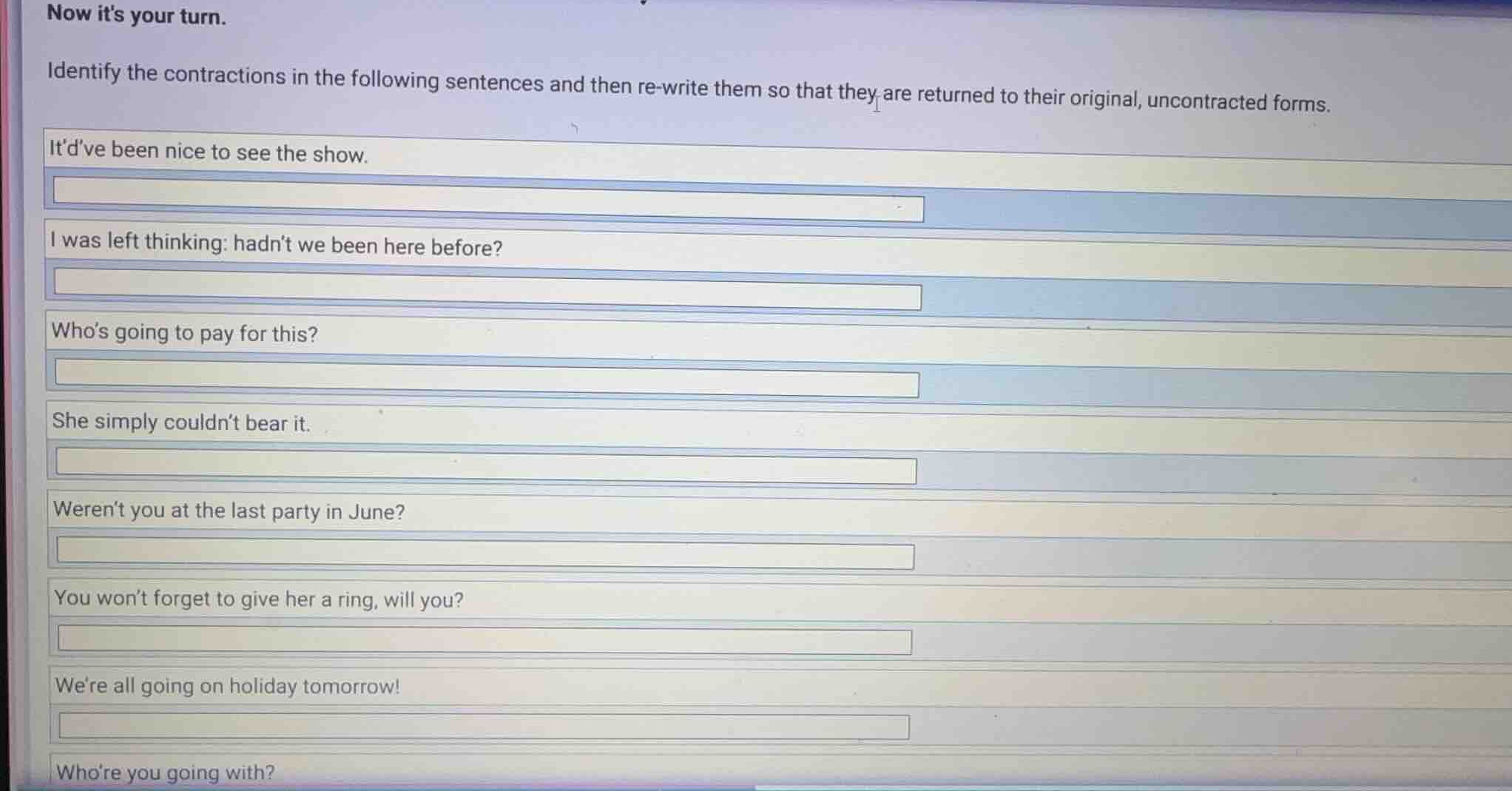
now its your turn.
identify the contractions in the following sentences and then re-write them so that they are returned to their original, uncontracted forms.
itdve been nice to see the show.
i was left thinking: hadnt we been here before?
whos going to pay for this?
she simply couldnt bear it.
werent you at the last party in june?
you wont forget to give her a ring, will you?
were all going on holiday tomorrow!
whore you going with?
Identify contractions in each sentence
We need to locate the shortened word forms containing apostrophes that represent combined words.
- Sentence 1: "It'd've" is a double contraction.
- Sentence 2: "hadn't" is a negative contraction.
- Sentence 3: "Who's" is a contraction of a question word and a verb.
- Sentence 4: "couldn't" is a negative contraction.
- Sentence 5: "Weren't" is a negative contraction.
- Sentence 6: "won't" is a negative contraction.
- Sentence 7: "We're" is a pronoun-verb contraction.
- Sentence 8: "Who're" is a question word-verb contraction.
Expand contractions to uncontracted forms
We will expand each identified contraction to its full, formal grammatical components.
- "It'd've" expands to "It would have".
- "hadn't" expands to "had not".
- "Who's" expands to "Who is" (or "Who has" depending on context; here "Who's going" means "Who is going").
- "couldn't" expands to "could not".
- "Weren't" expands to "Were not".
- "won't" expands to "will not".
- "We're" expands to "We are".
- "Who're" expands to "Who are".
Rewrite the sentences
Using the expanded forms, we reconstruct each sentence while maintaining correct Sentence Structure and capitalization.
- "It'd've been nice to see the show." becomes "It would have been nice to see the show."
- "I was left thinking: hadn't we been here before?" becomes "I was left thinking: had we not been here before?" (or "hadn't" to "had not" as "I was left thinking: had not we been here before?", but standard uncontracted form in questions typically places the subject between the auxiliary and "not": "had we not been here before?"). Let's provide the direct word-for-word expansion "had not we" as well as the natural uncontracted phrasing "had we not".
- "Who's going to pay for this?" becomes "Who is going to pay for this?"
- "She simply couldn't bear it." becomes "She simply could not bear it."
- "Weren't you at the last party in June?" becomes "Were you not at the last party in June?" (or "Were not you...").
- "You won't forget to give her a ring, will you?" becomes "You will not forget to give her a ring, will you?"
- "We're all going on holiday tomorrow!" becomes "We are all going on holiday tomorrow!"
- "Who're you going with?" becomes "Who are you going with?"

Snap & solve any problem in the app
Get step-by-step solutions on Sovi AI
Photo-based solutions with guided steps
Explore more problems and detailed explanations
Question 1
It'd've been nice to see the show.
<blank>It would have been nice to see the show.</blank>
Question 2
I was left thinking: hadn't we been here before?
<blank>I was left thinking: had we not been here before?</blank>
Question 3
Who's going to pay for this?
<blank>Who is going to pay for this?</blank>
Question 4
She simply couldn't bear it.
<blank>She simply could not bear it.</blank>
Question 5
Weren't you at the last party in June?
<blank>Were you not at the last party in June?</blank>
Question 6
You won't forget to give her a ring, will you?
<blank>You will not forget to give her a ring, will you?</blank>
Question 7
We're all going on holiday tomorrow!
<blank>We are all going on holiday tomorrow!</blank>
Question 8
Who're you going with?
<blank>Who are you going with?</blank>