QUESTION IMAGE
Question
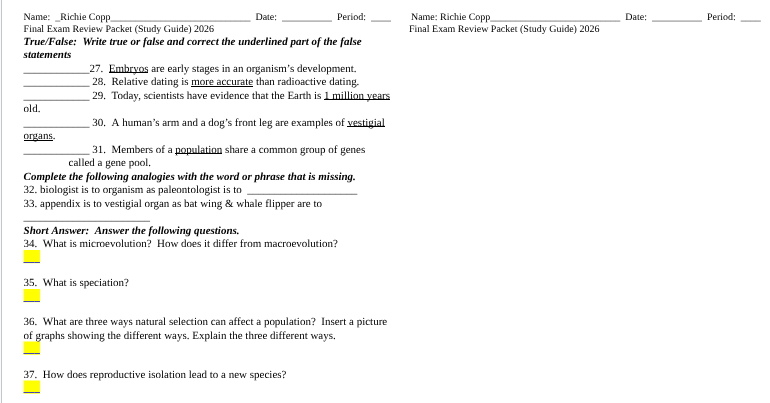
name: richie copp date: period:
final exam review packet (study guide) 2026
true/false: write true or false and correct the underlined part of the false statements
- embryos are early stages in an organisms development.
- relative dating is more accurate than radioactive dating.
- today, scientists have evidence that the earth is 1 million years old.
- a humans arm and a dogs front leg are examples of vestigial organs.
- members of a population share a common group of genes called a gene pool.
complete the following analogies with the word or phrase that is missing.
- biologist is to organism as paleontologist is to
- appendix is to vestigial organ as bat wing & whale flipper are to
short answer: answer the following questions.
- what is microevolution? how does it differ from macroevolution?
- what is speciation?
- what are three ways natural selection can affect a population? insert a picture of graphs showing the different ways. explain the three different ways.
- how does reproductive isolation lead to a new species?
⚡ Using what you learned: mechanisms of evolution and natural selection
---
Step 1: True/False and Corrections (Questions 27–31)
- 27. Embryos are early stages in an organism's development.
- Analysis: This is the correct definition of an embryo.
- Answer: True
- 28. Relative dating is <ins>more accurate</ins> than radioactive dating.
- Analysis: Relative dating only provides an estimated order of events (which layer is older or younger), whereas radioactive (absolute) dating provides an actual numerical age, making radioactive dating more accurate.
- Answer: False; less accurate (or "radioactive dating is more accurate")
- 29. Today, scientists have evidence that the Earth is <ins>1 million years</ins> old.
- Analysis: Scientific evidence (such as radiometric dating of meteorites) shows the Earth is approximately 4.5 billion years old.
- Answer: False; 4.5 billion years (or 4.6 billion years)
- 30. A human's arm and a dog's front leg are examples of <ins>vestigial</ins> organs.
- Analysis: A human's arm and a dog's front leg share a similar underlying bone structure due to common ancestry, but they serve different functions. This makes them homologous structures, not vestigial structures (which are evolutionary leftovers with little to no current function).
- Answer: False; homologous structures (or homologous organs)
- 31. Members of a <ins>population</ins> share a common group of genes called a gene pool.
- Analysis: A gene pool consists of all the genes, including all the different alleles, present in an interbreeding population.
- Answer: True
---
Step 2: Complete the Analogies (Questions 32–33)
- 32. biologist is to organism as paleontologist is to \_\_\_\_\_\_\_\_\_\_\_\_\_\_\_\_
- Analysis: A biologist studies living organisms; a paleontologist studies ancient life through fossils.
- Answer: fossil (or fossils)
- 33. appendix is to vestigial organ as bat wing & whale flipper are to \_\_\_\_\_\_\_\_\_\_\_\_\_\_\_\_
- Analysis: The appendix is a classic example of a vestigial organ. A bat's wing and a whale's flipper share a common skeletal structure inherited from a common ancestor, making them homologous structures.
- Answer: homologous structures (or homologous organs)
---
Step 3: Short Answer Questions (Questions 34–37)
- 34. What is microevolution? How does it differ from macroevolution?
- Microevolution: Small-scale evolutionary changes in allele frequencies within a single population over a short period (e.g., antibiotic resistance in bacteria).
- Difference: Microevolution occurs within a single species or population, while macroevolution refers to large-scale evolutionary patterns and trends over geological time scales, such as the origin of entirely new taxonomic groups or mass extinctions.
- 35. What is speciation?
- Definition: The evolutionary process by which populations evolve to become distinct, reproductively isolated species.
- 36. What are three ways natural selection can affect a population? Explain the three different ways.
- Directional Selection: Individuals at one extreme end of a phenotypic range are favored, causing the entire population's trait distribution to shift in that direction.
- Stabilizing Selection: Intermediate phenotypes are favored, while extreme phenotypes are selected against, narrowing the variation in the populatio…

Snap & solve any problem in the app
Get step-by-step solutions on Sovi AI
Photo-based solutions with guided steps
Explore more problems and detailed explanations
True/False and Corrections
- 27. True
- 28. False; less accurate (or: radioactive dating is more accurate)
- 29. False; 4.5 billion years
- 30. False; homologous structures
- 31. True
Analogies
- 32. fossil (or fossils)
- 33. homologous structures
Short Answer
- 34. Microevolution is a change in allele frequencies within a single population over a short period. It differs from macroevolution, which refers to large-scale evolutionary changes over geological time scales that result in the formation of new species and larger taxonomic groups.
- 35. Speciation is the evolutionary process by which new, distinct biological species arise from existing populations.
- 36. The three ways natural selection can affect a population are:
- Directional Selection: Favors phenotypes at one extreme of a trait's range, shifting the population average.
- Stabilizing Selection: Favors intermediate phenotypes, selecting against extreme variations and reducing diversity.
- Disruptive Selection: Favors phenotypes at both extremes of the range, selecting against the average, which can split the population into two distinct groups.
- 37. Reproductive isolation prevents two populations from interbreeding and exchanging genes. As a result, mutations, genetic drift, and natural selection act on each population independently. Over time, the populations accumulate enough genetic differences that they can no longer successfully interbreed, completing the process of speciation.