QUESTION IMAGE
Question
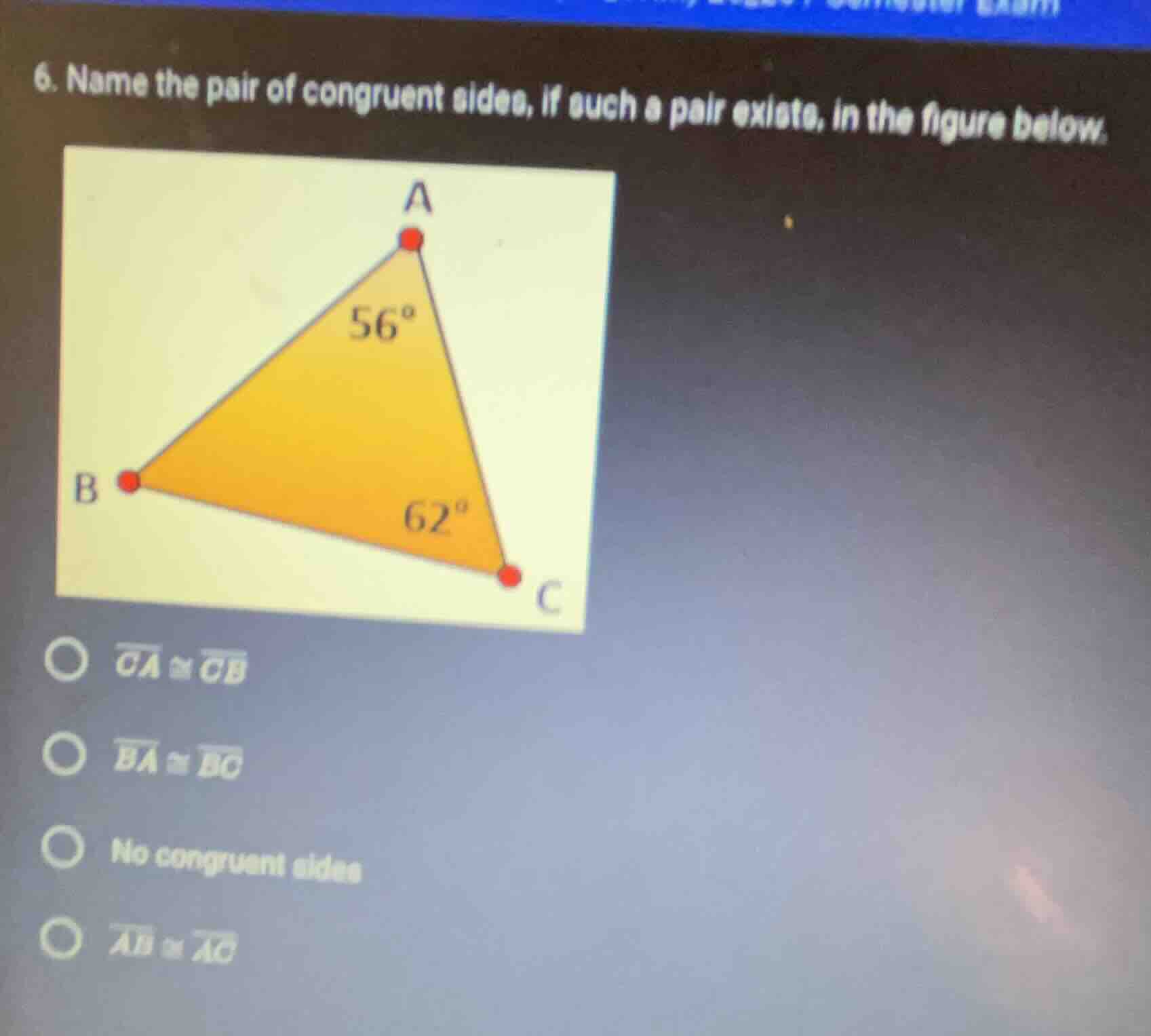
- name the pair of congruent sides, if such a pair exists, in the figure below.
\\(\overline{ca} \cong \overline{cb}\\)
\\(\overline{ba} \cong \overline{bc}\\)
no congruent sides
\\(\overline{ab} \cong \overline{ac}\\)
🆕 New Concept Discovered: Converse of the Isosceles Triangle Theorem
Sides opposite to equal angles are equal in length.
Step 1: Find the missing angle measure
The sum of the interior angles of any triangle is always \( 180^\circ \).
Substitute the given values:
Step 2: Identify equal angles
We now have the measures of all three angles:
- \( m\angle A = 56^\circ \)
- \( m\angle B = 62^\circ \)
- \( m\angle C = 62^\circ \)
Since \( m\angle B = m\angle C \), the triangle has two congruent angles.
Step 3: Determine the congruent sides
According to the Converse of the Isosceles Triangle Theorem, if two angles of a triangle are congruent, then the sides opposite those angles are also congruent.
- The side opposite to \( \angle B \) is \( \overline{AC} \) (or \( \overline{CA} \)).
- The side opposite to \( \angle C \) is \( \overline{AB} \) (or \( \overline{BA} \)).
Therefore, the sides opposite these equal angles must be congruent:

Snap & solve any problem in the app
Get step-by-step solutions on Sovi AI
Photo-based solutions with guided steps
Explore more problems and detailed explanations
\( \overline{AB} \cong \overline{AC} \) (the fourth option)