Sovi.AI - AI Math Tutor

Scan to solve math questions

QUESTION IMAGE

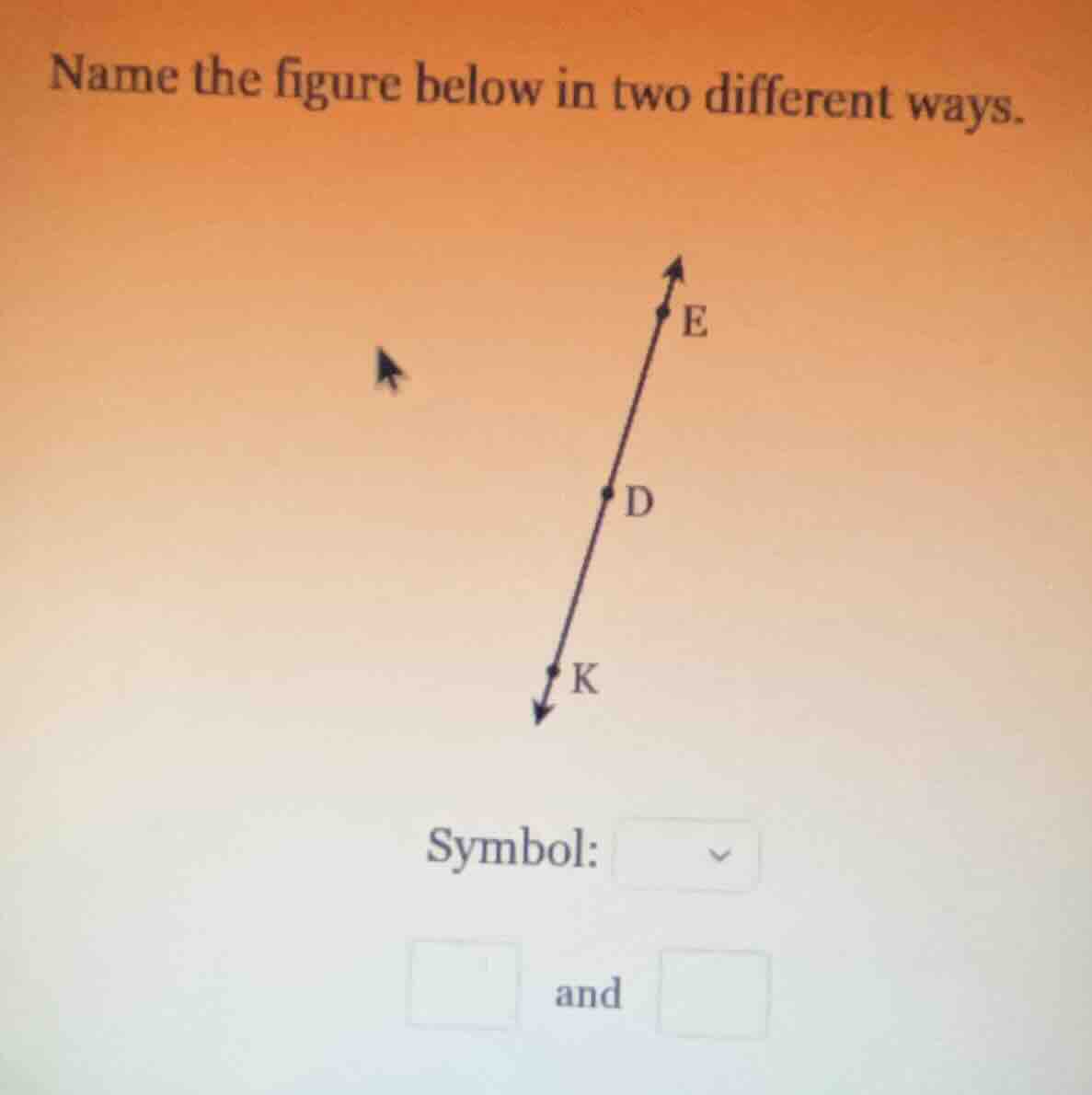
name the figure below in two different ways. p g c symbol: and

Question

name the figure below in two different ways. p g c symbol: and

Explanation:

Step1: Recall ray naming rules

A ray is named by its endpoint first, then another point on the ray. The endpoint is where the ray starts, and it extends infinitely in one direction.

Step2: Identify the ray's parts

In the given figure, the endpoint is \( C \), and the ray passes through \( G \) and \( P \). So one way to name it is using the endpoint \( C \) and another point \( P \), which is \( \overrightarrow{CP} \). Another way is using the endpoint \( C \) and the intermediate point \( G \), so \( \overrightarrow{CG} \). Wait, no, actually, a ray is named with the endpoint first, then any other point on the ray (since it extends through that point). Wait, the ray starts at \( C \) and goes through \( G \) and \( P \), so the ray can be named as \( \overrightarrow{CP} \) (since it starts at \( C \) and goes towards \( P \)) or \( \overrightarrow{CG} \)? Wait, no, actually, the ray is defined by its endpoint and the direction. So the ray starts at \( C \), and passes through \( G \) and \( P \), so the two names can be \( \overrightarrow{CP} \) (using endpoint \( C \) and point \( P \)) and \( \overrightarrow{CG} \) (using endpoint \( C \) and point \( G \))? Wait, no, maybe I made a mistake. Wait, the ray is drawn with an arrow at \( C \)? Wait, no, the arrow is at the end opposite to \( P \). Wait, looking at the figure: the ray has an endpoint? Wait, no, a ray has one endpoint and extends infinitely in one direction. Wait, the figure shows a ray with endpoint? Wait, no, the arrow is at \( C \), so the ray starts at \( P \) and goes through \( G \) to \( C \)? Wait, no, the arrow direction: the arrow is at \( C \), so the ray is going from \( P \) through \( G \) to \( C \), but that would mean the endpoint is \( P \)? Wait, no, I think I misread the arrow. Let me re-examine: the figure has a point \( P \), then \( G \), then \( C \), with an arrow at \( C \). So the ray starts at \( P \) and extends through \( G \) to \( C \) (but since it's a ray, it extends infinitely beyond \( C \)). Wait, no, the arrow indicates the direction of extension. So the ray has endpoint \( P \), and passes through \( G \) and \( C \), extending infinitely beyond \( C \). Wait, that makes more sense. So the ray is \( \overrightarrow{PC} \) (endpoint \( P \), passing through \( C \)) or \( \overrightarrow{PG} \) (endpoint \( P \), passing through \( G \))? Wait, no, the standard notation is: a ray is named by its endpoint first, then another point on the ray (in the direction of the arrow). So if the arrow is at \( C \), that means the ray starts at \( P \), goes through \( G \), and extends infinitely in the direction of \( C \). So the endpoint is \( P \), and the ray passes through \( G \) and \( C \). Therefore, two names for the ray are \( \overrightarrow{PC} \) (using endpoint \( P \) and point \( C \)) and \( \overrightarrow{PG} \) (using endpoint \( P \) and point \( G \))? Wait, no, maybe I had the endpoint wrong. Let's recall: a ray is a part of a line that starts at a point (endpoint) and extends infinitely in one direction. The arrow shows the direction of extension. So in the figure, the points are \( P \) (top), \( G \) (middle), \( C \) (bottom with arrow). So the ray starts at \( P \), goes through \( G \), and extends infinitely beyond \( C \) (since the arrow is at \( C \)). So the endpoint is \( P \), and the ray can be named as \( \overrightarrow{PC} \) (endpoint \( P \), passing through \( C \)) or \( \overrightarrow{PG} \) (endpoint \( P \), passing through \( G \))? Wait, no, actually, the ray is defined by its endpoint a…

Answer:

\(\overrightarrow{CP}\) and \(\overrightarrow{CG}\) (or \(\overrightarrow{PC}\) and \(\overrightarrow{PG}\) if the endpoint is \(P\); but based on the arrow at \(C\), the correct endpoint is \(C\), so \(\overrightarrow{CP}\) and \(\overrightarrow{CG}\))