QUESTION IMAGE
Question
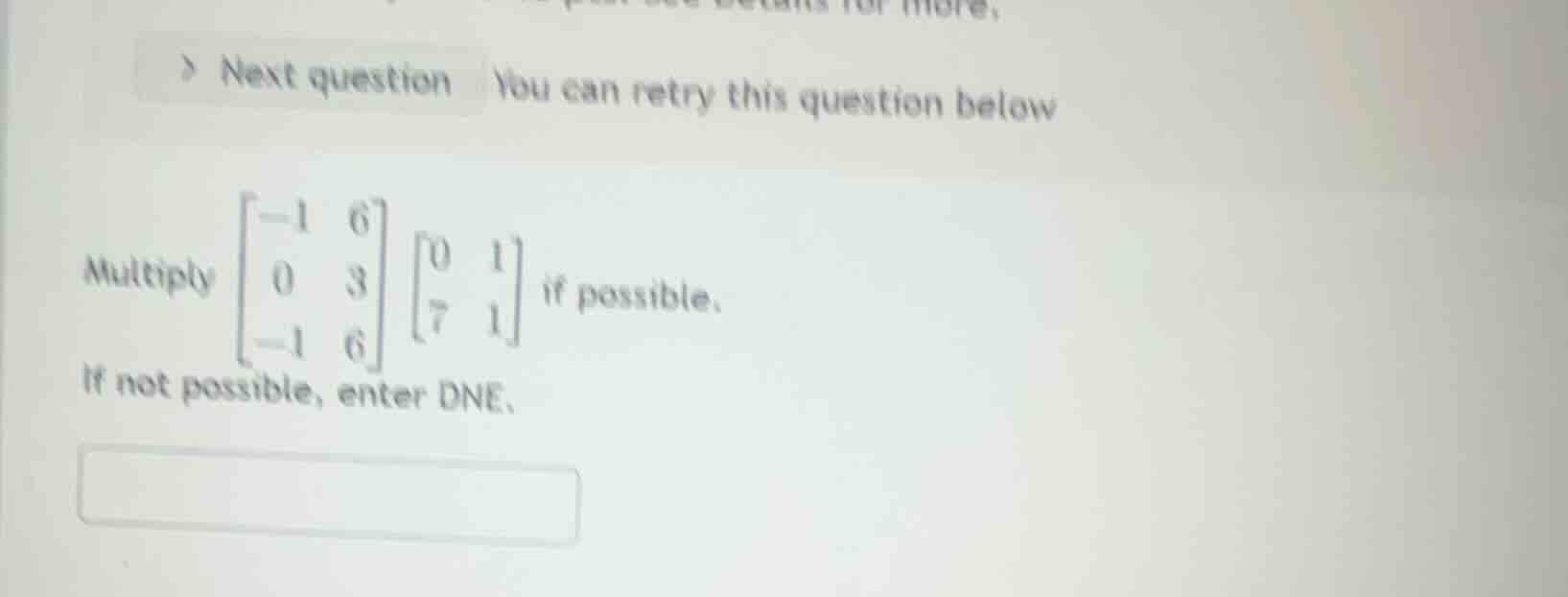
multiply \\(\
\
\\) if possible.
if not possible, enter dne.
Identify matrix dimensions
To determine if multiplication is possible, we first find the dimensions of each matrix.
The first matrix \(A\) has 3 rows and 2 columns:
The second matrix \(B\) has 2 rows and 2 columns:
Check multiplication compatibility
For the product \(AB\) to be defined, the number of columns in the first matrix \(A\) must equal the number of rows in the second matrix \(B\).
Here, the number of columns of \(A\) is 2, and the number of rows of \(B\) is 2.
Since \(2 = 2\), the multiplication is possible. The resulting matrix \(C = AB\) will have dimensions \(3 \times 2\).
Calculate the product elements
We compute each entry \(c_{ij}\) of the resulting matrix by taking the dot product of row \(i\) of \(A\) and column \(j\) of \(B\):
- Row 1, Column 1:
- Row 1, Column 2:
- Row 2, Column 1:
- Row 2, Column 2:
- Row 3, Column 1:
- Row 3, Column 2:
Construct the final matrix
We assemble the calculated entries into the final \(3 \times 2\) matrix:

Snap & solve any problem in the app
Get step-by-step solutions on Sovi AI
Photo-based solutions with guided steps
Explore more problems and detailed explanations
Multiply \(
\) if possible.
If not possible, enter DNE.
<blank>\(
\)</blank>