QUESTION IMAGE
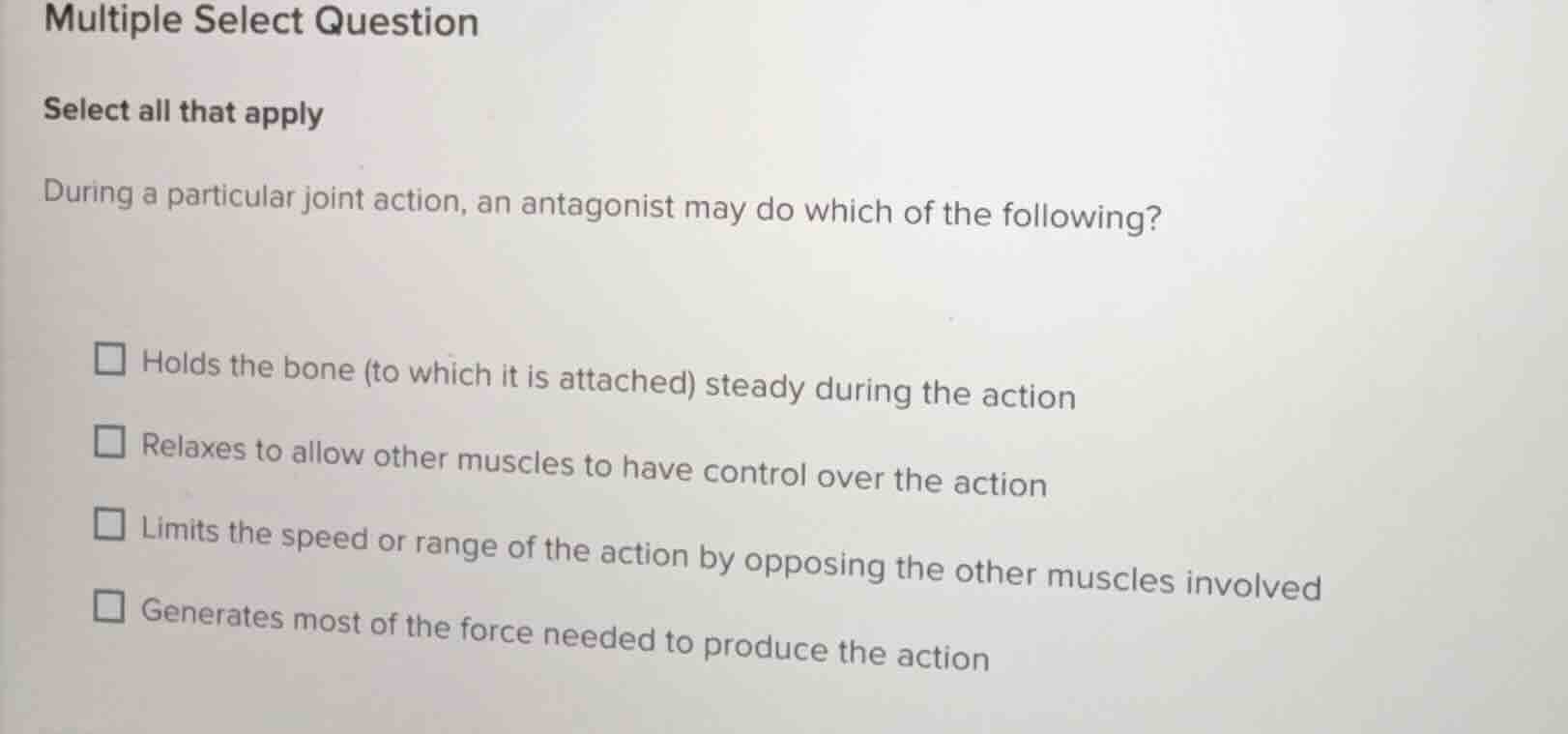
Question
multiple select question
select all that apply
during a particular joint action, an antagonist may do which of the following?
holds the bone (to which it is attached) steady during the action
relaxes to allow other muscles to have control over the action
limits the speed or range of the action by opposing the other muscles involved
generates most of the force needed to produce the action
Define the role of an antagonist muscle
Using the Muscle Functional Groups knowledge point, an antagonist is a muscle that opposes the prime mover (agonist). It acts on the opposite side of a joint during a movement.
Analyze the first option
Using the Synergist Muscle Function knowledge point, holding a bone steady to prevent movement or stabilize a joint is the primary role of a fixator muscle, not an antagonist.
Analyze the second option
Using the Muscle Functional Groups knowledge point, an antagonist must relax or yield to allow the agonist (prime mover) to contract and have control over the joint action. Thus, this statement is correct.
Analyze the third option
Using the Muscle Functional Groups knowledge point, an antagonist can contract moderately to slow down, control, or limit the speed and range of a movement, protecting the joint from injury. Thus, this statement is correct.
Analyze the fourth option
Using the Prime Mover and Agonist Muscle knowledge points, generating most of the force needed to produce the action is the definition of the prime mover (agonist), not the antagonist.

Snap & solve any problem in the app
Get step-by-step solutions on Sovi AI
Photo-based solutions with guided steps
Explore more problems and detailed explanations
- Holds the bone (to which it is attached) steady during the action
- Relaxes to allow other muscles to have control over the action (Correct answer)
- Limits the speed or range of the action by opposing the other muscles involved (Correct answer)
- Generates most of the force needed to produce the action