QUESTION IMAGE
Question
multiple choice question
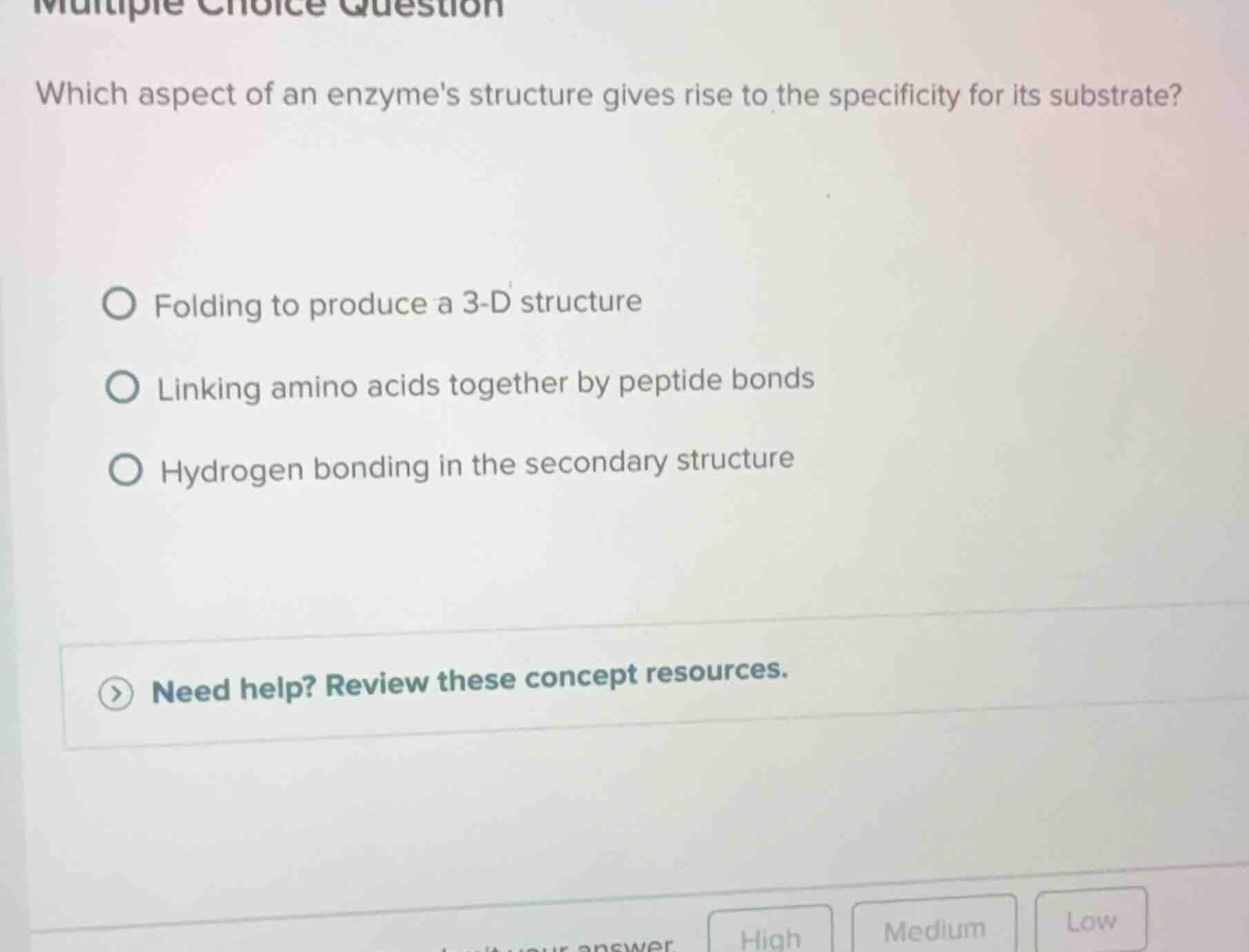
which aspect of an enzymes structure gives rise to the specificity for its substrate?
folding to produce a 3-d structure
linking amino acids together by peptide bonds
hydrogen bonding in the secondary structure
Analyze the structural basis of enzyme specificity
The unique three-dimensional (3-D) conformation of an enzyme, resulting from tertiary and quaternary folding, creates a highly specific active site that matches the shape and chemical properties of its substrate.
Evaluate the given options
- Folding to produce a 3-D structure: Correct. This folding creates the specific active site pocket required for substrate binding.
- Linking amino acids together by peptide bonds: Incorrect. This forms the primary structure, which is a linear chain and does not yet possess a functional active site.
- Hydrogen bonding in the secondary structure: Incorrect. This forms local structures like alpha-helices and beta-sheets, but does not define the overall unique 3-D active site pocket.

Snap & solve any problem in the app
Get step-by-step solutions on Sovi AI
Photo-based solutions with guided steps
Explore more problems and detailed explanations
- Folding to produce a 3-D structure (Correct answer)
- Linking amino acids together by peptide bonds
- Hydrogen bonding in the secondary structure