QUESTION IMAGE
Question
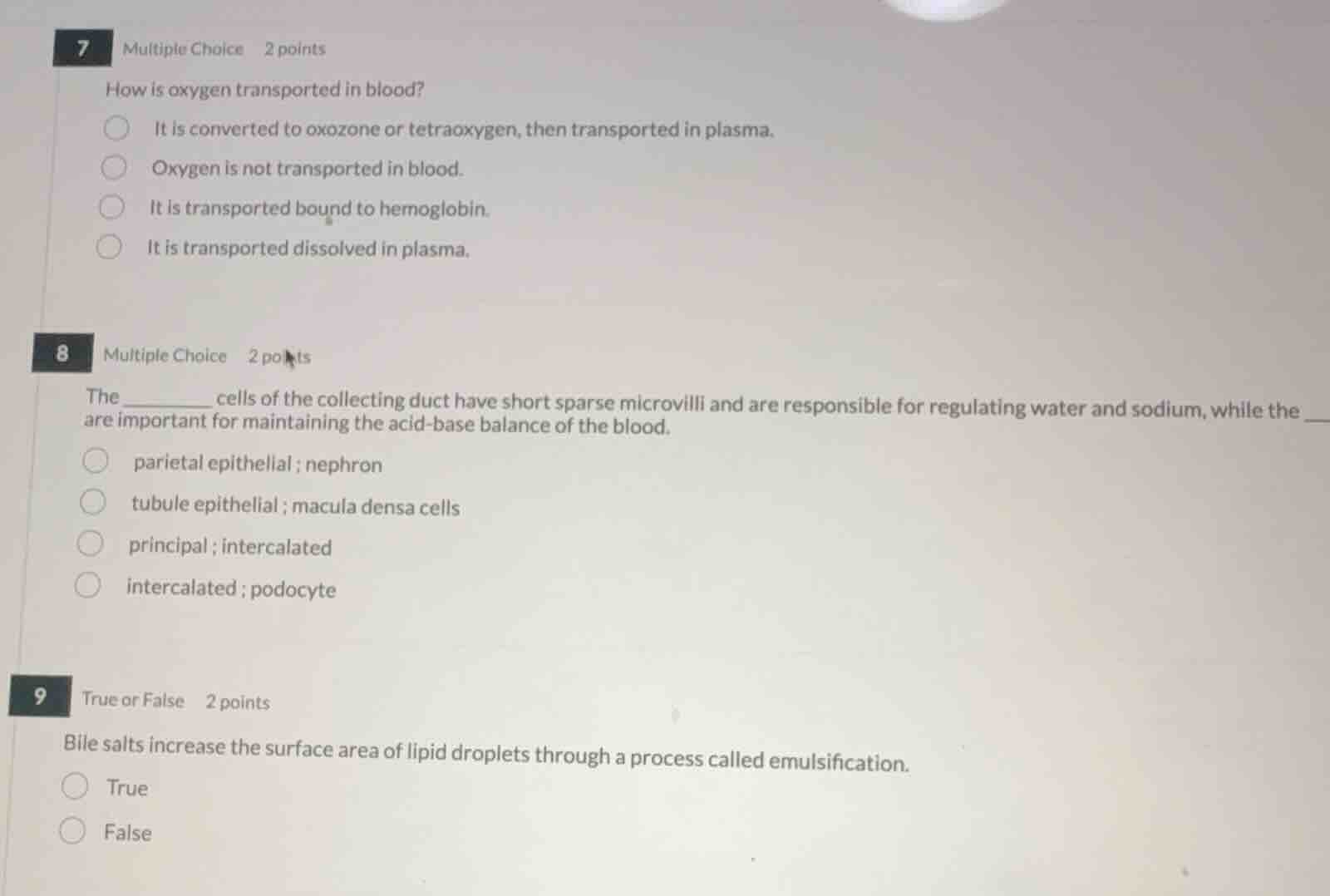
7 multiple choice 2 points
how is oxygen transported in blood?
it is converted to oxozone or tetraoxygen, then transported in plasma.
oxygen is not transported in blood.
it is transported bound to hemoglobin.
it is transported dissolved in plasma.
8 multiple choice 2 points
the ____ cells of the collecting duct have short sparse microvilli and are responsible for regulating water and sodium, while the ____ are important for maintaining the acid-base balance of the blood.
parietal epithelial ; nephron
tubule epithelial ; macula densa cells
principal ; intercalated
intercalated ; podocyte
9 true or false 2 points
bile salts increase the surface area of lipid droplets through a process called emulsification.
true
false
Analyze oxygen transport in blood
Oxygen is primarily transported bound to hemoglobin inside red blood cells (about 98.5%), while a small fraction is dissolved in plasma (about 1.5%). Among the choices, "It is transported bound to hemoglobin" represents the primary and correct mechanism.
Identify collecting duct cell types
Principal cells of the collecting duct have short, sparse microvilli and regulate water and sodium balance (under ADH and aldosterone control). Intercalated cells (alpha and beta) are responsible for acid-base balance by secreting hydrogen ions or bicarbonate. Thus, the correct pair is "principal ; intercalated".
Evaluate the role of bile salts
Bile salts act as detergents to break down large lipid globules into smaller droplets, a physical process called emulsification. This significantly increases the surface area available for pancreatic lipase to digest the lipids. The statement is true.

Snap & solve any problem in the app
Get step-by-step solutions on Sovi AI
Photo-based solutions with guided steps
Explore more problems and detailed explanations
Question 7
- It is converted to oxozone or tetraoxygen, then transported in plasma.
- Oxygen is not transported in blood.
- It is transported bound to hemoglobin. (Correct answer)
- It is transported dissolved in plasma.
Question 8
- parietal epithelial ; nephron
- tubule epithelial ; macula densa cells
- principal ; intercalated (Correct answer)
- intercalated ; podocyte
Question 9
- True (Correct answer)
- False