QUESTION IMAGE
Question
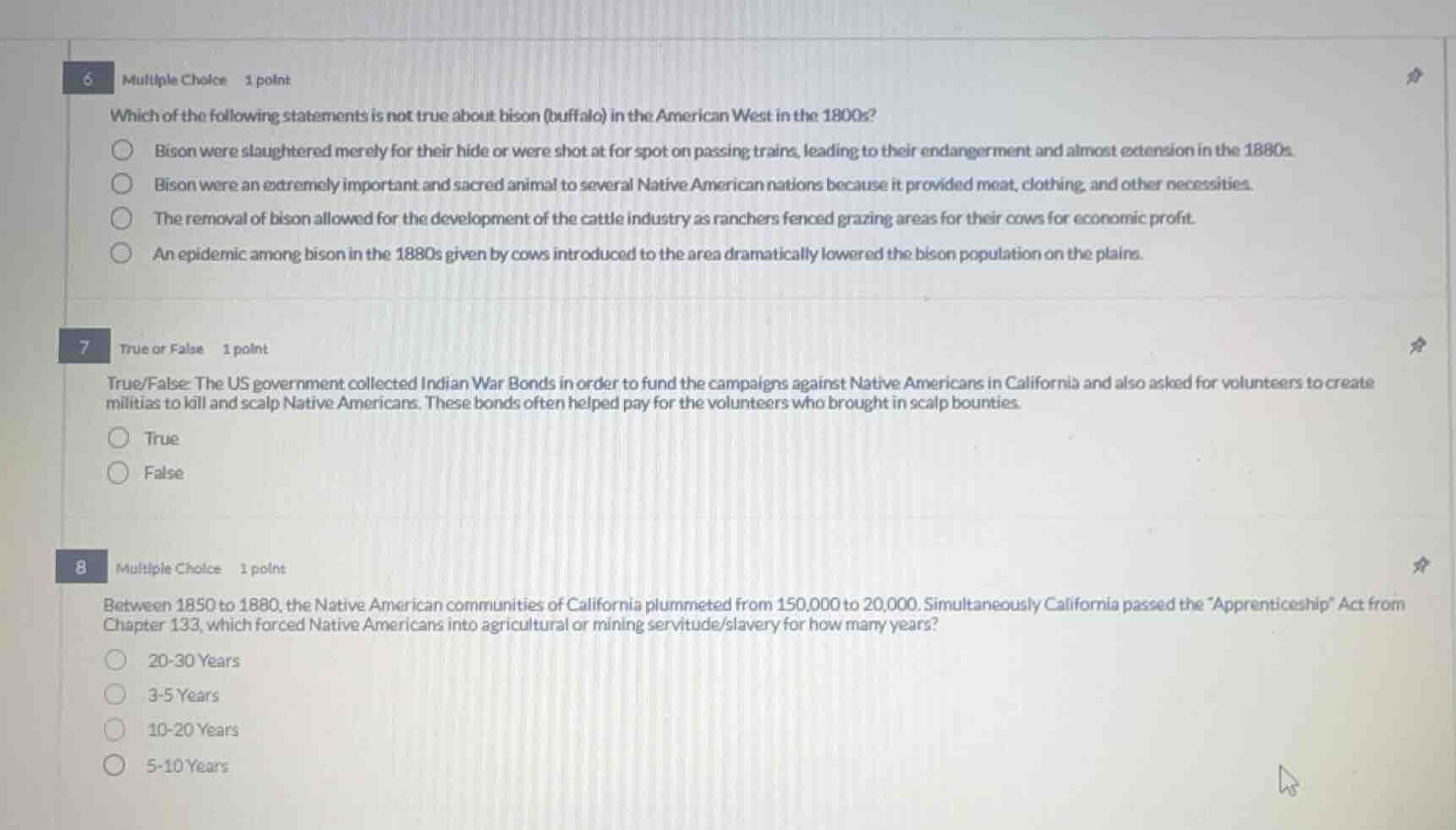
6 multiple choice 1 point
which of the following statements is not true about bison (buffalo) in the american west in the 1800s?
bison were slaughtered merely for their hide or were shot at for sport on passing trains, leading to their endangerment and almost extinction in the 1880s.
bison were an extremely important and sacred animal to several native american nations because it provided meat, clothing, and other necessities.
the removal of bison allowed for the development of the cattle industry as ranchers fenced grazing areas for their cows for economic profit.
an epidemic among bison in the 1880s given by cows introduced to the area dramatically lowered the bison population on the plains.
7 true or false 1 point
true/false: the us government collected indian war bonds in order to fund the campaigns against native americans in california and also asked for volunteers to create militias to kill and scalp native americans. these bonds often helped pay for the volunteers who brought in scalp bounties.
true
false
8 multiple choice 1 point
between 1850 to 1880, the native american communities of california plummeted from 150,000 to 20,000. simultaneously california passed the \apprenticeship\ act from chapter 133, which forced native americans into agricultural or mining servitude/slavery for how many years?
20-30 years
3-5 years
10-20 years
5-10 years
Analyze Question 6
This question asks for the statement that is not true about bison in the American West during the 1800s. Let's evaluate the options:
- Option 1: Bison were indeed slaughtered for hides, sport, and to clear the plains, leading to near extinction by the late 1800s.
- Option 2: Bison were deeply sacred and essential to many Plains Native American nations for food, shelter, and clothing.
- Option 3: The systematic removal of bison cleared the grasslands, allowing the cattle ranching industry to expand rapidly.
- Option 4: While cattle did introduce diseases like brucellosis, the primary and overwhelming driver of the dramatic population collapse was systematic overhunting and deliberate slaughter by humans, not a cow-borne epidemic in the 1880s. Thus, this statement is historically inaccurate.
Analyze Question 7
This question is a True/False statement regarding California's state-funded campaigns against Native Americans.
- During the California Gold Rush and subsequent decades, the state government issued "Expedition Bonds" (often referred to as Indian War Bonds) to fund local volunteer militias.
- These state-sanctioned militias actively hunted, killed, and displaced Native Americans, and the state paid out bounties for scalps or heads, funded by these bonds and later reimbursed by the federal government.
- Therefore, the statement is historically true.
Analyze Question 8
This question asks about the duration of servitude/slavery forced upon Native Americans under the "Apprenticeship" provision of California's legislation.
- Using the California Act for the Government and Protection of Indians (specifically Chapter 133, passed in 1850), secular authorities could indenture or "apprentice" Native Americans.
- Under Section 3 of the Act, Native American children and adults could be indentured. Amendments and practices allowed for terms of servitude that typically lasted 10-20 Years (specifically, up to 15 or 20 years depending on age and gender, with many young Native Americans bound until they reached majority age, which was set up to 15-21 years).
- Looking at the standard historical curriculum options, the correct range representing these indenture terms is 10-20 Years.

Snap & solve any problem in the app
Get step-by-step solutions on Sovi AI
Photo-based solutions with guided steps
Explore more problems and detailed explanations
Question 6
- (A) Bison were slaughtered merely for their hide or were shot at for spot on passing trains, leading to their endangerment and almost extension in the 1880s.
- (B) Bison were an extremely important and sacred animal to several Native American nations because it provided meat, clothing, and other necessities.
- (C) The removal of bison allowed for the development of the cattle industry as ranchers fenced grazing areas for their cows for economic profit.
- (D) An epidemic among bison in the 1880s given by cows introduced to the area dramatically lowered the bison population on the plains. (Correct answer)
Question 7
- True (Correct answer)
- False
Question 8
- 20-30 Years
- 3-5 Years
- 10-20 Years (Correct answer)
- 5-10 Years