QUESTION IMAGE
Question
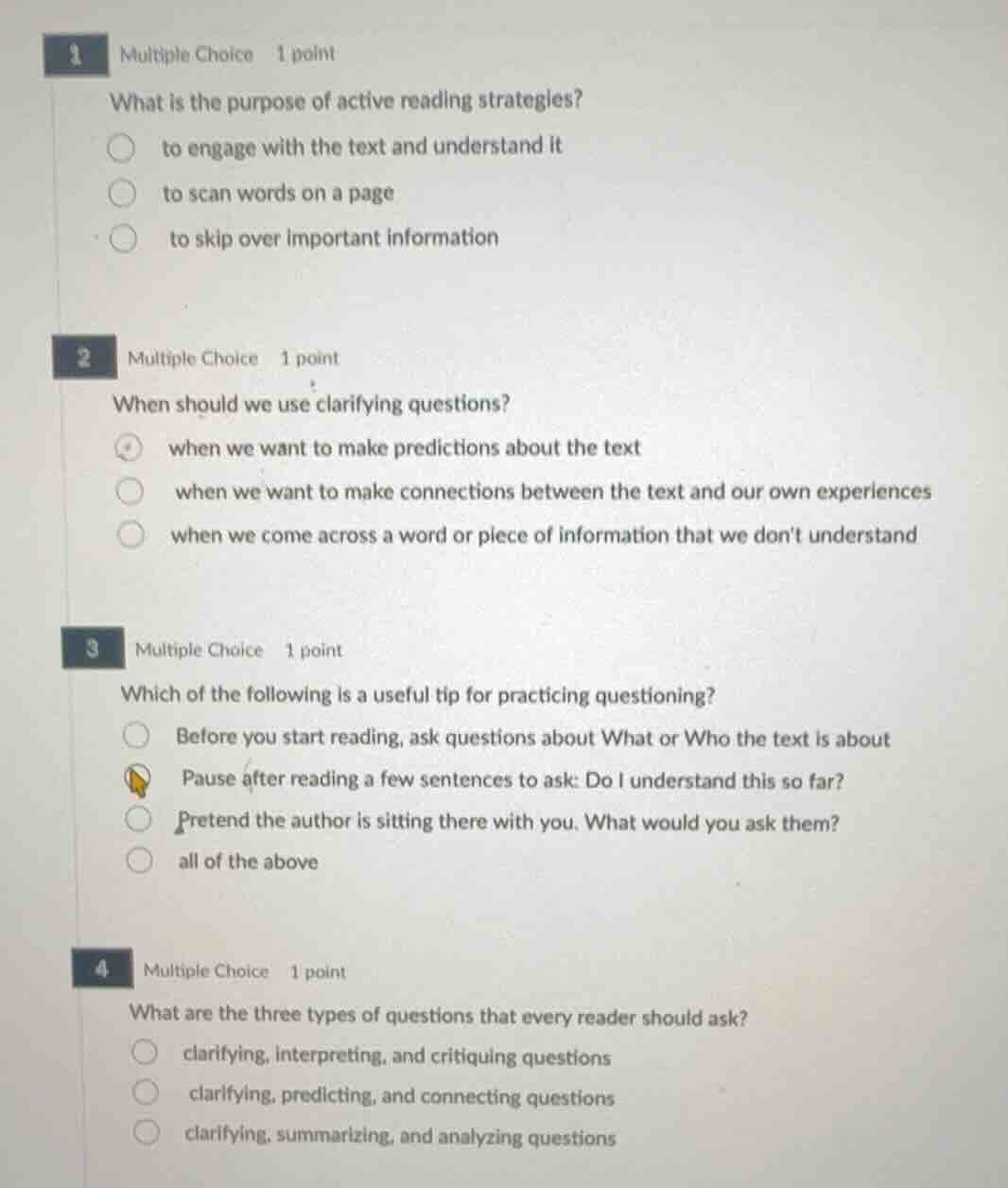
1 multiple choice 1 point
what is the purpose of active reading strategies?
to engage with the text and understand it
to scan words on a page
to skip over important information
2 multiple choice 1 point
when should we use clarifying questions?
when we want to make predictions about the text
when we want to make connections between the text and our own experiences
when we come across a word or piece of information that we dont understand
3 multiple choice 1 point
which of the following is a useful tip for practicing questioning?
before you start reading, ask questions about what or who the text is about
pause after reading a few sentences to ask: do i understand this so far?
pretend the author is sitting there with you. what would you ask them?
all of the above
4 multiple choice 1 point
what are the three types of questions that every reader should ask?
clarifying, interpreting, and critiquing questions
clarifying, predicting, and connecting questions
clarifying, summarizing, and analyzing questions
Analyze Question 1
Active reading strategies are designed to help readers actively engage with, process, and comprehend the text rather than passively scanning words or skipping information.
Analyze Question 2
Clarifying questions are used specifically when a reader encounters confusing words, phrases, or concepts to resolve misunderstandings and gain clarity.
Analyze Question 3
Useful tips for practicing questioning include asking pre-reading questions, pausing during reading to self-monitor comprehension, and imagining a dialogue with the author. Therefore, all of the options listed are useful tips.
Analyze Question 4
In active reading frameworks, the three fundamental types of questions that readers are taught to ask to deepen comprehension are clarifying (to understand), predicting (to anticipate), and connecting (to relate to personal knowledge or other texts).

Snap & solve any problem in the app
Get step-by-step solutions on Sovi AI
Photo-based solutions with guided steps
Explore more problems and detailed explanations
Question 1
- to engage with the text and understand it (Correct answer)
- to scan words on a page
- to skip over important information
Question 2
- when we want to make predictions about the text
- when we want to make connections between the text and our own experiences
- when we come across a word or piece of information that we don't understand (Correct answer)
Question 3
- Before you start reading, ask questions about What or Who the text is about
- Pause after reading a few sentences to ask: Do I understand this so far?
- Pretend the author is sitting there with you. What would you ask them?
- all of the above (Correct answer)
Question 4
- clarifying, interpreting, and critiquing questions
- clarifying, predicting, and connecting questions (Correct answer)
- clarifying, summarizing, and analyzing questions