QUESTION IMAGE
Question
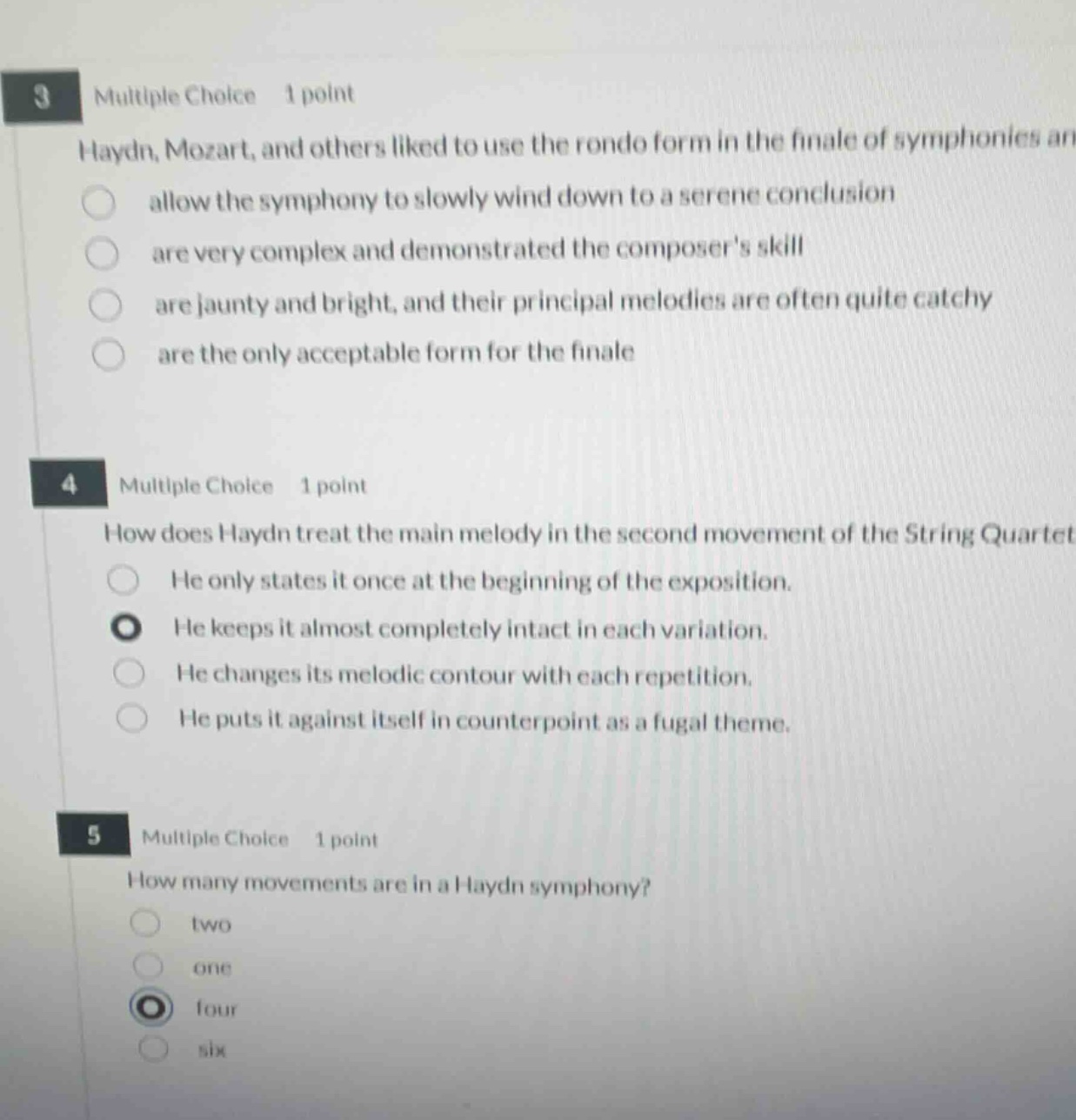
3 multiple choice 1 point
haydn, mozart, and others liked to use the rondo form in the finale of symphonies because rondos
allow the symphony to slowly wind down to a serene conclusion
are very complex and demonstrated the composers skill
are jaunty and bright, and their principal melodies are often quite catchy
are the only acceptable form for the finale
4 multiple choice 1 point
how does haydn treat the main melody in the second movement of the string quartet, op. 76, no. 3?
he only states it once at the beginning of the exposition.
he keeps it almost completely intact in each variation.
he changes its melodic contour with each repetition.
he puts it against itself in counterpoint as a fugal theme.
5 multiple choice 1 point
how many movements are in a haydn symphony?
two
one
four
six
Analyze Rondo Form characteristics
The first question asks why Classical composers like Haydn and Mozart favored Rondo Form for their finales. Rondos feature a recurring, lively main theme (A) alternating with contrasting episodes (e.g., ABACA). This structure makes them inherently jaunty, bright, and catchy, providing a lighthearted and satisfying conclusion to a multi-movement work.
Analyze Haydn's Emperor Quartet movement
The second question concerns the second movement of Haydn's String Quartet in C major, Op. 76, No. 3 ("Emperor"). This movement is a set of theme and variations based on the "Emperor's Hymn." In Haydn String Quartet performance practice, Haydn treats the main melody unusually by keeping it almost completely intact in each variation, passing it unchanged from instrument to instrument while the surrounding accompaniment changes.
Analyze Classical symphony structure
The third question asks about the standard number of movements in a Haydn symphony. Under the standard Classical Symphony Structure established during the Classical era by composers like Haydn, a symphony typically consists of four movements: a fast opening, a slow second movement, a minuet or scherzo third movement, and a fast finale.

Snap & solve any problem in the app
Get step-by-step solutions on Sovi AI
Photo-based solutions with guided steps
Explore more problems and detailed explanations
Question 3
- allow the symphony to slowly wind down to a serene conclusion
- are very complex and demonstrated the composer's skill
- are jaunty and bright, and their principal melodies are often quite catchy (Correct answer)
- are the only acceptable form for the finale
Question 4
- He only states it once at the beginning of the exposition.
- He keeps it almost completely intact in each variation. (Correct answer)
- He changes its melodic contour with each repetition.
- He puts it against itself in counterpoint as a fugal theme.
Question 5
- two
- one
- four (Correct answer)
- six