QUESTION IMAGE
Question
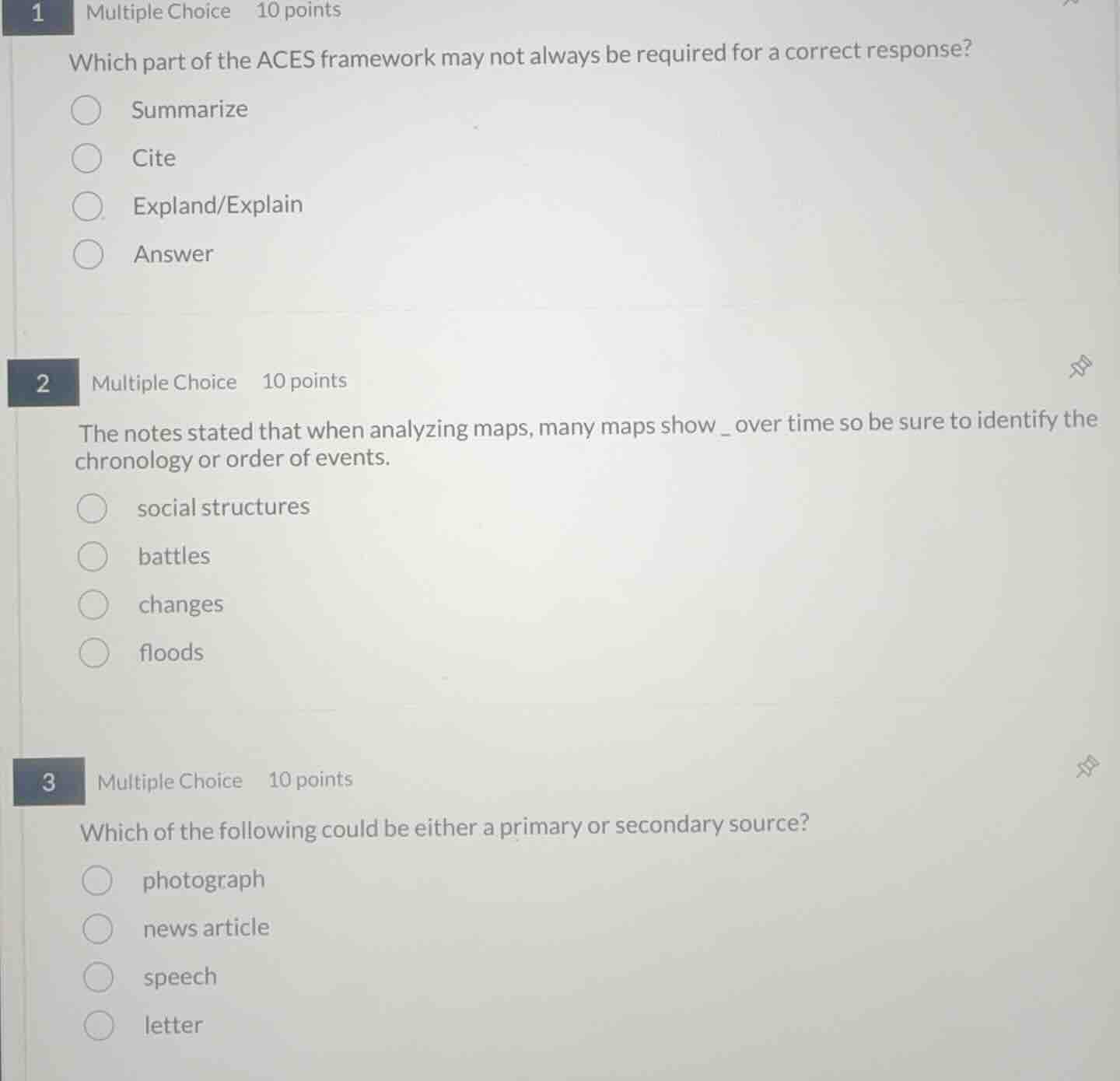
1 multiple choice 10 points
which part of the aces framework may not always be required for a correct response?
summarize
cite
expland/explain
answer
2 multiple choice 10 points
the notes stated that when analyzing maps, many maps show _ over time so be sure to identify the chronology or order of events.
social structures
battles
changes
floods
3 multiple choice 10 points
which of the following could be either a primary or secondary source?
photograph
news article
speech
letter
<pre_analysis>
{
"quality": "clear",
"question_count": 3,
"skills_matched": [
"direct_cot",
"multiple_choice_formatter",
"explain_then_answer",
"quick"
],
"needs_drawing": false,
"concepts_used": [],
"new_concepts": [],
"current_concepts": [
"ACES Writing Framework",
"Chronological Map Analysis",
"Historical Source Analysis"
]
}
</pre_analysis>
<reasoning>
Analyze ACES framework components
The ACES writing framework stands for Answer, Cite, Explain, and Summarize. In many short-answer contexts, summarizing is optional or not strictly required for a correct response, whereas answering, citing evidence, and explaining are essential.
Analyze chronological map reading
The sentence states: "...many maps show _ over time so be sure to identify the chronology or order of events." The phrase "over time" and "chronology" directly relate to tracking "changes" occurring across a timeline.
Analyze primary vs secondary sources
A news article can be a primary source if written by a witness at the time of an event, or a secondary source if written later by a journalist analyzing historical events. Photographs, speeches, and letters are almost always primary sources.
</reasoning>
<answer>
Question 1
<mcq-correct>(A) Summarize</mcq-correct>
<mcq-option>(B) Cite</mcq-option>
<mcq-option>(C) Expland/Explain</mcq-option>
<mcq-option>(D) Answer</mcq-option>
Question 2
<mcq-option>(A) social structures</mcq-option>
<mcq-option>(B) battles</mcq-option>
<mcq-correct>(C) changes</mcq-correct>
<mcq-option>(D) floods</mcq-option>
Question 3
<mcq-option>(A) photograph</mcq-option>
<mcq-correct>(B) news article</mcq-correct>
<mcq-option>(C) speech</mcq-option>
<mcq-option>(D) letter</mcq-option>
</answer>
<post_analysis>
{
"subject": "Social Science",
"question_type": "Multiple Choice",
"knowledge_point": [
"Social Science",
"History",
"Historical Methodology"
]
}
</post_analysis>
Snap & solve any problem in the app
Get step-by-step solutions on Sovi AI
Photo-based solutions with guided steps
Explore more problems and detailed explanations
<pre_analysis>
{
"quality": "clear",
"question_count": 3,
"skills_matched": [
"direct_cot",
"multiple_choice_formatter",
"explain_then_answer",
"quick"
],
"needs_drawing": false,
"concepts_used": [],
"new_concepts": [],
"current_concepts": [
"ACES Writing Framework",
"Chronological Map Analysis",
"Historical Source Analysis"
]
}
</pre_analysis>
<reasoning>
Analyze ACES framework components
The ACES writing framework stands for Answer, Cite, Explain, and Summarize. In many short-answer contexts, summarizing is optional or not strictly required for a correct response, whereas answering, citing evidence, and explaining are essential.
Analyze chronological map reading
The sentence states: "...many maps show _ over time so be sure to identify the chronology or order of events." The phrase "over time" and "chronology" directly relate to tracking "changes" occurring across a timeline.
Analyze primary vs secondary sources
A news article can be a primary source if written by a witness at the time of an event, or a secondary source if written later by a journalist analyzing historical events. Photographs, speeches, and letters are almost always primary sources.
</reasoning>
<answer>
Question 1
<mcq-correct>(A) Summarize</mcq-correct>
<mcq-option>(B) Cite</mcq-option>
<mcq-option>(C) Expland/Explain</mcq-option>
<mcq-option>(D) Answer</mcq-option>
Question 2
<mcq-option>(A) social structures</mcq-option>
<mcq-option>(B) battles</mcq-option>
<mcq-correct>(C) changes</mcq-correct>
<mcq-option>(D) floods</mcq-option>
Question 3
<mcq-option>(A) photograph</mcq-option>
<mcq-correct>(B) news article</mcq-correct>
<mcq-option>(C) speech</mcq-option>
<mcq-option>(D) letter</mcq-option>
</answer>
<post_analysis>
{
"subject": "Social Science",
"question_type": "Multiple Choice",
"knowledge_point": [
"Social Science",
"History",
"Historical Methodology"
]
}
</post_analysis>