QUESTION IMAGE
Question
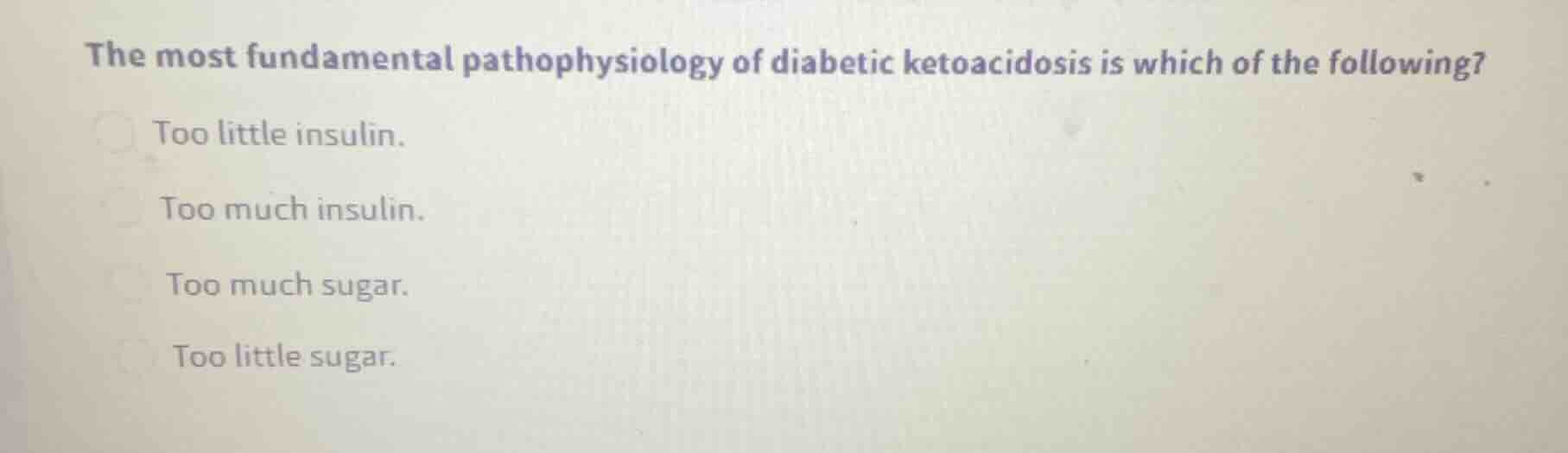
the most fundamental pathophysiology of diabetic ketoacidosis is which of the following?
too little insulin.
too much insulin.
too much sugar.
too little sugar.
Identify the core mechanism of DKA
Using the Diabetic Ketoacidosis Pathophysiology knowledge point
- Diabetic ketoacidosis (DKA) is a life-threatening complication primarily occurring in patients with Type 1 diabetes.
- The fundamental underlying cause of DKA is an absolute or relative deficiency of insulin (too little insulin).
- Without adequate insulin, cells cannot uptake glucose for energy, leading the body to break down fats for fuel, which produces acidic ketone bodies.
Evaluate the given options
- "Too little insulin": Directly matches the primary pathophysiological trigger of DKA.
- "Too much insulin": This would lead to hypoglycemia (low blood sugar), not DKA.
- "Too much sugar": While hyperglycemia is present in DKA, it is a consequence of the lack of insulin, not the fundamental pathophysiological trigger itself.
- "Too little sugar": This describes hypoglycemia.

Snap & solve any problem in the app
Get step-by-step solutions on Sovi AI
Photo-based solutions with guided steps
Explore more problems and detailed explanations
- Too little insulin. (Correct answer)
- Too much insulin.
- Too much sugar.
- Too little sugar.