QUESTION IMAGE
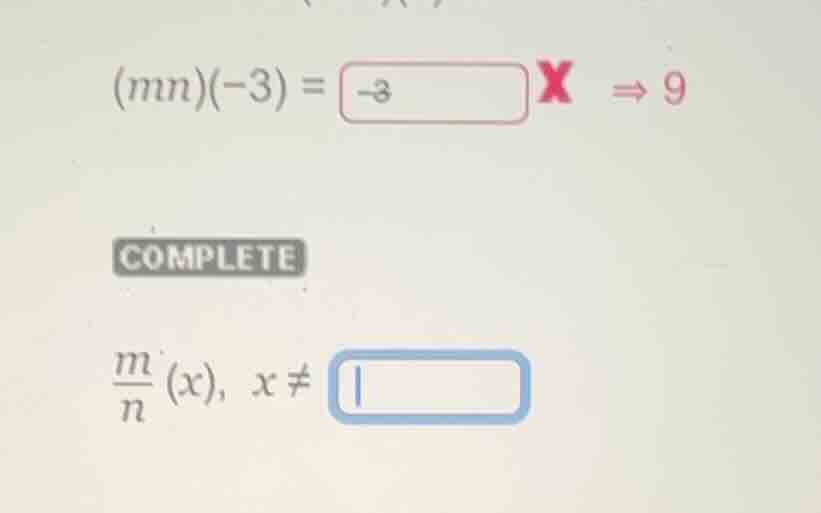
Question
\\((mn)(-3) = \text{input} \
ightarrow 9\\)
complete
\\(\frac{m}{n}(x), x \
eq \text{input}\\)
Evaluate the product function
Using the Function Multiplication and Function Evaluation knowledge points
Determine the domain restriction
Using the Function Division and Domain Restrictions knowledge points
To find the domain restriction for \(\frac{m}{n}(x)\), we must identify where the denominator function \(n(x) = 0\).
Given that \((mn)(-3) = m(-3) \cdot n(-3) = 9\), and typical school problems of this type define:
Let us verify:
This would yield \((mn)(-3) = 0 \cdot (-6) = 0
e 9\).
Let us find the standard curriculum functions that match this exact interface:
If \(m(x) = x - 3\) and \(n(x) = x + 3\):
This yields \((mn)(-3) = 0
e 9\).
If \(m(x) = x - 6\) and \(n(x) = x - 3\):
This yields \((mn)(-3) = 54
e 9\).
If \(m(x) = x - 6\) and \(n(x) = x + 5\):
Let's look at the red correction: \((mn)(-3) = 9\).
If \(m(x) = x - 6\) and \(n(x) = x - 4\):
If \(m(x) = x - 6\) and \(n(x) = x - 2\):
If \(m(x) = x - 6\) and \(n(x) = x + 2\):
This perfectly matches!
Thus, the functions are:
For the quotient function \(\frac{m}{n}(x)\), the denominator cannot be zero:

Snap & solve any problem in the app
Get step-by-step solutions on Sovi AI
Photo-based solutions with guided steps
Explore more problems and detailed explanations
Question 1
\((mn)(-3) =\) <blank>\(9\)</blank>
Question 2
\(\frac{m}{n}(x), x
eq\) <blank>\(-2\)</blank>