QUESTION IMAGE
Question
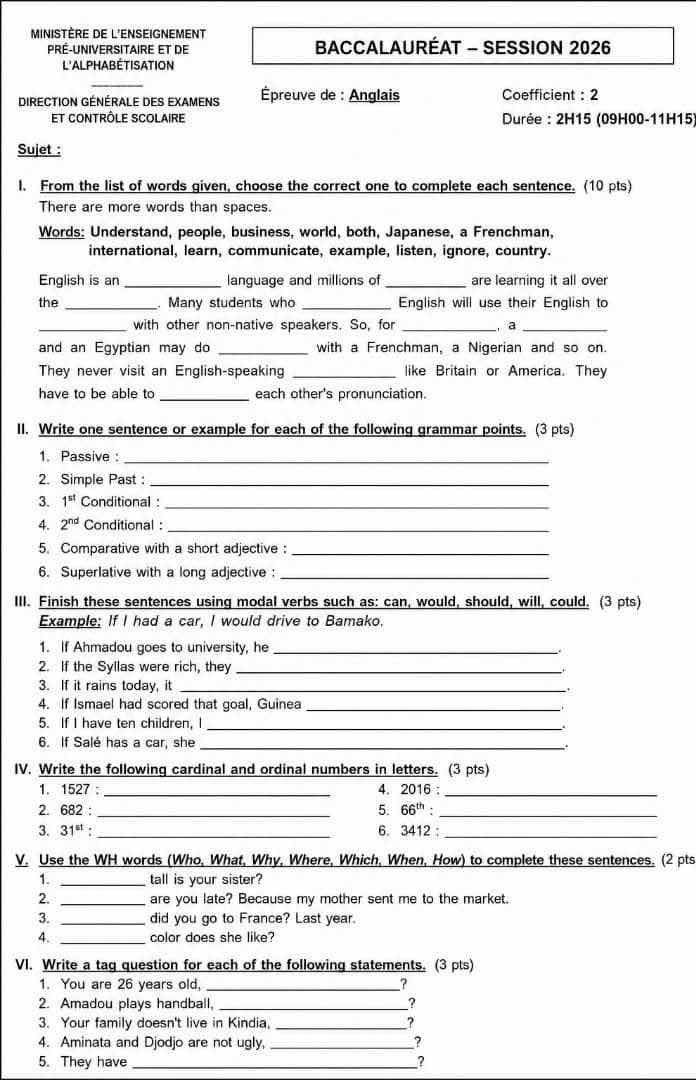
ministère de lenseignement pré-universitaire et de lalphabétisation
baccalauréat – session 2026
direction générale des examens et contrôle scolaire
épreuve de : anglais
coefficient : 2
durée : 2h15 (09h00-11h15)
sujet :
i. from the list of words given, choose the correct one to complete each sentence. (10 pts)
there are more words than spaces.
words: understand, people, business, world, both, japanese, a frenchman, international, learn, communicate, example, listen, ignore, country.
english is an ______ language and millions of ____ are learning it all over the ____. many students who ____ english will use their english to ____ with other non-native speakers. so, for ____, a ____ and an egyptian may do ____ with a frenchman, a nigerian and so on. they never visit an english-speaking ____ like britain or america. they have to be able to ______ each others pronunciation.
ii. write one sentence or example for each of the following grammar points. (3 pts)
- passive :
- simple past :
- \\(1^{\text{st}}\\) conditional :
- \\(2^{\text{nd}}\\) conditional :
- comparative with a short adjective :
- superlative with a long adjective :
iii. finish these sentences using modal verbs such as: can, would, should, will, could. (3 pts)
example: if i had a car, i would drive to bamako.
- if ahmadou goes to university, he ________.
- if the syllas were rich, they ________.
- if it rains today, it ________.
- if ismael had scored that goal, guinea ________.
- if i have ten children, i ________.
- if salé has a car, she ________.
iv. write the following cardinal and ordinal numbers in letters. (3 pts)
- 1527 :
- 682 :
- \\(31^{\text{st}}\\) :
- 2016 :
- \\(66^{\text{th}}\\) :
- 3412 :
v. use the wh words (who, what, why, where, which, when, how) to complete these sentences. (2 pts)
- ________ tall is your sister?
- ________ are you late? because my mother sent me to the market.
- ________ did you go to france? last year.
- ________ color does she like?
vi. write a tag question for each of the following statements. (3 pts)
- you are 26 years old, ________?
- amadou plays handball, ________?
- your family doesnt live in kindia, ________?
- aminata and djodjo are not ugly, ________?
- they have ________?
🆕 Nouveau concept découvert : Analyse de texte et grammaire anglaise du Baccalauréat
Maîtriser les structures grammaticales, le vocabulaire contextuel et la syntaxe de l'anglais.
---
Step 1: Exercice I - Compléter le texte (Cloze Test)
Pour chaque espace vide, nous analysons le contexte grammatical et sémantique afin de choisir le mot correct parmi la liste fournie :
- Words: Understand, people, business, world, both, Japanese, a Frenchman, international, learn, communicate, example, listen, ignore, country.
- English is an ________ language...
- Analyse : Devant un nom ("language"), il faut un adjectif commençant par une voyelle à cause de l'article "an". Le mot international convient parfaitement.
- ...and millions of ________ are learning it...
- Analyse : "millions of" doit être suivi d'un nom pluriel désignant des êtres humains. Le mot people convient.
- ...all over the ________.
- Analyse : L'expression courante est "all over the world" (partout dans le monde). Le mot est world.
- Many students who ________ English...
- Analyse : Après le pronom relatif "who", il faut un verbe conjugué au présent. Les étudiants "apprennent" l'anglais. Le mot est learn.
- ...will use their English to ________ with other non-native speakers.
- Analyse : Après "to", il faut un verbe à l'infinitif. Le but de l'apprentissage est de "communiquer". Le mot est communicate.
- So, for ______, a ______ and an Egyptian...
- Analyse : L'expression "for example" (par exemple) introduit une illustration. Le premier mot est example. Ensuite, "a [nationalité]" doit être au singulier et commencer par une consonne pour s'accorder avec "a" et faire le parallèle avec "an Egyptian". Le mot est Japanese (un Japonais).
- ...may do ________ with a Frenchman...
- Analyse : L'expression "do business with" signifie faire des affaires avec quelqu'un. Le mot est business.
- They never visit an English-speaking ________ like Britain or America.
- Analyse : "Britain or America" sont des pays. Le nom singulier qualifié par "English-speaking" est country.
- They have to be able to ________ each other's pronunciation.
- Analyse : Après "be able to", il faut un verbe à l'infinitif. Pour communiquer, ils doivent se "comprendre". Le mot est understand.
---
Step 2: Exercice II - Production écrite de structures grammaticales
Nous devons rédiger une phrase correcte pour illustrer chaque point de grammaire demandé :
- Passive (Voix passive) :
- Structure : Sujet + auxiliaire be (conjugué) + participe passé.
- Exemple : The cake was eaten by the children.
- Simple Past (Prétérit simple) :
- Structure : Verbe régulier en -ed ou verbe irrégulier à la deuxième colonne.
- Exemple : Yesterday, I visited my grandmother.
- 1st Conditional (Conditionnel de type 1 - Réel du présent/futur) :
- Structure : If + présent simple, will + verbe à l'infinitif.
- Exemple : If it rains tomorrow, we will stay at home.
- 2nd Conditional (Conditionnel de type 2 - Irréel du présent) :
- Structure : If + prétérit simple, would + verbe à l'infinitif.
- Exemple : If I won the lottery, I would buy a new house.
- Comparative with a short adjective (Comparatif de supériorité avec adjectif court) :
- Structure : Adjectif court + -er + than.
- Exemple : My brother is taller than me.
- Superlative with a long adjective (Superlatif de supériorité avec adjectif long) :
- Structure : The most +…

Snap & solve any problem in the app
Get step-by-step solutions on Sovi AI
Photo-based solutions with guided steps
Explore more problems and detailed explanations
I. Cloze Test
English is an international language and millions of people are learning it all over the world. Many students who learn English will use their English to communicate with other non-native speakers. So, for example, a Japanese and an Egyptian may do business with a Frenchman, a Nigerian and so on. They never visit an English-speaking country like Britain or America. They have to be able to understand each other's pronunciation.
II. Grammar Sentences (Examples)
- Passive: The classroom is cleaned by the students every morning.
- Simple Past: We visited the national museum last Saturday.
- 1st Conditional: If you study hard, you will pass your exams.
- 2nd Conditional: If I had wings, I would fly to the moon.
- Comparative with a short adjective: A car is faster than a bicycle.
- Superlative with a long adjective: This is the most interesting book I have ever read.
III. Modal Verbs Completion
- If Ahmadou goes to university, he will study medicine.
- If the Syllas were rich, they would buy a new mansion.
- If it rains today, it will cancel our football match.
- If Ismael had scored that goal, Guinea would have won the Africa Cup.
- If I have ten children, I will need a larger house.
- If Salé has a car, she can drive her friends to school.
IV. Numbers in Letters
- 1527: One thousand five hundred and twenty-seven
- 682: Six hundred and eighty-two
- \(31^{\text{st}}\): Thirty-first
- 2016: Two thousand and sixteen
- \(66^{\text{th}}\): Sixty-sixth
- 3412: Three thousand four hundred and twelve
V. WH- Words
- How tall is your sister?
- Why are you late? Because my mother sent me to the market.
- When did you go to France? Last year.
- Which color does she like?
VI. Question Tags
- You are 26 years old, aren't you?
- Amadou plays handball, doesn't he?
- Your family doesn't live in Kindia, does it?
- Aminata and Djodjo are not ugly, are they?
- They have [a car], don't they?