QUESTION IMAGE
Question
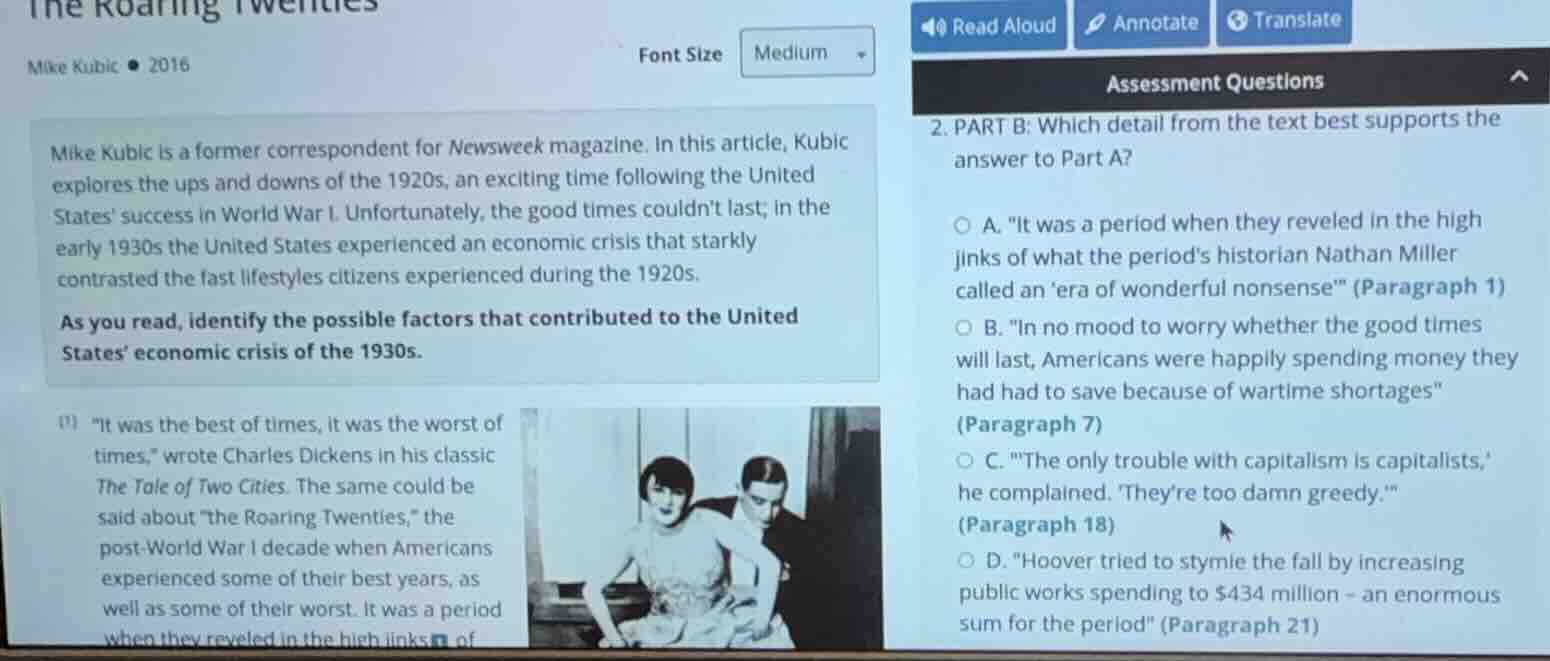
mike kubic is a former correspondent for newsweek magazine. in this article, kubic explores the ups and downs of the 1920s, an exciting time following the united states success in world war i. unfortunately, the good times couldnt last; in the early 1930s the united states experienced an economic crisis that starkly contrasted the fast lifestyles citizens experienced during the 1920s. as you read, identify the possible factors that contributed to the united states economic crisis of the 1930s. (1) \it was the best of times, it was the worst of times,\ wrote charles dickens in his classic the tale of two cities. the same could be said about \the roaring twenties,\ the post - world war i decade when americans experienced some of their best years, as well as some of their worst. it was a period when they reveled in the high jinks of... 2. part b: which detail from the text best supports the answer to part a? a. \it was a period when they reveled in the high jinks of what the periods historian nathan miller called an era of wonderful nonsense\ (paragraph 1) b. \in no mood to worry whether the good times will last, americans were happily spending money they had had to save because of wartime shortages\ (paragraph 7) c. \the only trouble with capitalism is capitalists, he complained. theyre too damn greedy.\ (paragraph 18) d. \hoover tried to stymie the fall by increasing public works spending to $434 million - an enormous sum for the period\ (paragraph 21)
To solve this, we need to know the answer to Part A (likely about the cause of the 1930s economic crisis, e.g., overspending, economic factors, etc.). Let's analyze each option:
- Option A: Talks about the "era of wonderful nonsense" (lifestyle), not directly a cause of the crisis.
- Option B: Says Americans were "happily spending money they had had to save because of wartime shortages"—this overspending could lead to economic issues (like depleting savings, unsustainable spending), which would support a Part A answer about consumer spending leading to the crisis.
- Option C: Is a quote about capitalists being greedy, which is more about a critique of capitalism, not a direct detail supporting a cause of the crisis (unless Part A was about capitalist greed, but this is less direct than overspending).
- Option D: Is about Hoover's response (after the crisis started), not a cause.
Assuming Part A was about consumer overspending or unsustainable economic behavior, Option B shows Americans spending saved money, leading to potential economic instability.
To determine the best supporting detail, we analyze each option:
- A describes the era’s tone, not a crisis cause.
- B shows Americans spending saved money (overspending), which could contribute to economic instability (supporting a Part A answer about consumer behavior/crisis causes).
- C critiques capitalists, not a direct crisis cause.
- D is a response to the crisis, not a cause.

Snap & solve any problem in the app
Get step-by-step solutions on Sovi AI
Photo-based solutions with guided steps
Explore more problems and detailed explanations
B. "In no mood to worry whether the good times will last, Americans were happily spending money they had had to save because of wartime shortages" (Paragraph 7)