QUESTION IMAGE
Question
4 - mechanistic change models
learning objective: define strategies for change within a mechanistic organization.
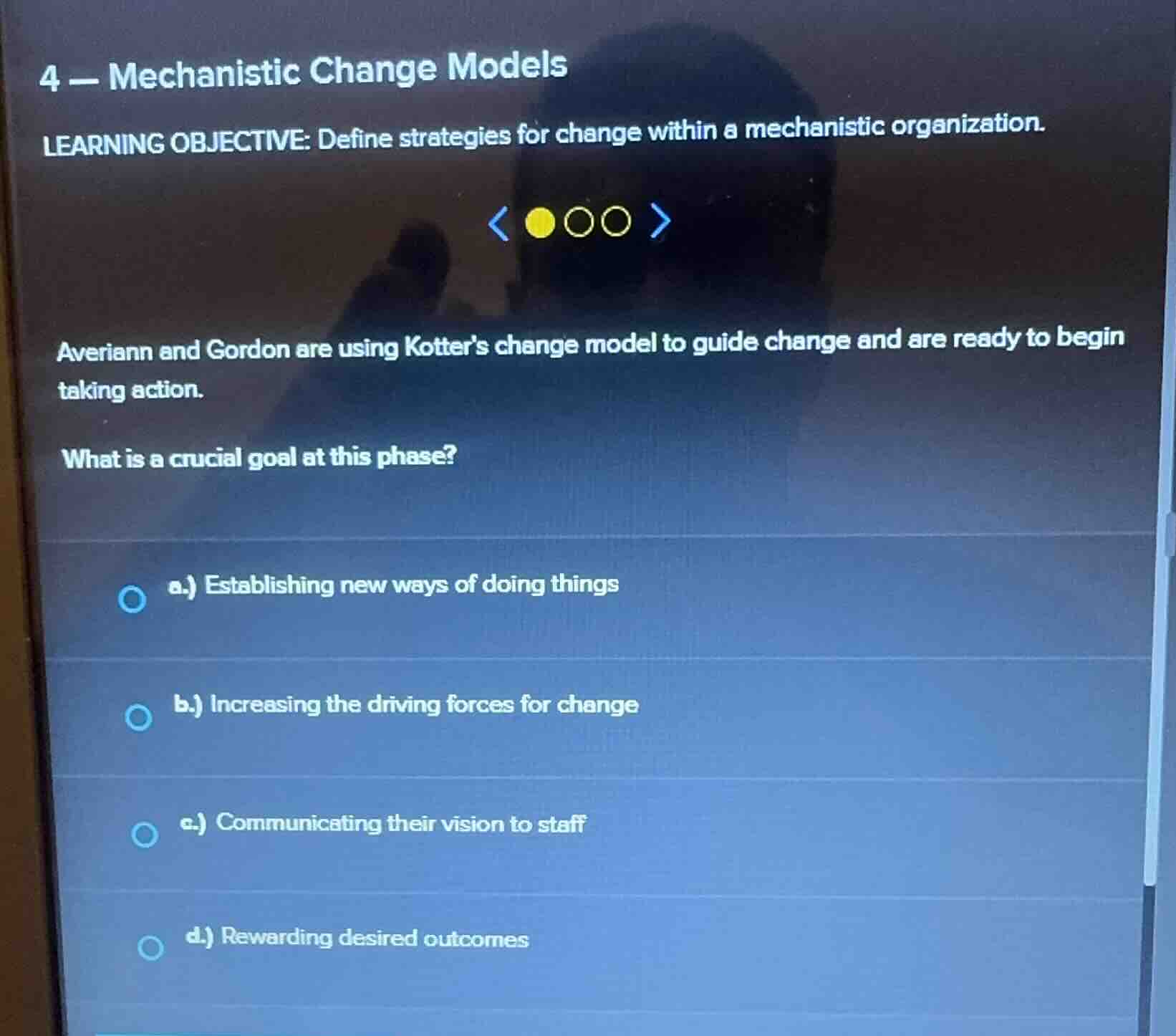
averiann and gordon are using kotters change model to guide change and are ready to begin taking action.
what is a crucial goal at this phase?
a.) establishing new ways of doing things
b.) increasing the driving forces for change
c.) communicating their vision to staff
d.) rewarding desired outcomes
Analyze the phase of Kotter's model
The prompt states that Averiann and Gordon are using Kotter's change model and are "ready to begin taking action." In Kotter's 8-step change model, the process is divided into three overarching phases:
- Creating a climate for change (Steps 1–3: Establish urgency, form a powerful coalition, create a vision).
- Engaging and enabling the organization / taking action (Steps 4–6: Communicate the vision, empower action/remove obstacles, generate short-term wins).
- Implementing and sustaining the change (Steps 7–8: Build on the change, anchor the changes in corporate culture).
When leaders are "ready to begin taking action" (entering the second phase), they must first engage and enable the organization. The very first step of this action phase is to communicate the change vision to the staff to ensure alignment and buy-in.
Evaluate the given options
- a.) Establishing new ways of doing things: This corresponds to anchoring changes in the culture, which is the final step of the model (sustaining phase), occurring long after initial action is taken.
- b.) Increasing the driving forces for change: This is associated with Lewin's Force Field Analysis and the unfreezing stage, rather than the active implementation phase of Kotter's model.
- c.) Communicating their vision to staff: This is Step 4 of Kotter's model ("Communicate the Vision"). It is the crucial first step when moving from planning/preparation to taking active, organization-wide action. Without clear communication of the vision, staff cannot align their actions.
- d.) Rewarding desired outcomes: This corresponds to generating and recognizing short-term wins (Step 6) or anchoring change, which occurs after action has already been initiated and produced results.
Connect to workplace change management
Using Workplace Change Management principles, communication is the bridge between strategic planning and active execution. Therefore, communicating the vision to staff is the most crucial goal at the onset of the action phase.

Snap & solve any problem in the app
Get step-by-step solutions on Sovi AI
Photo-based solutions with guided steps
Explore more problems and detailed explanations
- a.) Establishing new ways of doing things
- b.) Increasing the driving forces for change
- c.) Communicating their vision to staff (Correct answer)
- d.) Rewarding desired outcomes