QUESTION IMAGE
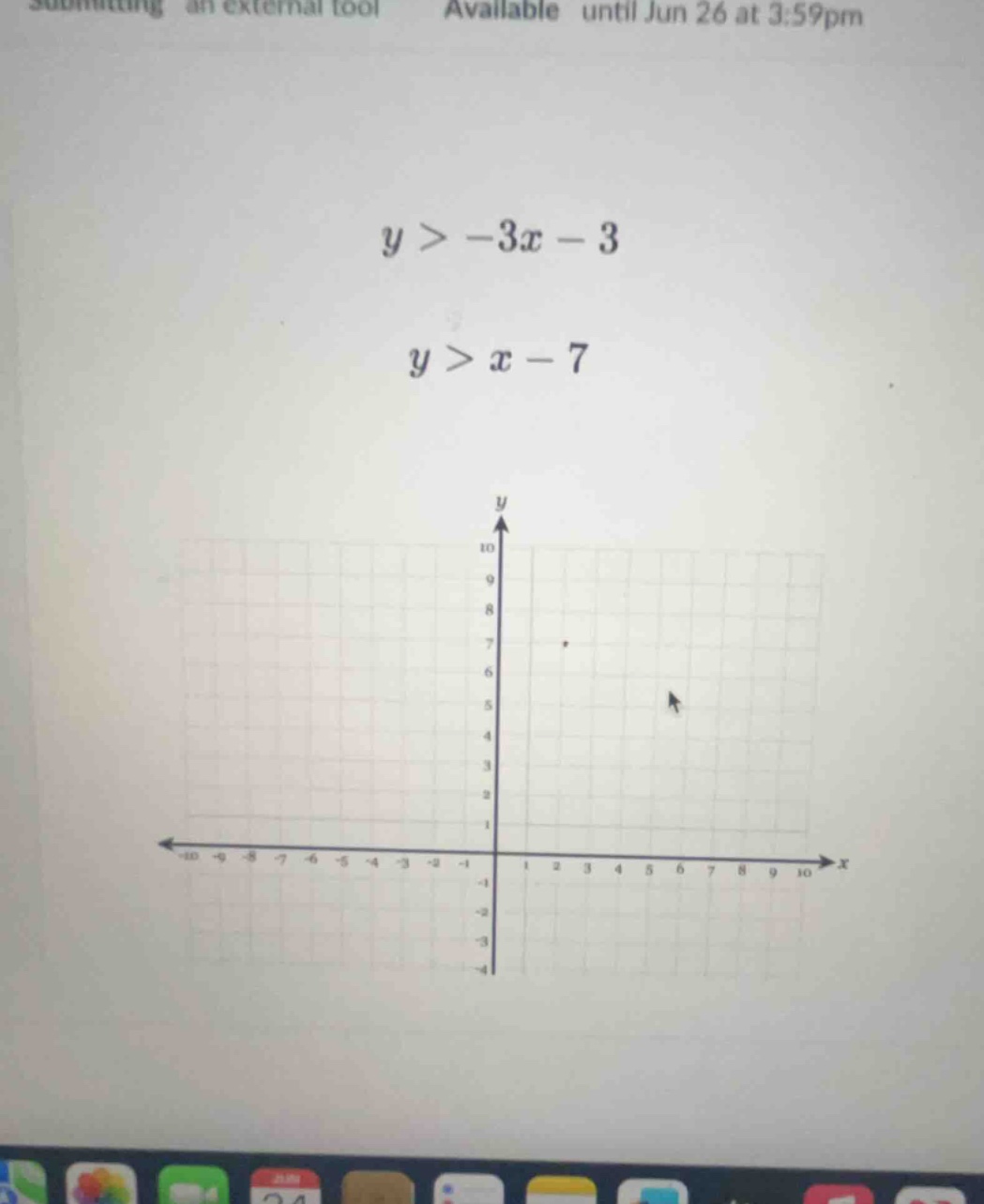
Question
\\y > -3x - 3\\
\\y > x - 7\\
Identify the boundary lines
The system of inequalities is:
The boundary lines are \(y = -3x - 3\) and \(y = x - 7\). Both inequalities use strict inequality (\(>\)), so both boundary lines must be dashed.
Find key points for the first line
For the line \(y = -3x - 3\):
- The \(y\)-intercept is \((0, -3)\).
- If \(x = -1\), \(y = 0\), giving the \(x\)-intercept \((-1, 0)\).
- If \(x = -2\), \(y = 3\).
Find key points for the second line
For the line \(y = x - 7\):
- The \(y\)-intercept is \((0, -7)\).
- If \(x = 7\), \(y = 0\), giving the \(x\)-intercept \((7, 0)\).
- If \(x = 2\), \(y = -5\).
Determine the intersection point
Set the two equations equal to find where the boundary lines intersect:
Substitute \(x = 1\) into \(y = x - 7\):
The intersection point is \((1, -6)\).
Determine the shaded region
For both inequalities, \(y\) is greater than the expression:
- For \(y > -3x - 3\), shade the region above the line \(y = -3x - 3\).
- For \(y > x - 7\), shade the region above the line \(y = x - 7\).
The solution set is the overlapping region that lies above both dashed boundary lines.

Snap & solve any problem in the app
Get step-by-step solutions on Sovi AI
Photo-based solutions with guided steps
Explore more problems and detailed explanations
To graph the system of linear inequalities:
- Graph the first boundary line \(y = -3x - 3\):
- Draw a dashed line passing through \((0, -3)\) and \((-1, 0)\).
- Shade the region above this line.
- Graph the second boundary line \(y = x - 7\):
- Draw a dashed line passing through \((0, -7)\) and \((7, 0)\).
- Shade the region above this line.
- Identify the solution set:
- The final solution is the region where the two shaded areas overlap, which is the region located above both dashed lines, starting from their intersection point at \((1, -6)\).